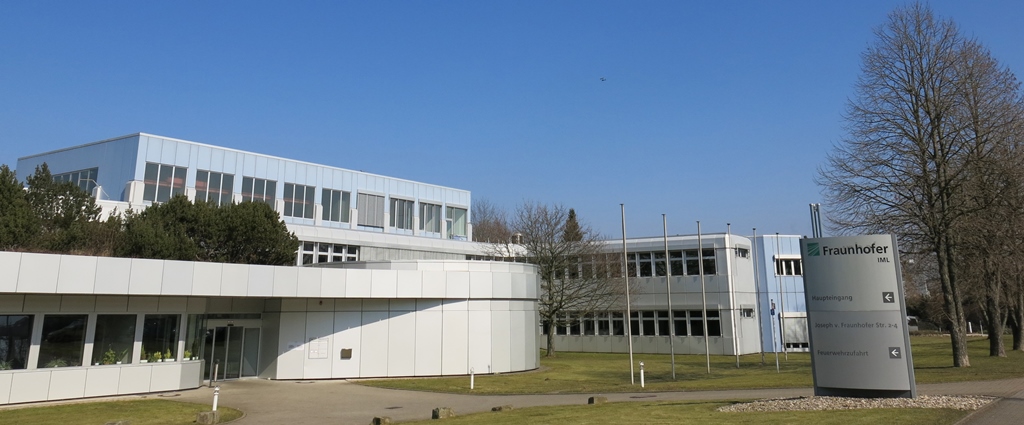
In 1982, the Fraunhofer Institute for Material Flow and Logistics was founded in Dortmund, focussing on applied research in the field of transport and goods distribution. As it was soon recognised that the suitability of packaging for distribution could not only be satisfactorily determined theoretically, the packaging laboratory was added in 1986.
Since then, around 50 different development and research orders from product manufacturers, the food trade and other research organisations have been processed each year, allowing the stresses acting on the product and packaging during the various distribution stages to be simulated in the laboratory with a high degree of fidelity to reality.
Task-related testing technology
All standardised as well as user-specific tests are usually carried out with Original charging units and -packs takes place. This requires appropriately adapted testing technology. For example, tests are carried out to determine the Box compression comparison value and the stacking factor derived from it with a Tensile-compression test system, whose compressive force is 200 kN with a contact area of 1,500 mm x 1,500 mm and the maximum height of the load unit of 1,800 mm. With the help of the results, the user can develop the necessary stacking patterns on the pallet or for block storage. Weak point analysis and constructive Optimisation measures accompany every test. New pallet designs are tested almost monthly on this tensile-compression test system in accordance with all relevant test standards.

Other focal points are tests on the most diverse types of risks that arise in the global movement of goods. climatic conditions, for which realistic test procedures are essential.
Furthermore, the testing of packaging with insulating properties. The variety of products that need to be distributed within a specified temperature range extends from pharmaceuticals, human organs and foodstuffs to chemicals. The suitability of the packaging systems required for this is tested with thermocouples and Temperature data loggers tested. The Fraunhofer Institute initiated the first DIN standard for this.
Combined Mechanical and climatic loads can be simulated using the vertical vibration test system, which is covered by a climatic chamber. It can be used to test masses of up to 1,500 kg in the frequency range from 2 to 150 Hz. This corresponds to the largest proportion of vibrations and shocks in all modes of transport. Further development and realisation.
Full braking in the test
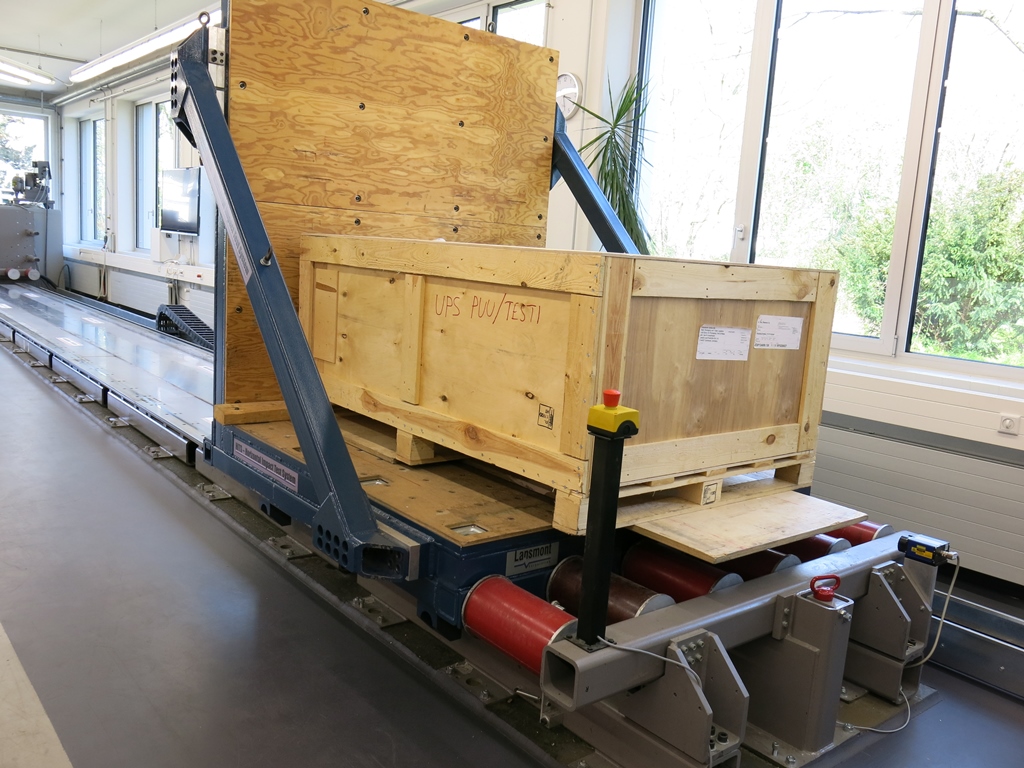
One of the most important investments in recent years was the „Horizontal Impact Test System“ (HITS) from Lansmont Corp., USA. It was designed according to IML specifications, which were developed as part of the European research project „COSATT“ and formed a valuable database for the 17 metre long system. At the same time Two pallets tested and Emergency braking of lorries, railway shunting collisions and crash situations.
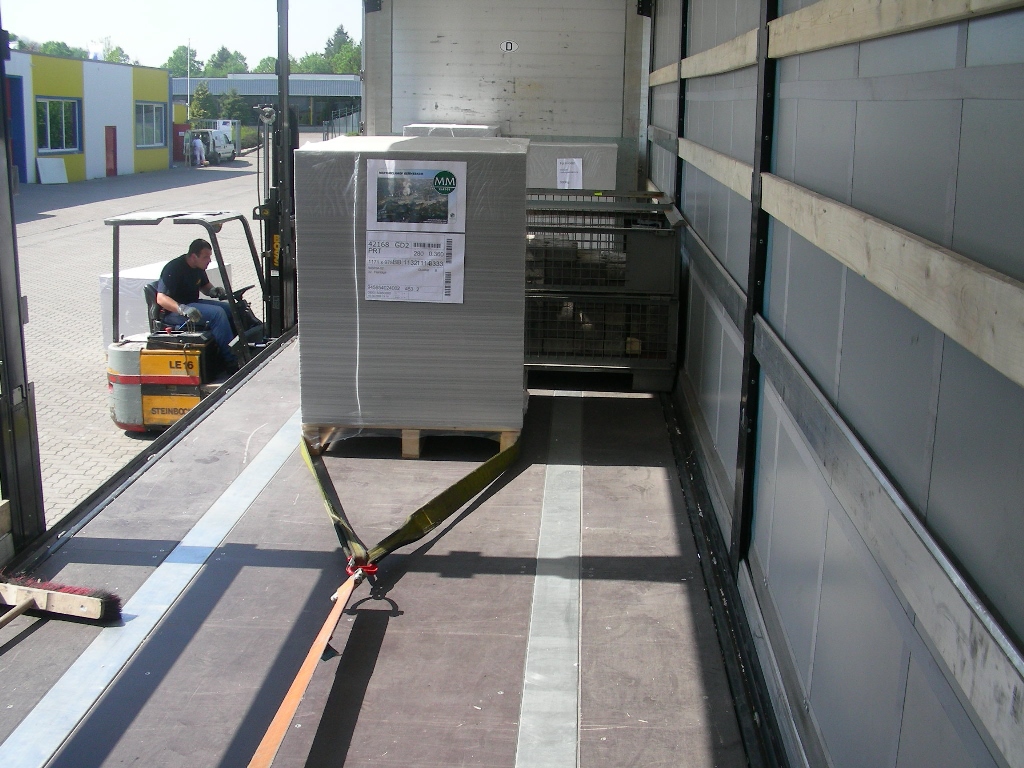
Another procedure is „Field-to-Lab“. Measurement data from real measurements of acceleration and climatic conditions are used here, which can be utilised to determine the causes of transport damage. The IML is also intensively involved in load securing, for example by developing reliable friction coefficients using the most powerful mobile measuring system in Germany.
These endeavours for continuous further development are implemented through participation in the DIN NAVp, but also in committees of the VDI, as a member of the IAPRI and, from 2016, as an „ista“ body.
Contact:
Fraunhofer Institute IML
Packaging laboratory
Joseph-von-Fraunhofer-Str. 2-4
44227 Dortmund
Gerrit Hasselmann
Phone +49 231 9743 302
e-mail: gerrit.hasselmann@iml.fraunhofer.de
Ralf Wunderlich
Phone +49 231 9743 301
e-mail: ralf.wunderlich@iml.fraunhofer.de