
Tjoapack plans extensive expansion of its US capacities - packaging journal
The company intends to expand its packaging and logistics expertise with a new location in Tennessee.
The trade magazine for the packaging industry
Packaging machine manufacturers know that they have a lot to offer technologically in order to provide online and mail order companies with optimised shipping packaging. What options are available to developers to fulfil differentiated customer requirements? And how do these processes look from the perspective of a machine manufacturer?
E-commerce and mail order are growing enormously and are on trend, as the pandemic has once again made clear. At the same time, consumers want more sustainability. What requirements does this place on shipping packaging and packaging machines? Are there any trends here as well?
Where far too often far too large shipping packaging has been sent to customers in the past, the aim today is to transport as little „air“ as possible, i.e. to use packaging that is as optimised as possible. But what should they look like and what transport loads do they have to withstand?
Currently experiencing Customised bags a boom. Here too, the aim is to use only as much material as is actually needed. For example, extremely tight packaging can be used and the machines must adapt „intelligently“ to the product dimensions, resulting in significant material savings. These requirements apply to both film and paper.
Companies should support their customers as actively as possible in choosing the best possible material. This is not only depending on the product and the individual sustainability goals, but also from the existing Logistics and production environment. Switching to paper is not necessarily the more environmentally friendly solution when you consider the individual ecological balance.
Different packaging materials and different types of packaging are therefore put to the test. It's not just about the protective function, but also about finding the right packaging for the respective product. an unmistakable brand experience in terms of long-term customer loyalty.
In addition to the selection of various films and papers that can be processed and possible material savings, there are also a number of additional options that senders want. They are by no means just a „side issue“, but can bring considerable simplifications and simplifications in practice: The packaging machines should be optimally adapted to the production environments and the sometimes very differentiated storage conditions. The solutions must be easy to integrate into a production line and be compatible with the customer's ERP or control system. In addition to the creation of the dispatch label, invoice printing with handling of inserts may also be required from a single source.
But how can the special challenges facing packaging materials and equipment in this booming sector be technically realised? We once asked the packaging machine manufacturer Hugo Beck over the shoulder. As an industry specialist, the company monitors current packaging trends in the e-commerce and mail order sector and accompanies the processes with numerous further developments in the machine portfolio. Most of these are developed in close collaboration with customers.
In fact, the company had already had the option of paper packaging in its programme for many years, but it was hardly ever in demand because there was still too little focus on sustainability. It was therefore not necessary to start from scratch when developing paper packaging machines. Almost two years ago, the company reacted proactively to market requirements and introduced a new generation of flow-wrapping hybrid machine that can produce not only resource-saving film packaging but also paper packaging cost-effectively.

Customers approach the Swabian family business with a wide variety of requests and requirements. This is not just about replacing plastic film with paper, as one might expect, but also about sustainable film packaging.
A standard machine solution is often no longer sufficient to offer the rapidly growing industry real opportunities to operate ever more sustainably. Added to this are the very short delivery times required with increasing order volumes. Speed, automation and tracking options also play a role in the suitability of the packaging system. So where, in this specific example, are there sustainable, trend-orientated solutions?
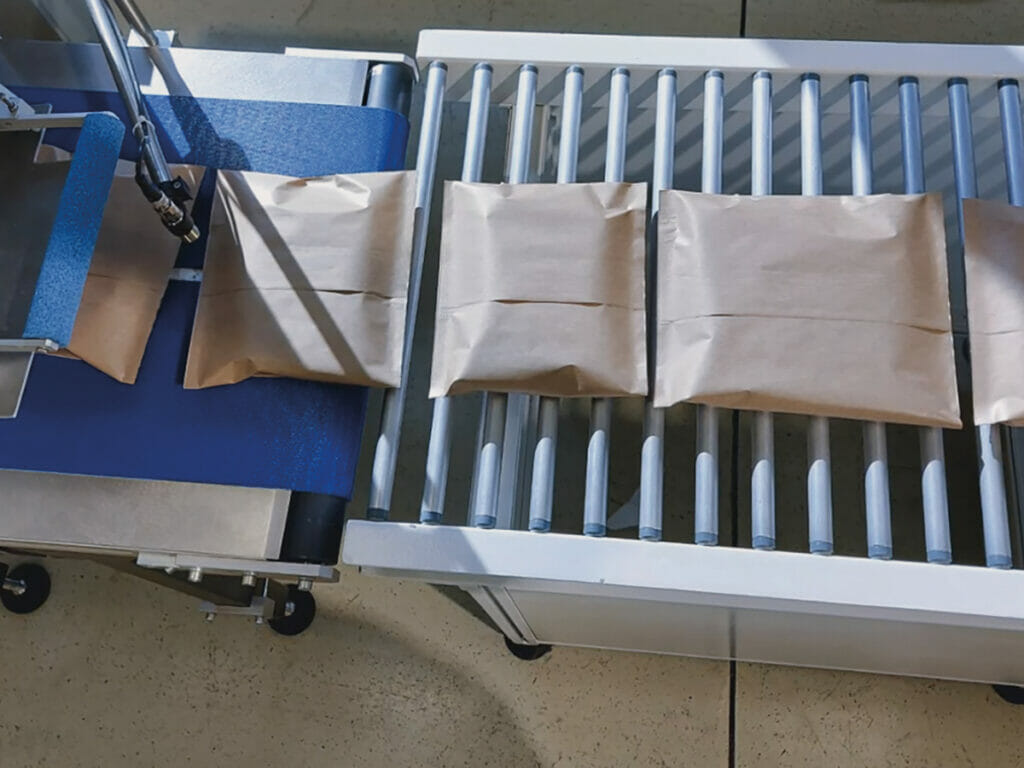
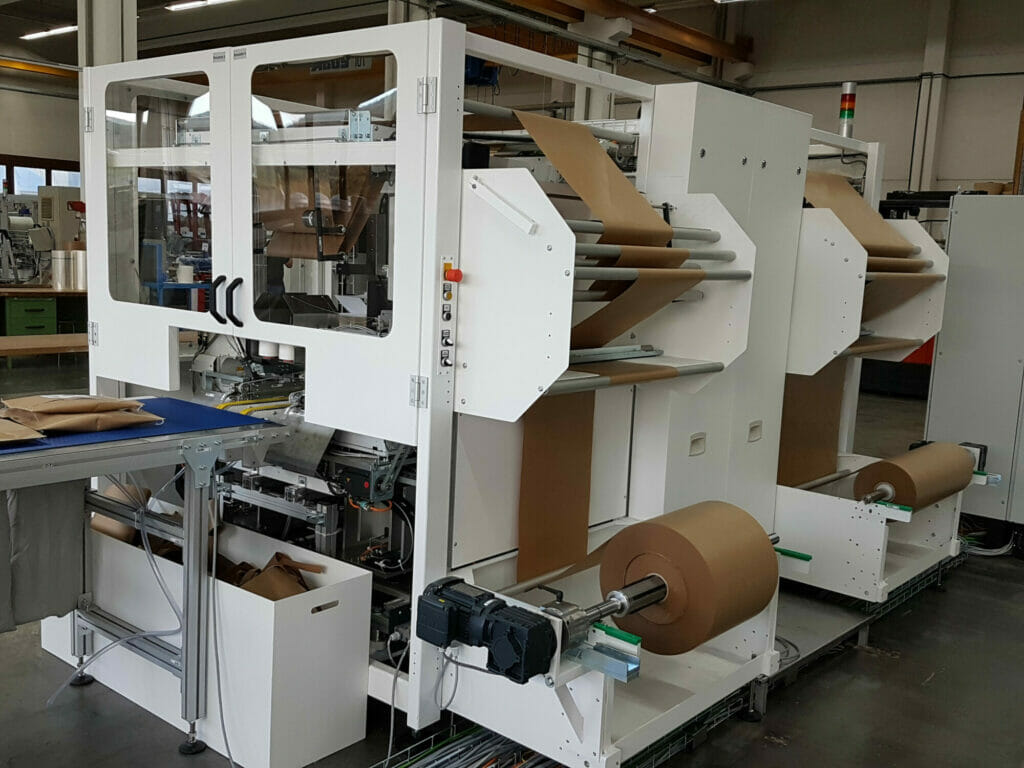
The production of film and paper packaging on just one machine means that the new generation of flexible flow-wrapping machines can be converted quickly. However, the trend towards pure paper packaging machines has established itself, so that further innovations have been driven forward here. This was followed by the market launch of a completely new type of packaging and machine for paper bags. For the first time, two Pfaff sewing machine units were integrated into the Paper E-Com flex from Hugo Beck. The result is shipping bags sewn on two sides with an overlap at the top, which is a completely new type of bag in the horizontal packaging market and particularly popular for shipping textile goods. Uncoated paper is used as standard. The development of this machine innovation was subsidised by the Federal Ministry for Economic Affairs and Energy.

With the aim of minimising paper consumption, the machines adjust themselves fully automatically during the packaging process to varying product sizes in length, width and height for perfectly fitting mailing bags. The highlight is that two different paper web widths are used to customise the packaging size. After the product scan, the machine „decides“ how wide the paper web for the shipping bag needs to be and selects one of these two paper rolls. This packaging concept can also be applied to differently branded paper types, e.g. for contract packers to pack products from different manufacturers on one machine.
In practice, the product height often poses a particular technical challengeHere it can be up to 200 millimetres without compromising the visual appearance or tearing the packaging during shipping. In addition to product protection, this is also an argument in favour of the positive brand experience that manufacturers want to create for their customers when unpacking.

But film mailing bags also continue to play an important role, according to Hugo Beck's current experience. „However, the desired material composition is increasingly changing in the direction of films with a high proportion of recycled material, i.e. it is going beyond the ‚only‘ 100 per cent recyclable film made of mono-material. The trend is moving towards already recycled material, which will be used more in future. A similar development is also recognisable for paper as a packaging material. There is now a frequent requirement to switch production to a new film in the future, which is easily possible with our machines“, explains Timo Kollmann, who has been Managing Director of Hugo Beck since the beginning of 2021. „Our experience shows that films with a high proportion of recycled material can also be processed very well and can therefore be flexibly converted to different films.“
You can choose between an intermittent flow-wrapping machine with half-tube film or a continuous film packaging machine with top and bottom film. This variant enables two-colour mailing bags, for example, and therefore greater scope for branding. Both machines minimise the use of materials. It is packed as tightly as possible and the bag size is adapted to the product length and height as standard.
Technical answers are also required with regard to maximum machine availability and flexibility as well as ease of operation. „Time is short for the operators or pickers of single or multi-packers with different dispatch items,“ emphasises Timo Kollmann. „Hand movements therefore have to be right on target and superfluous paths have to be avoided. The cycle output must also be correspondingly high, that's clear. The degree of automation in the packaging process naturally varies from customer to customer. When it comes to optimised usability and accessibility, we are often faced with individual requirements that go beyond simple operation. Then we make flexible adjustments.“
Monitoring, analysis and visualisation of operating and machine data may also be required. All of this is optionally possible via the Hugo Beck Cockpit, for example.
Precisely sewn or glued bags, additional options for the resource-saving handling of returns or highly flexible technology are the demands of the day. Added to this is the intelligent selection and use of packaging materials. Timo Kollmann puts it in a nutshell: „The trend towards developing new packaging materials is continuing. In recent times, we have repeatedly tested new, particularly very robust papers without coating or transparent variants. There will be a lot of changes in the packaging market in the direction of greater sustainability. Online and mail-order retailers are sensitised to future requirements on the part of consumers or possibly legislation and are therefore also very interested in future-proof and therefore sustainable machine concepts that offer them the flexible technical framework conditions they need.“

The company intends to expand its packaging and logistics expertise with a new location in Tennessee.

On 1 February 2026, the company takes over a neighbouring building in Aalen that was previously used as a supermarket.

Packaging machine manufacturer Meypack relies on Schmersal's Safety Fieldbox for safety-related signal processing. This concept benefits not only the designers, but also the users of the machines.

At Austro Vin Tulln, Bluhm Systeme will be presenting its labelling technology specifically for the requirements of the wine and beverage industry.

The transaction strengthens Sacmi's position in the food packaging sector and at the same time expands its industrial presence in France and other markets.

The cutting-die and tool manufacturer Marbach looks back on an intensive year 2025.