Sustainable packaging is currently on everyone's lips, the major drivers of trade and legislation have become active and the industry is desperately looking for alternative solutions. Replacing the materials or reducing the packaging is often on the test bench. But EcoDesign offers more options. But how can companies establish a good starting point and the right direction for them?
For over ten years, the Munich-based packaging design agency Pacoon has been working intensively on the topic of „Sustainable packaging“ and has noticed a brisk demand for consulting and development services in recent months. Not a week goes by without requests for presentations, training courses, in-house workshops, consultancy support, research into alternative materials or new packaging concepts being received by the Bavarians.
The origin of the interested parties almost covers the Complete supply chain and hardly leaves out any industrial sector. Whether it's retailers, private label suppliers or brand manufacturers, the packaging industry or even associations - everyone is desperately and quickly looking for Solutions and approaches, how they can respond to the new legal and social requirements.

The industry is now also looking at recycling itself - while a workshop organised by the agency at a recycling plant in early 2018 barely attracted 15 participants, visits to sorting companies and recyclers are now sprouting up like mushrooms. Because anyone who wants to know how Recycling-friendly packaging must also understand where in the organisation Waste disposal the sticking points occur.
[infotext icon]More than just recyclability and material reductionSustainable packaging and EcoDesign involve more than just recyclability and material reduction. The right approach requires a Comprehensive analysis, which can be implemented pragmatically and at short notice. The Sales markets play an essential role in this and a close look at the Supply Chain. Anyone who puts their packaging to the test can discover completely new opportunities and, with the right concept, the end result can be cost reduction, easier handling and a more valuable brand image as well as differentiation from the competition.
Inaction is followed by a frantic search for a solution
After years without a clear target set by the key players in the market, retailers, manufacturers and packers, everyone has chosen their own priorities; all too often, however, the maxim has been „wait and see“. Recently, however, two approaches have emerged as dominant: the legal requirements for Recyclability of packaging and the associated Higher use of recyclates and the Consumer demands for fewer plastics.
The two are not necessarily mutually exclusive, but there are not yet sufficient solutions. Certainly, the announcements of the last 18 months of ‚100 % recyclable packaging', total or large-scale elimination of plastic, use of recyclates or reduction of single-use products show that the industry is finally moving. But we are also slowly crystallising the Limits of these demands out.
Where do all the recyclates come from that companies want to use if their own packaging was previously not recyclable? Who will bear the costs of the packaging changeover on the machine, whose production was previously geared towards efficiency and high performance? Are there already solutions beyond plastic that also guarantee product safety and are cost-effective? Is the CO2-Is the balance sheet of the potential new solutions better than the previous one? Is the recyclable material being utilised at all in the respective sales markets or even collected and sorted?
How can potential solutions be developed?
This is where one of Pacoon's main points of advice comes in: Providing information on the key definitions and background, including a look at the conditions in the sales markets. In recent months, the agency has collected information from around 50 countries around the world to provide a quick overview of the situation on the ground.
You don't even have to look at other continents to see big differences. In Europe alone there are Three different levels of recycling infrastructureThe highly developed countries in central and northern Europe, the „emerging economies“ in the west, south and east, and the „developing countries“ in the south-east of the EU.
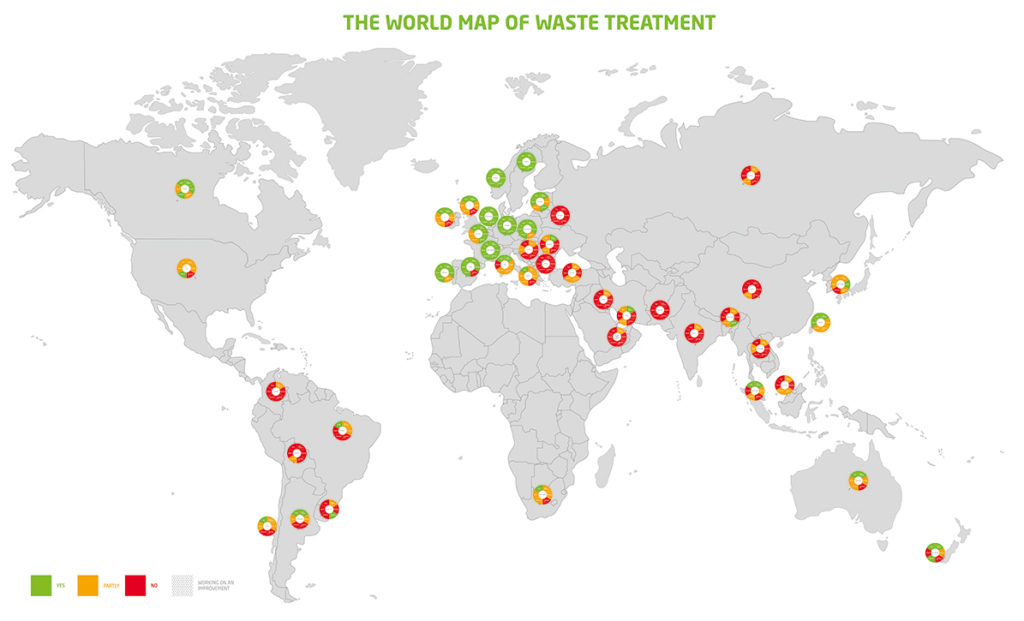
None of the designers' customers sell their products only in Germany, which is why a Superordinate solution necessary. What can be recycled in Germany is at best good for incineration in other major European sales markets - but the packaging often ends up in landfill. The situation is just as different in the rest of the world.
Recyclable packaging needs to be adapted to the different regional collection and recycling processes. Packaging for regions without a recycling infrastructure requires a completely different approach.
Scrutinise the packaging concept as a whole
However, EcoDesign doesn't just mean swapping materials, but also scrutinising the packaging concept as a whole. What requirements does the product place on the packaging, what is really important in logistics and in the sales channel? Which functions of the packaging are just „nice to have“, what are really important? Significant purchase incentives and necessities in retail?
For example, a very long best-before date may offer a high level of safety in logistics for fresh products, but is rarely utilised for fast-moving items. Is a particularly high barrier requirement even necessary? Here is the Intensive dialogue with the trade in demand.
It is therefore appropriate to question whether the particularly high requirements for individual products in a range must necessarily be the minimum standard for all products - even for those with lower requirements? The most important products should therefore be defined in order to find the optimum packaging mix for each of them. Special solutions can be deliberately authorised here.
The strategy toolbox
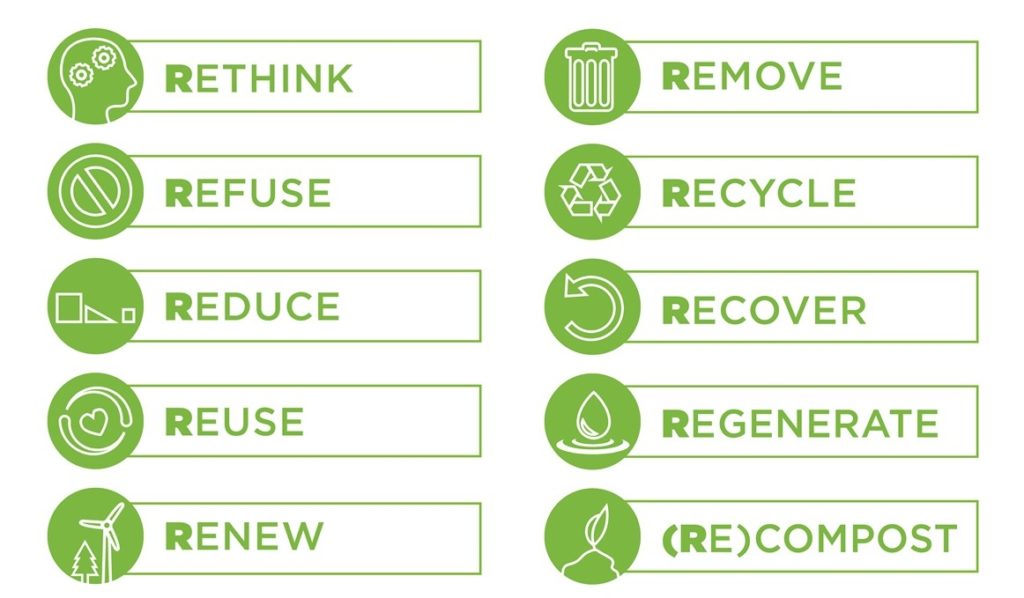
The companies' situation is therefore generally more complex than the requirements suggest, even if most solutions focus on replacing the material. To this end, the agency has „10 Rs“ of more sustainable packaging which show the main strategic approaches. The solution is usually not based on just one approach, but on a combination of several.
Rethink stands for scrutinising the packaging to see whether a different packaging concept offers added value or simplifies logistics or warehousing. This includes such simple things as the printing process or a switch to other containers. Our experience shows that by looking at the entire supply chain, total cost optimisation also provides potential for improving packaging, for both the company and the user.
Refuse poses the general question of whether packaging as it is today is necessary - always from the point of view of product safety, of course.
Reduce means not only using less packaging, but also varying the packaging format, for example - a more compact format quickly saves 15 to 20 1TP3 tonnes of packaging material.
Reuse is not yet the focus of many companies, but it is becoming clear that this approach harbours great potential, especially in the B2B sector. Reuse often goes hand in hand with rethink.
Renew is particularly effective when little can be changed in the actual type of packaging or optimisation is already well advanced. Renewable resources or energy are also emotionally charged, especially among consumers.
Remove aims to avoid and replace substances of concern, be they materials or processes that are harmful to health or the environment.
Recycle needs little explanation these days and is one of the most focussed approaches. But it is also important to see whether recycling takes place at all where my products are sold.
Recover is a relatively new approach and attempts to recover materials from previously ignored processes. These can be metals from the slag of paper recycling or further utilisation of waste, in particular electronic waste. New methods are being developed to obtain the materials.
Regenerate is still in the future, but includes, for example, the utilisation of CO2 for the production of new materials.
(Re)Compost is appropriate in many countries that have no waste collection, sorting and recycling infrastructure and where packaging is highly likely to end up in nature. There they should cause as little damage as possible and „disappear into thin air“. In countries with a good infrastructure, composting is less interesting because the energy put into the packaging is lost.
The first steps towards EcoDesign
In recent months, most retailers have sent out their own guidelines or checklists to companies or discussed the fact that the goal for the next few years is to achieve recyclability. These are also the official announcements in the press.
Some provide very specific options for the new materials, while others point out obstacles to recycling and try to suggest better solutions. This presents private label manufacturers with the challenge of harmonising the retailer's specifications if they supply several retail companies in order to optimise their production.
It is therefore not only for branded companies that define your own goals and strategies, The brand must also be able to stand the test of time, even if the relationship with retailers or their demands change. Ultimately, the brand must differentiate itself from the competition in the long term and create incentives for consumers.
At a time when product formulations are largely exhausted or comparable and consumers are demanding more sustainable behaviour, one option is the Brand presence via more sustainable packaging - After all, packaging is a brand's most important means of communication (Touchpoint Study 2015; FFI Fachverband Faltschachtel-Industrie e. V.), unless it has a large advertising budget. Several studies (Nielsen, The sustainability imperative, 2011 ff., SmartCon, CSR Kompass Schokoladenprodukte 2018 and others) also confirm the increasing influence of sustainability and sustainable packaging on the Purchase decision. This requires courageous action on the part of the industry and is currently very noticeable.

Guest author: Peter Désilets, Managing Director of Pacoon GmbH, a design agency for sustainable packaging solutions based in Munich with an office in Hamburg.
In the next part we use concrete examples to explain how the strategy and packaging concepts are implemented step by step and where potential can be found.
And we report on the „SOLPACK 3.0 - International Conference for Sustainable Packaging“, at which current and future developments in packaging were discussed.
[infotext icon]Pacoon still sees a lot of catching up to do when it comes to basic knowledge about sustainable packaging in companies. This is why the Munich-based company, in cooperation with the IHK Munich, is offering a first Training day for companies to provide an overview of the most important topics and definitions. The aim is to bring companies up to a high level of knowledge and to invest more ideas in new solutions rather than discussing internal differences of opinion. Up to 200 participants from southern Bavaria and neighbouring (federal) states are expected to attend. Info at http://www.Pacoon.de.[/infotext]