This year, Solpack 4.0 has become Solpack Digital.1. The sustainability conference organised by design agency Pacoon is being held as a webinar due to the coronavirus crisis. The results of the 2020 sustainability survey have just been presented.
Pacoon had consumers online since January 2020 on various aspects of sustainable packaging surveyed. „Over 500 participants aged between 25 and 60 took part in the survey. Although it is not a representative survey, the large number of responses gives us a good feeling of where the journey is heading,“ says Managing Director Peter Désilets.
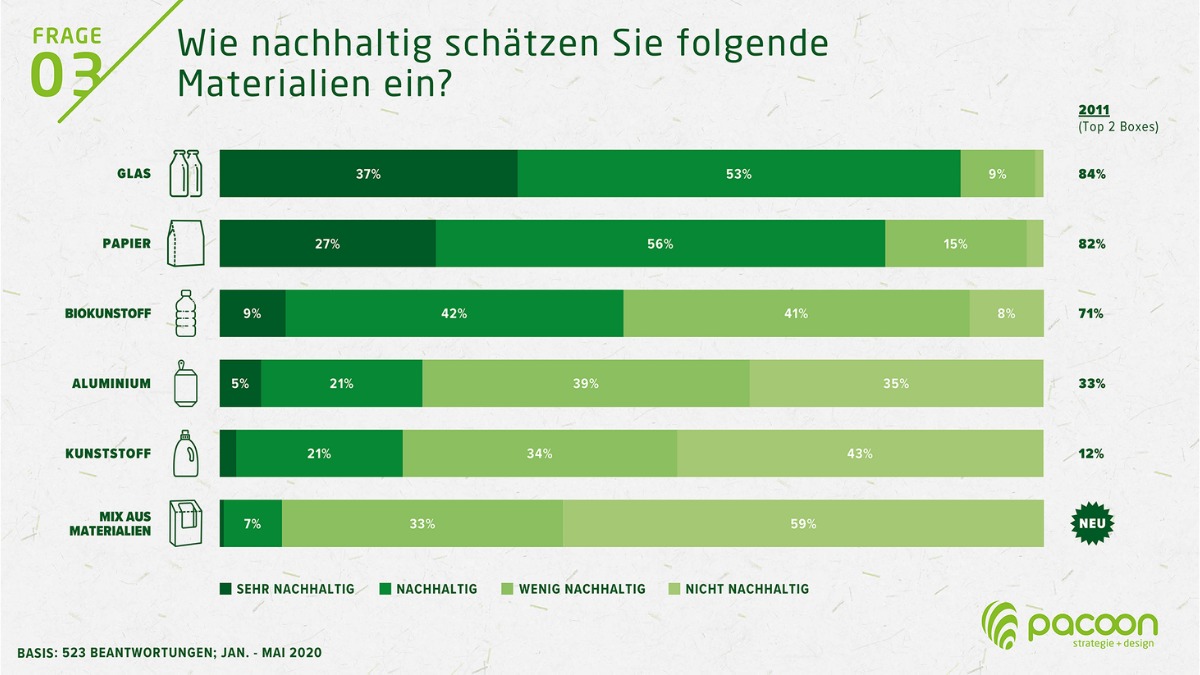
Glass and paper are considered by far the most sustainable by the respondents - as in a similar survey conducted by the agency in 2011 - while bioplastics have decreased significantly compared to 2011. Plastic in general, on the other hand, has increased slightly. „Even though the desire to avoid or reduce plastic is omnipresent, the positive aspects are also more respected. However, as in 2011, the reputation of plastic itself is the lowest alongside the material mix."

For 90 per cent of participants, sustainable packaging be recyclable, made from recycled or renewable materials or reusable be. Compostable, deposit, paper and cardboard packaging and ‚no packaging at all‘ (unpackaged/refill) follow at some distance with around 70 per cent of respondents. Those based on metal, aluminium or fossil raw materials generally have a difficult time being considered sustainable packaging.
As many as 94 per cent of respondents would prefer a sustainably packaged product to a non-sustainably packaged product. This is a significant increase compared to 2011 (80 %).
„Packaging has certainly become even more of a focal point in recent years,“ says Peter Désilets.
For a large majority, a sustainably packaged product can also cost a little more, „at least in theory.“ The answers were very clear with regard to the Labelling of sustainability factors on food packaging out. Almost every participant in the online survey would like to see information on the packaging about whether sustainability aspects are taken into account.
Another question focussed on waste separation. „It seems that respondents are separating more household waste than in 2011, with mentions of glass, yellow bins, organic waste and metal/aluminium all increasing significantly. About Every fourth person has their own home compost - which is in line with our survey on recycling aspects from 2018,“ explains the Pacoon Managing Director.
Haptics also play a role for consumers: in order to evoke a lasting association, it appears that Rough, textured and grainy surfaces rather than soft and smooth packaging surfaces, which have a much harder time here.
Source: Pacoon