
In the current report „Plastics - The Facts 2022“, Plastics Europe provides information on the state of the plastics industry and the changes towards a more circular economy and greenhouse gas neutrality. On a positive note, the report shows that 20 per cent more recycled plastic was used in new products compared to 2020.
Despite the progress currently being made, however, the report also shows that the systematic transition to a circular economy and greenhouse gas neutrality must be accelerated. Chemical recycling is thus gaining in importance as a complementary instrument to mechanical recycling and is a decisive lever for increasing recyclates and achieving greater resource efficiency.
However, recent developments show just how difficult the path towards a green transformation is: The rising prices for energy and raw materials as a result of Russian aggression against Ukraine a very serious challenge for the plastics industry, supply chains and all EU economies.
„It is more important than ever that we create a supportive industrial policy framework that promotes the leading role of European industry in the transition to greenhouse gas neutrality and a circular economy. If we want to make our industry fit for the future, acceptance of chemical recycling, including the mass balance approach, is essential to accelerate the dual transformation of our industry. More intensive and harmonised cooperation across the value chains and with political decision-makers is of central importance for this to succeed. On their own, neither a private nor a public partner can offer viable solutions to the complex problems in these unprecedented times.“
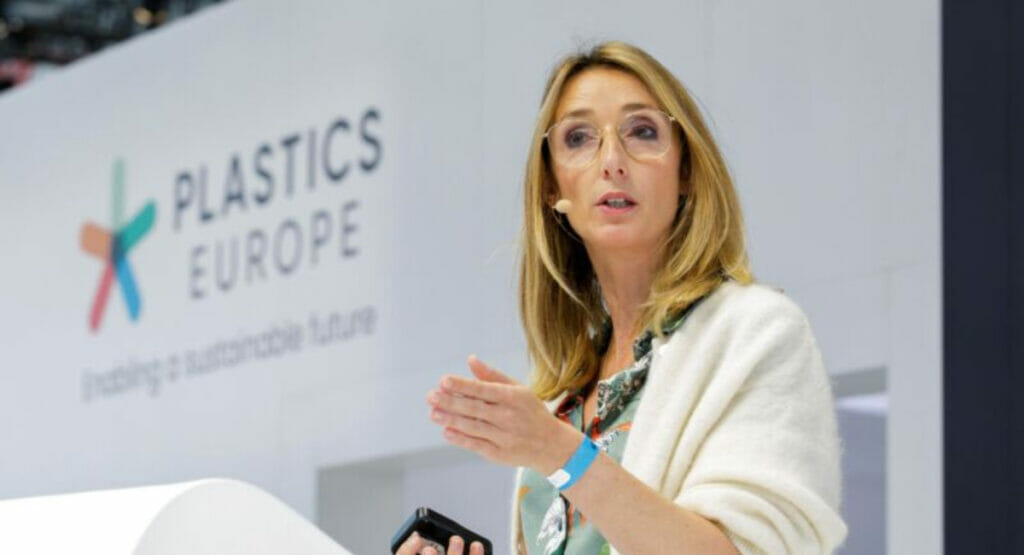
DisplayVirginia Janssens, Managing Director of Plastics Europe, presented „Plastics - The Facts 2022“ at a press conference at K 2022
Supply bottlenecks will most likely persist in the coming months and remain a problem. Despite this challenging environment, the plastics industry is working relentlessly to further reduce emissions and decouple the production of plastics from fossil raw materials. According to the latest report, in 2021 the Production of non-fossil plastics accounts for 12.4 per cent of total European plastics production. The industry is hoping for a tailwind for this development from politics.
Despite the pandemic, the industry has managed to maintain its Maintain employment levels in Europe in 2021. With more than 1.5 million direct employees, the European plastics industry remains a key player in the EU economies. In addition, the latest data on the recovery after the pandemic in 2020 points to a Increase in global and European plastics production is a fact. However, it is also a fact that the European share of global production has fallen continuously from 23 per cent in 2006 to 15 per cent last year.
Assuming there is no gas shortage in the coming months, European plastics production is expected to fall by four per cent by the end of the year. In view of the major uncertainties regarding the supply of raw materials, energy prices and possible supply bottlenecks, it is not possible to provide an outlook for 2023. However, it is already apparent that more and more Companies have problems passing on the increased costs for energy, raw materials and logistics to their customers. The weal and woe of the plastics value chain is now primarily determined by the reliable availability of high-quality raw materials.
Source: IK Industrievereinigung Kunststoffverpackungen e.V. (Industrial Association for Plastic Packaging)
More news on plastics and composites


Treofan concludes insolvency proceedings

Waste disposal associations support plastic levy

Mandatory testing in the single-use plastics fund meets with widespread criticism

DUH calls for a switch to reusable plant transport