In plant engineering, but also in brewing and beverage production as a whole, nothing more and nothing less than the next revolution is set to follow: Keyword Industry 4.0. drinktec 2017 from 11 to 15 September 2017 at the Munich Exhibition Centre will show in detail what opportunities this will bring for the global beverage and liquid food industry.
„As long as matter cannot be transported via the internet, there will be filling and packaging lines“: this quote from the former CEO of Krones AG, Hans-Jürgen Thaus, is of course still true. But digitalisation has long since changed the entire industry.
Industry 4.0, naturally raises the question first: Which three revolutionary or evolutionary steps preceded it? The first was the invention of the steam engine, which made it possible to drive mechanical trades. The second was electrical engineering, which made it possible to further increase mass production. The third was the microprocessor, which digitalised control and process control technology ...

Smart Factory: Intelligently networked knowledge crystal
The key difference between 4.0 and this third stage is the end-to-end Application of internet technologies for communication between people, machines and products. The hierarchical IT pyramid from the field level to the control and operating level to the operations control and business level with all its interfaces is thus transformed into a knowledge crystal that is intelligently networked in all directions and across borders. In such a smart factory, the machines and systems independently provide information on all important process and system statuses. At the same time, they communicate with each other and intervene in production processes to correct and optimise them. Or to put it more simply: the raw material knows what it wants to become. The machines know what they can do and when they have free capacity and offer their services independently. All of this, of course, in close coordination with the demand side, which is planned in advance based on historical data, current trends and, if necessary, even with the help of intelligent refrigerators and external weather models.
Such a Intelligent factory masters complex processes perfectly, is resistant to downtimes and can react flexibly to changes in the production process at any time. The autonomous control of production eliminates downtimes and stoppages, the machines are always optimally utilised and energy consumption is reduced. As there is less waste, material costs are also reduced.
Some ideas are already a reality
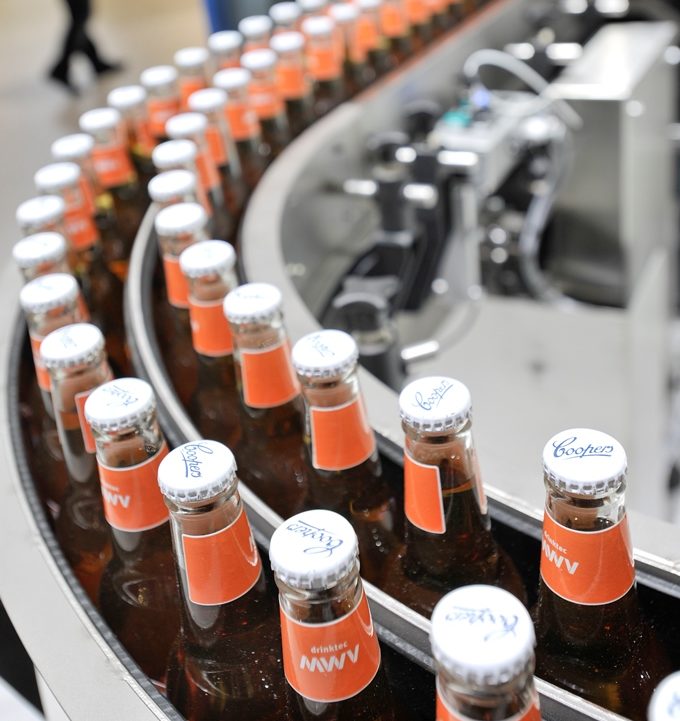
Industry 4.0 components have long since found their way into the beverage and liquid food industry. „Many devices support this with features such as Heartbeat technology, by checking their own functions and actively signalling any upcoming need for intervention. The availability of so many signals also enables better linking of batch and process data with quality assurance,“ says Holger Schmidt, Global Industry Manager Food & Beverage at Endress & Hauser Messtechnik GmbH & Co. KG. Also Teleservice is the order of the day. In this case, for example, a palletising robot is adapted to new packaging using an external computer simulation. The finished program is then uploaded over the weekend via the Internet and only minor optimisations (if any) are required for the start of production on Monday morning.
Another key aspect of Industry 4.0 is the Individualised production. The aim is to fulfil all relevant customer requirements at low cost. „It still seems like a distant vision,“ explains Richard Clemens, „but the beverage industry in particular is subject to rapidly changing trends. Customised production could be the answer to ever shorter product life cycles. However, many development steps and corresponding investments are still necessary before we get there.“
Cost-effective filling
The research project „RoboFill 4.0“ achieve. A new, flexible automation concept is to be used to achieve this. Customised beverage bottles and containers can be filled cost-effectively, even in Lot size 1. The current project consortium is made up of the Chair of Brewing and Beverage Technology (TUM), Chair of Food Packaging Technology (TUM), Fraunhofer IWU - RMV project group, Bayerische Staatsbrauerei Weihenstephan, Beckhoff Automation GmbH & Co. KG, infoteam Software AG, Krones AG, ProLeiT AG, Siemens AG, Till GmbH, Yaskawa Europe GmbH and Zimmer GmbH.
Specifically, with RoboFill 4.0, the machines and processes will be able to Plan and optimise yourself can. The synchronisation of customer requirements and production orders as well as the associated production planning and control is carried out via a virtual image of the production environment in the cloud. Compared to rigidly configured and controlled filling lines in the beverage industry, this creates highly flexible processing stations that are intelligently controlled by the product. In this way, RoboFill 4.0 is intended to provide small and medium-sized companies in particular with a decisive competitive advantage over rival producers on the international market.