Procter & Gamble wants to avoid packaging and increase the use of recycled materials. Within ten years, the Group plans to halve the use of virgin plastic and aims to save over 300,000 tonnes per year.
At the leading global trade fair for the plastics industry „K 2019“, P&G reaffirms its goals for a sustainable circular economy and presents a new pioneering project to strengthen the circular economy
- HolyGrail 2.0„ project: Better sorting and recycling of plastic packaging through digital watermarks
- In Europe, around 95% of all packaging materials at P&G are to be recyclable by 2025
- Expert presentations at „K 2019“ in the VDMA Pavilion on 17 and 21 October 2019 and at the Open House at Tomra on 22 October 2019
As one of the largest consumer goods companies in the world, Procter & Gamble has set itself the goal of, to enable sustainable consumption on a broad basis. This includes using significantly less new plastic made from crude oil and more recycled material for products and packaging.

The company has already achieved important milestones in the avoidance of packaging waste and the reuse of raw materials. This has been made possible by P&G utilising its economies of scale in global partnerships, innovative industry solutions and environmentally friendly product packaging.
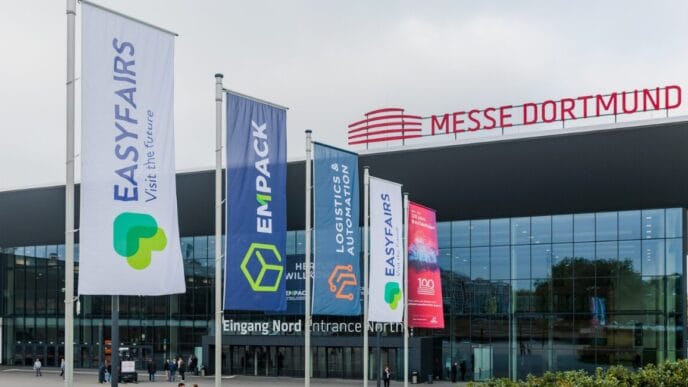
P&G at the „K 2019“
At the leading global trade fair for the plastics industry „K 2019“, P&G reaffirmed its goals for a sustainable circular economy. The aim is to reduce the use of virgin plastic made from crude oil by 50% by 2030. In addition, all P&G packaging is to be recyclable or reusable by then. In Europe, around 95% of all packaging materials should be recyclable by 2025. In addition, further sustainability programmes have been launched in Europe and will be implemented by 2025.
Against this background, P&G will be presenting the project „HolyGrail 2.0“ in the focus. The aim of the project is to create better conditions for a circular economy in the packaging sector. Well-known companies from the consumer goods, retail and recycling sectors have joined forces in the project to increase the sorting purity of plastic packaging and the sorting efficiency of recycling.
This is made possible by the use of digital watermarks. The working group is led by Gian de Belder, packaging expert at P&G. In September 2019, the project was „HolyGrail 2.0“ was honoured with the Sustainability Award 2019 at FACHPACK, the leading trade fair for the packaging industry, as the overall winner and in the „Circular Economy“ category.
„As one of the pioneers in combining a high degree of sustainability and industrial economies of scale, P&G is driving the Change within its industry towards the sustainable use of plastics.
In addition to infrastructure and the involvement of households, low recycling rates are primarily linked to poor sorting efficiency. We want to address this with the digital watermarks for plastic change,“ says Gian De Belder, P&G packaging expert and project manager of „HolyGrail 2.0“ on the presentation of the project and the strategies and measures for packaging avoidance and sustainable packaging at K 2019.
Digital watermarks for packaging are codes that are barely perceptible to the human eye and offer major advances over previous sorting technologies. For example, they provide information about the material the packaging is made of and whether it contains food, cosmetics or a detergent or cleaning agent.
The stored information can be utilised across the entire value chain (from production to recycling). This ultimately increases the quality and availability of high-quality recyclate.
„Worldwide, P&G strives to ensure that all our packaging to be recyclable or reusable by 2030 are. In Europe, we are setting ourselves even more ambitious goals: By 2025, all of our most important packaging platforms will be recyclable. This includes around 95% of all packaging materials. In addition, we have made a global commitment to reduce the use of virgin plastic in our packaging by 50% by 2030. This is an ambitious target and we expect to save over 300,000 tonnes of virgin plastic made from petroleum worldwide by then,“ says De Belder continue.
„P&G has successfully realigned itself as a company and is focussing on the areas in which we can play to our strengths. We have also reorganised the way in which we drive innovation. We are breaking new ground with our products and we are breaking new ground in advertising.
Also for the Avoidance of packaging waste we are setting new accents. We want to help anchor sustainability in everyday life and in society as a whole. We have defined clear goals and we measure our progress very transparently. In order to make progress, we are implementing very specific measures on a broad basis. This will also be visible in our major brands in the near future: from December 2019, for example, OLAY's cardboard packaging will no longer be labelled with a additional cellophane film will be wrapped. The new packaging will go on sale from January 2020.
From spring 2020, Ariel will be switching from large-volume packaging for its Ariel PODS stock packs to material-saving bag around,“ emphasises Gabriele Hässig, Managing Director Sustainability in the DACH region at P&G. „With this packaging, we save 75% of the plastic previously used per wash load.“
With the sustainability agenda „Ambition 2030“ P&G has defined the key elements that contribute to anchoring sustainable consumption in society as a whole. P&G uses life cycle analyses to determine the actual impact of the brands.
In order to improve people's lives today and for future generations, P&G takes responsibility for the sustainable use of its products and sets priorities in those areas where the leverage for environmental protection is greatest.
Sustainability agenda for a functioning circular economy
To achieve the goals of the „Ambition 2030“ P&G relies on a functioning circular economy that is based on the following factors:
Design for recycling, effective collection systems, informed households, optimised automated sorting systems, use of recycled materials and technical innovations. In order to drive innovation, P&G is active in various pioneering initiatives: with the LOOP deposit system, which is being piloted in Paris and New York, packaging is no longer turned into waste, but is instead recycled, i.e. collected, cleaned and refilled after use.
With Fatersmart, a joint venture between P&G and the Angelini Group in Italy, the company is working to introduce nappy recycling in at least 10 major cities worldwide by 2030. The first plant is located in Treviso, Italy. Another collection centre is already up and running in Amsterdam.
Alliances and partnerships
P&G relies on global alliances and partnerships as well as national initiatives to establish and secure closed loops in plastics recycling. In view of the global challenges, the Alliance to End Plastic Waste This is of crucial importance to P&G: with the alliance, P&G is investing in the infrastructure for disposing of plastic waste in those parts of the world where the challenge is greatest.
In Germany, P&G is involved as a partner in the German Sustainability Award and is an initiative member of GeTon, an initiative alliance of companies in the packaging industry, brand manufacturers and retail companies as well as the dual systems and recycling companies for the organisation of an efficient and exemplary circular economy.
At the same time, P&G is using its strong brands to bring about broad-based change for greater sustainability in the market and increase the use of recycled materials in its products.
In detail, P&G currently uses the following quantities of recyclate throughout Europe:
- 50% Recyclate in Lenor fabric softener bottles (plastic: PET)
- 50% Recyclate in Unstoppables bottles (plastic: PET)
- 25% Recyclate in Ariel and Lenor detergent bottles (plastic: HDPE)
- 25% Recyclate in Pantene shampoo bottles (plastic: HDPE) - 25% Recyclate in Head&Shoulders shampoo bottles (plastic: HDPE) -
- 40-100% Recyclate in Fairy washing-up liquid bottles (plastic: PET)
The quantities stated are post-consumer recyclate (PCR).
The P&G brands are continuously raising the bar when it comes to the use of recycled ingredients. Due to the size of the brands, this contributes in particular to the transformation of the industry towards sustainable consumption in everyday life.
Source: Proctor & Gamble