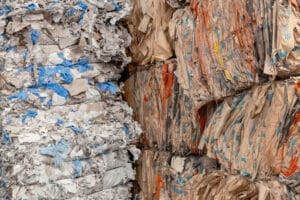
Paper sack industry records slight recovery
The German paper sack industry has recovered slightly in 2025. Despite high costs and uncertainties, the industry is optimistic about the future and is preparing for new EU regulations.
Read more " 



The new EU Packaging and Packaging Waste Regulation (PPWR) places high demands on the reusability of packaging - including transport safety devices such as stretch film and strapping. A group of 13 companies from the strapping industry, including Mosca GmbH, Teufelberger and Fromm Plastics, see this as a risk to transport safety and have therefore founded the „Strapping Project Alliance“.
The focus is on Article 29 of the regulation, which defines strict reuse quotas. Allianz is calling for a delegated act to exempt strapping bands from this obligation. A position paper is planned to be submitted to the EU Commission in mid-2025.

Central to the issue is a scientifically sound position paper that is currently being developed with the involvement of the Fraunhofer Institute for Microstructure of Materials and Systems (IMWS). According to initial results, the studies show that strapping loses stability when used several times. This could have serious consequences for the safety of transport packaging and supply chains - especially under dynamic loads such as emergency braking.
Dr Martin Bussmann, Deputy Chairman of the Project Alliance and Head of Material Innovation at Mosca, explains that there is an urgent need for action on Article 29 to ensure the safety of product transport and to safeguard supply chains. Initial research results have confirmed the Alliance's assumption that reuse leads to material weaknesses, which could jeopardise the safety of the transport packaging.
The results will then be independently verified by a European university to ensure scientific validity.
In addition to safety-related arguments, the alliance points to the ecological balance of strapping: In a life cycle analysis, they perform better than alternatives such as metal boxes or foldable transport crates. „The results so far show that strapping has a better carbon footprint than heavier, reusable packaging solutions, despite being used only once,“ says Bussmann.
Sustainability and safety should thus serve equally as arguments in favour of a targeted exception.
By handing over the position paper in Brussels, the project alliance hopes to convince political decision-makers to recognise strapping as a special case in the PPWR and exclude it from the reuse quotas. The aim is to enable sustainable and safe transport packaging in the long term.