Coffee milk in plastic containers is difficult to handle and causes a lot of waste. Researchers at the University of Halle-Wittenberg are working on milk capsules made from sugar that dissolve in the coffee itself. The first prototypes have been successfully tested. Now the method still has to be made ready for the market.
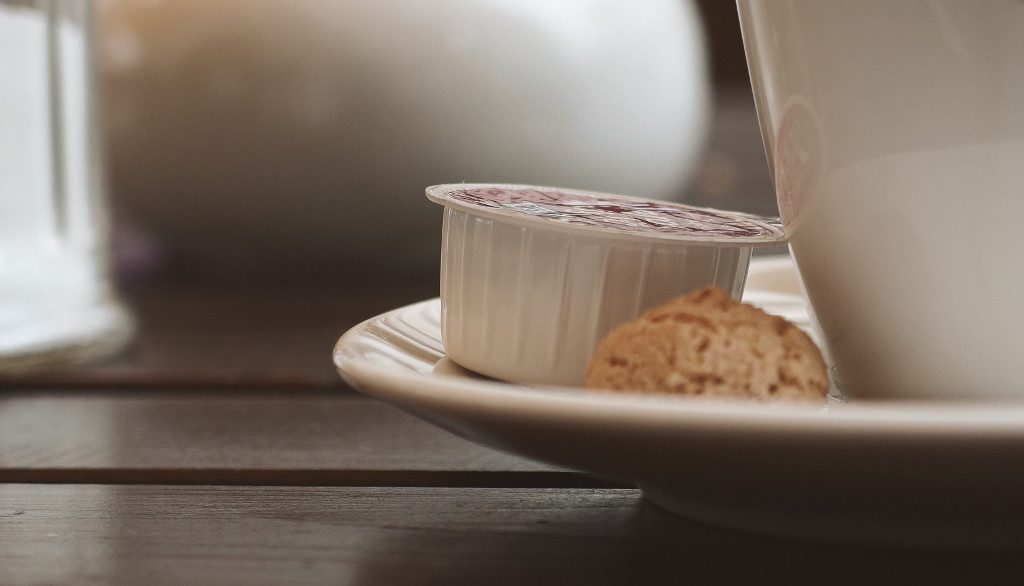
Who doesn't know them? In the catering trade, the small plastic containers with Coffee milk widespread. However, they are not particularly popular despite their widespread use. Too often, when removing the Cover film the milk on the clothes. What's more, unsightly waste is left behind.
According to M. Sc. Martha Wellner from the Martin Luther University Halle-Wittenberg, consumers and the environment will soon benefit from a new development that is as practical as it is valuable. The doctoral student of Prof. Dr Joachim Ulrich is working on solutions for self-dissolving Milk capsules. With success: Wellner and Ulrich's research group has now presented the first prototypes of the liquid packaging and reported on them in the specialist journal „Chemical Engineering & Technology“. A patent application has also been filed for the invented encapsulation method.

Supersweetened milk as the key to a stable shell
The idea behind the research project is as simple as it is obvious. The search was on for a stable Water and Oxygen impenetrable shell for coffee milk, which dissolves in warm liquids and must of course be suitable for human consumption. According to Joachim Ulrich, the solution lay in using sugar as the material for the milk capsules. He had already devised corresponding concepts a few years ago.
The developers in Halle an der Saale have now developed the following process in the laboratory: It all starts with milk that is too sweet. This is because a heated liquid supersaturated with a sugar substance is required. This is poured into a mould and cooled in a targeted manner. This then forms Sugar crystals, which move to the edge of the mould and gradually enclose the remaining liquid. In a similar way, the food industry already traditionally produces chocolates with a Liquid core here.
The encapsulation process now also works for milk and condensed milk. The sugar substances used so far are Sucrose, granulated sugar, and Erythritol for use. Both differ in their degree of sweetness. The tests showed that the granulated sugar is more soluble. However, this also means that the coated milk or condensed milk will be sweeter after the dissolving process. Condensed milk, on the other hand, has to be heated more so that the Sugar shell can dissolve.
We are still working on unsweetened alternatives
The two sugars tested also differed in terms of the stability of the casing. In principle, the scientists in Halle found that it should be at least one centimetre thick. However, erythritol in particular proved to be a difficult substance because it forms sharp-edged crystals when it crystallises in contact with milk, which can cause fine cracks in the coating. Sucrose was less problematic.
The agenda of the coffee capsule researchers led by Martha Wellner and Joachim Ulrich over the next few months is now to find the Capsule prototypes to be further optimised. The size and shape still need to be adapted. The scientists also want to „fine-tune“ the dissolution time of the sugar shell. „Our current focus is on optimising and developing a sugar-free and an unsweetened alternative. We have already made progress, but have not yet developed a final product,“ says Martha Wellner, citing a task that still needs to be completed.
Fruit juice concentrate can also be coated
In principle, everyone involved is convinced that they have developed a promising product that offers many advantages. It is not only suitable for dairy products. „We can, for example Fruit juice concentrate encapsulate,“ reports the doctoral student. There are few doubts about their practical suitability. The self-dissolving milk capsules can be stored at room temperature. Once encapsulated, milk will keep for at least three weeks because sugar is generally a good preservative, explains Wellner. She also has little to criticise about the robustness of the capsules: „The capsules don't need to be ‚packed in cotton wool‘ and can be handled in a user-friendly way.“
After completing the basic research on self-dissolving milk capsule The focus will later be on developing packaging production processes suitable for industrial use. There has already been initial interest from industry, but no concrete agreements have yet been reached. Martha Wellner predicts that it could well be a year or more before customers see the new coffee milk containers on the shop shelves.