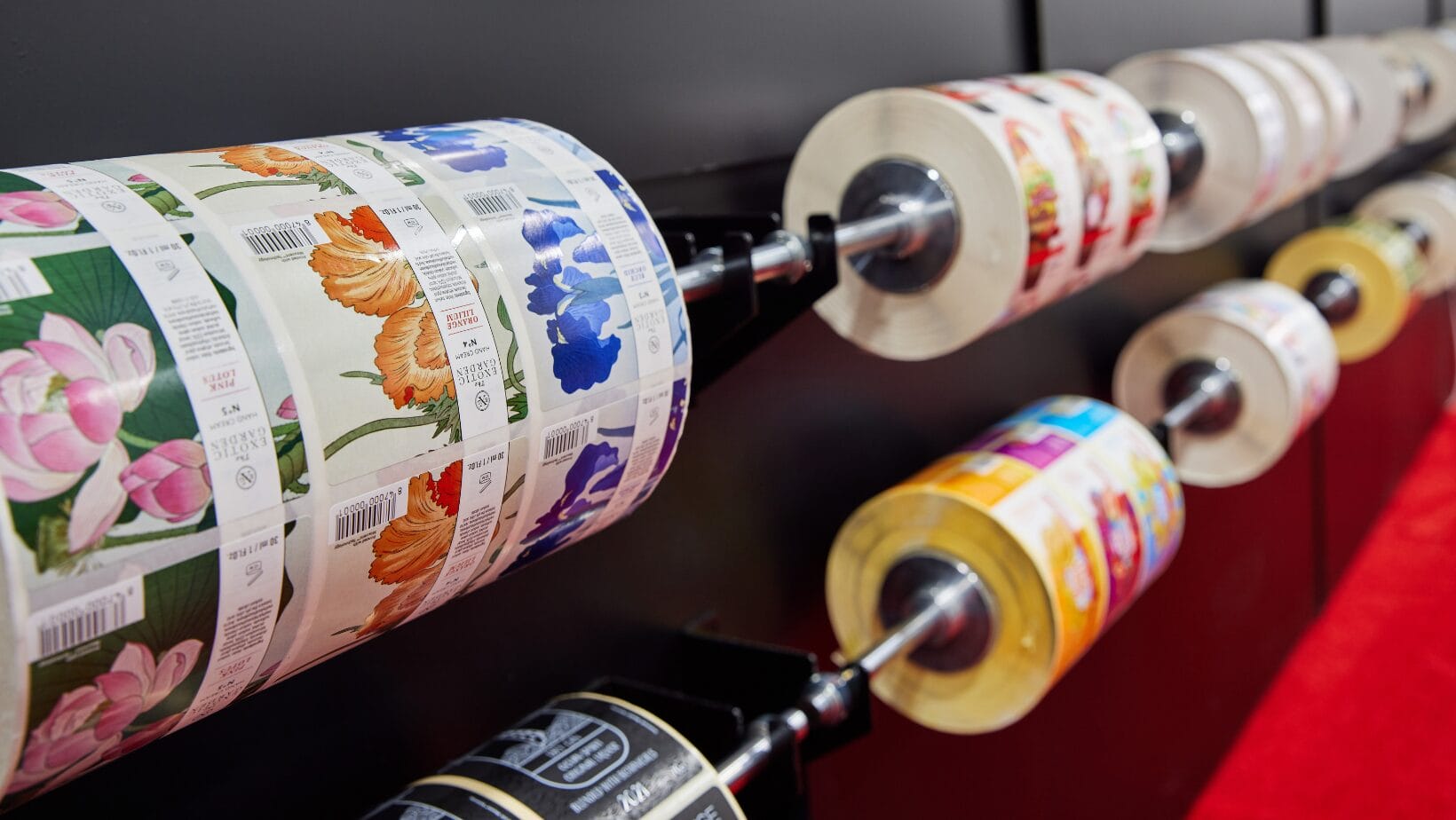
Labels offer a wide range of functions, but all too often these functions are lost due to unintentional or even wilful removal of the label. Labels and cardboard processing companies in the packaging industry can have their products assessed for durability, stability and tamper evidence.
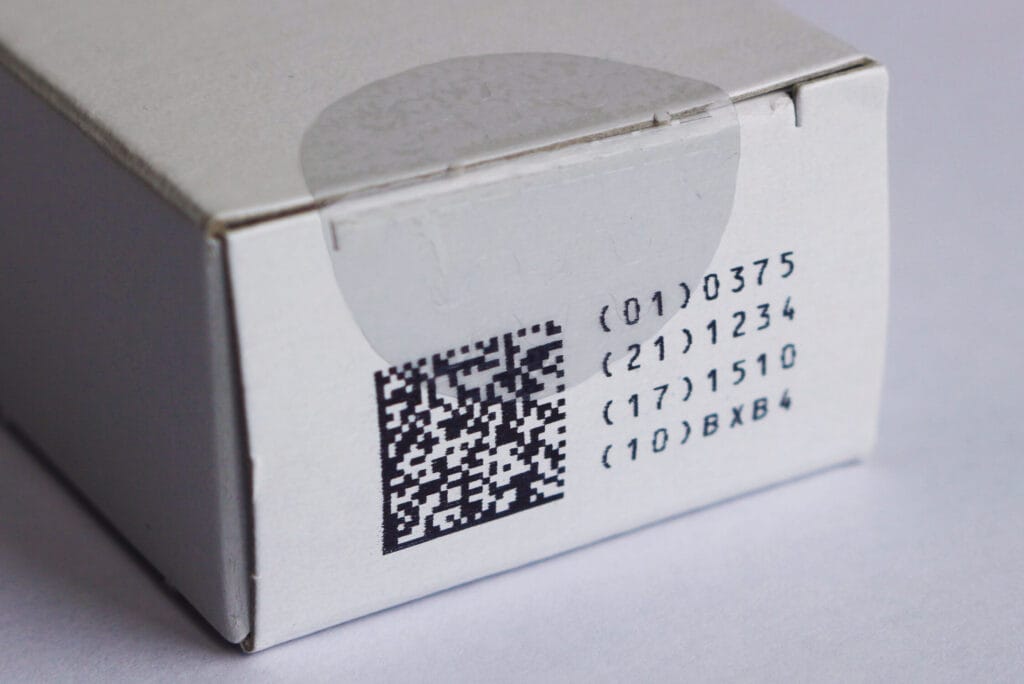
Whether smooth, textured, porous or flexible: in general, different types of surfaces require suitable adhesive properties to ensure the integrity of the labels over their service life. Some users require particularly high demands on the material combinations to be used. An explosive example of the necessity of a label's function is product protection. In various industries, such as pharmaceuticals or cosmetics, this requires packaging to be equipped with first-opening protection. This means that in the case of prescription-only pharmaceutical packaging, label-cardboard laminates meet the highest quality standards, to protect packaged products from tampering and thus consumer safety. An anti-tampering device (ATD) is intended to provide an unmistakable indication of whether a folding carton has been opened or tampered with as the outer packaging of a product. Without this security feature, the individual coding (unique identifier) for checking the authenticity of the product is worthless, as the contents of the packaging can be altered in an uncontrolled manner.
Problems in the industry
In a global market in which products are constantly exposed to different environmental conditions and mechanical stresses, for example during storage or transport, the Ensuring the stability and ageing resistance of label-cardboard laminates This is a key aspect that needs to be proven using targeted investigation methods.

These include adhesion tests, accelerated ageing tests, exposure to environmental conditions such as moisture, temperature and UV radiation as well as resistance and tampering tests. These tests enable label users to evaluate the behaviour of the materials or the composite under real or simulated conditions and identify potential weak points before processing their products. The Research Foundation of the Paper Industry provides practical testing facilities for this purpose, to evaluate the durability of labels on different substrates.

„Basically, our new method provides carton and label manufacturers with an assessment of the materials used with regard to the durability of the label-carton adhesive laminates of more than one year.“
Anke Nikowski, Project Manager Printing and Processing in the Materials Testing and Analytics division at the Research Foundation of the Paper Industry (PTS) Heidenau
Potential of the review
The requirements for the label-cardboard adhesive bond are primarily based on from the intended use. Based on this, various relevant criteria for functionality are evaluated as part of the test methodology:
- Stability and irreversibility of the bond between the label and the cardboard surface: The label must not come loose or even fall off automatically or as a result of real environmental influences.
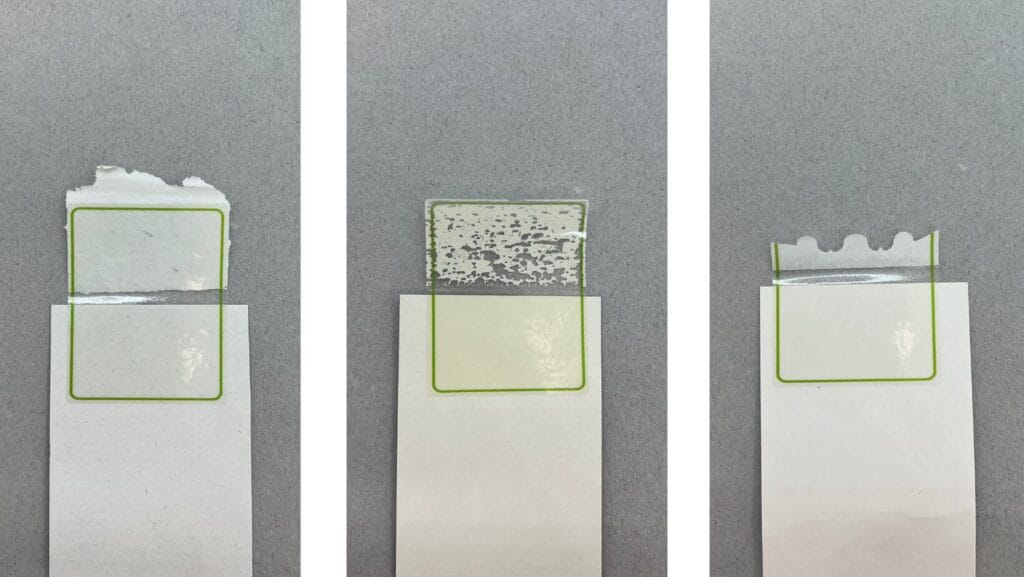
- Visibility of any tampering: The removal of the label from the surface must leave visible traces in the form of line removal or fibre tears. In the case of special void labels, the coloured pigmentation should remain on the surface of the packaging and not be removable without a trace.
- Maintaining elasticity during service life: The label material must not become brittle so that perforations attached to the label in particular do not break without external influence.
- Colour stability or preservation of transparency: The label-cardboard adhesive bond as a whole must not discolour in such a way that this leads to problems with the legibility of the unique identifier (UI).
Test methodology at a glance
The method provides for testing the shelf life and stability of label-cardboard laminates, including. a defined deduction check of the non-aged and accelerated aged adhesive composites with subsequent fracture pattern evaluation.
However, it is not only mechanical strength that plays a role in the application of label-cardboard laminates on packaging. Different environmental influences and ageing processes can have a greater or lesser effect on the visual properties of packaging fitted with a label. In addition to purely aesthetic requirements In particular, the legibility of important information for various applications is essential. This must not be altered by ageing and environmental influences in such a way that, for example, data matrix codes can no longer be read.
How tamper-proof is the product?
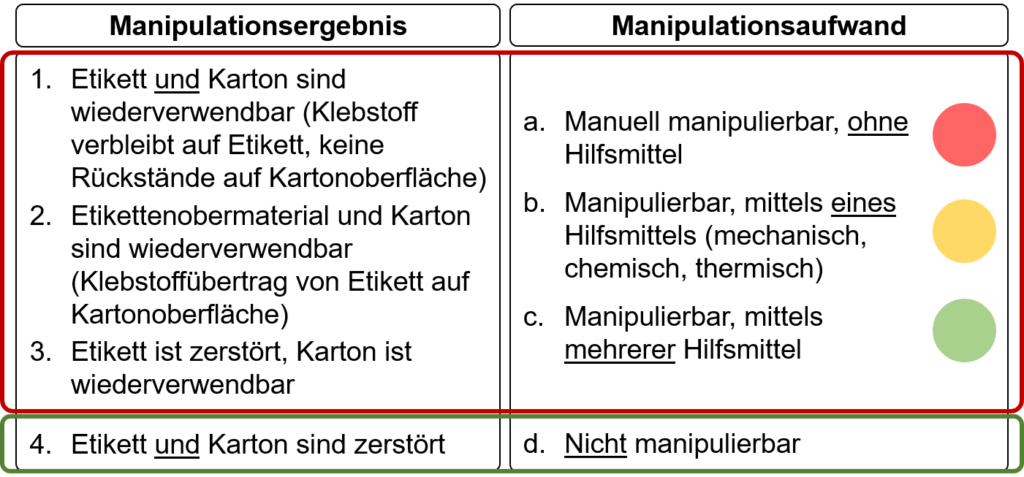
It is not only in the pharmaceutical sector that tamper-proof packaging is highly relevant. The right combination of folding boxboard and labelling is essential when it comes to this, guarantee the counterfeit protection of a product. As part of a research project, the Research Foundation of the Paper Industry (PTS) has developed manipulation tests and underpinned them with an intuitive evaluation scheme. The evaluation is based on the manipulation result and the manipulation effort. The traffic light system introduced shows the degree of difficulty of the respective manipulation attempt at first glance. A label-cardboard adhesive bond that can be easily separated by hand without leaving any traces of tampering is categorised as RED (a.). The classification GREEN (c.) generally describes a label-cardboard bond that is difficult to manipulate.
Implications for practice
The methodical approach to the evaluation of label-cardboard laminates helps companies to, adapt new product developments to the relevant application in a time and cost-efficient manner, and offers potential users an impression of the expected functionality even before using the product. Significant gains can be expected through increased sales and cost savings.
The survey results also offer companies the Possibility of qualified material selection and reduced complaint rates sustainable. In addition to a reduction in rejects, this also leads to resource savings in terms of energy, materials and human resources. Companies can significantly reduce cases of damage.
Non-manipulable label-packaging connections offer, for example for pharmaceutical packaging, packaging for high-quality cosmetics, but also for cost-intensive electronic devices Security for suppliers and buyers. An exchange with counterfeit goods is prevented or a corresponding attempt at fraud is made visible. For example, according to a press release from the Office of the European Union, a Estimated Europe-wide damage from counterfeit medicines of around 10.2 billion euros. The loss of sales due to counterfeiting amounts to 4.4 per cent of all legally sold medicines in the EU.
Even non-intentional detachment of a label from packaging can lead to high amounts of damage. PTS has already analysed various complaints in the past, where the combination of labelling and packaging was not adapted to the intended use. For example, the labels on meat packaging from the chiller cabinet became detached. In another case, more than ten combinations of label and corrugated cardboard materials were handed over for testing, with the label labelled across the corner detaching from the corrugated cardboard.
There is a need for quality-oriented selection not only of labels and cardboard, but in principle of all materials to be labelled. This PTS methodology is not only of interest to all companies in the label manufacturing and converting industry, but also to all companies in the labelling industry. Generally for all industries in which labels are used, whether as product protection, information or advertising media.