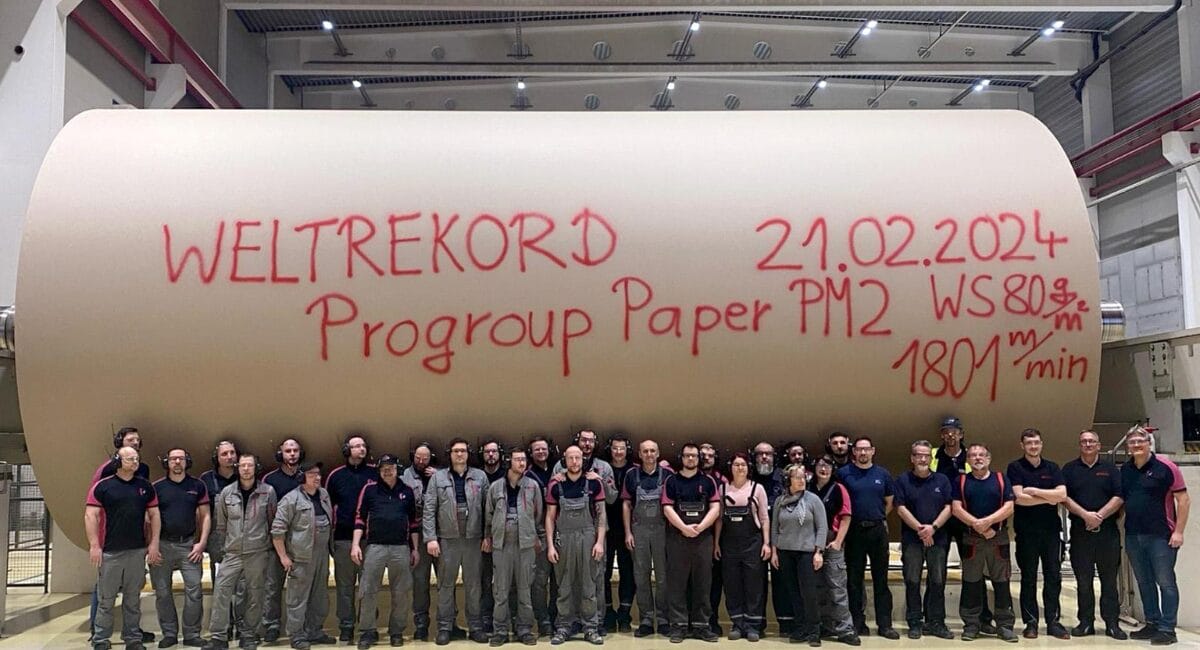
Progroup has achieved a record in paper production with its PM2 paper machine. The company ran the machine for over 25 hours and produced 1,801 metres per minute.
Detlef Weidlich, site manager in Eisenhüttenstadt, explains how the fabulous record was set on 21 February: „We defined the procedure for the speed test based on a sophisticated test plan. The result: we achieved over 25 hours of WS 80g paper produced - and that at 1,801 metres per minute, i.e. more than 108 kilometres per hour! That was an outstanding achievement by the entire team. My thanks to all my colleagues, you can be very proud of this result!“
„It's like in sport: thorough preparation and planning is an important factor. We had already been thinking about when a suitable time might be since the end of November. To this end, we drew up a plan for how the machine should be set up and operated, which risks, such as power peaks, need to be considered and made other preliminary technological considerations. We achieved the necessary stability in December 2023 and January 2024.“
Detlef Weidlich
And like good football coaches, Weidlich and his team also set up and prepared the team for the speed test. The day X then quickly approached in February: „After a Standstill and the change of clothing on 1 February and the subsequent running-in, we went to full speed in the third week. Then another check to see if all Technical and organisational requirements in place are - and then just do it!“

With a working width of 10.20 metres, the 300-metre-long paper machine, which has been optimised for the production of lightweight „next fibre papers“, is considered a milestone in the production of corrugated base paper. In Eisenhüttenstadt, either four paper rolls of 2.50 metres or three paper rolls of 3.35 metres are produced simultaneously around the clock. The Performance and equipment features correspond to those of machines in the graphics sector. It is operated with four times as many control circuits as an Airbus A380, for example.
In Eisenhüttenstadt, super-lightweight papers with a basis weight of 58 to 90 grams are produced on the basis of recycled paper. The corrugated base papers marketed under the next fibre brand have a very high the same strength values with less raw material and fibre input as classic, heavy qualities. The production of next fibre papers alone already saves around 50 percent CO2 compared to conventional paper. But the savings potential also continues in the further life cycle. The finished corrugated board formats next board and the resulting packaging are light and thin-walled and - compared to heavy grades - can be up to 24 per cent CO2 save.
Source: Progroup