New reference model for operational waste and recyclables management

TÜV Süd offers a new reference model for operational waste and recyclables management. With the DIN SPEC 91436 certification, private companies, among others, can have their management recognised.

When dealing with waste on the way to a resource-conserving circular economy, the goal is "zero waste". TÜV Süd now offers a new reference model for operational waste and recyclables management. With the DIN SPEC 91436 certification, private companies, public institutions, cities, municipalities, foundations and associations can minimise their residual materials, among other things. 

Sustainable waste management in accordance with DIN SPEC 91436 has various objectives: measuring the maturity of waste and materials management, the recycling of unavoidable waste and the minimisation of residual materials. Thereby the new industry standard goes beyond the legal minimum in its scope and takes a holistic approach to sustainability in order to continuously reduce the residual waste rate. The standard was developed by a consortium of representatives from NGOs, science and industry, in which TÜV SÜD Management Service also participated.

Creating awareness for sustainable waste management

Certification in accordance with DIN SPEC 91436 provides organisations with objective and transparent proof that they handle waste and recyclables responsibly. Through Recycling, reuse, repair and short transport routes optimise the use of existing resources and reduce costs at the same time. This also minimises the risk of contamination of local soil, groundwater and air. Certification therefore not only creates trust among stakeholders and the general public, but also raises employee awareness of sustainable waste and recycling management at all levels.

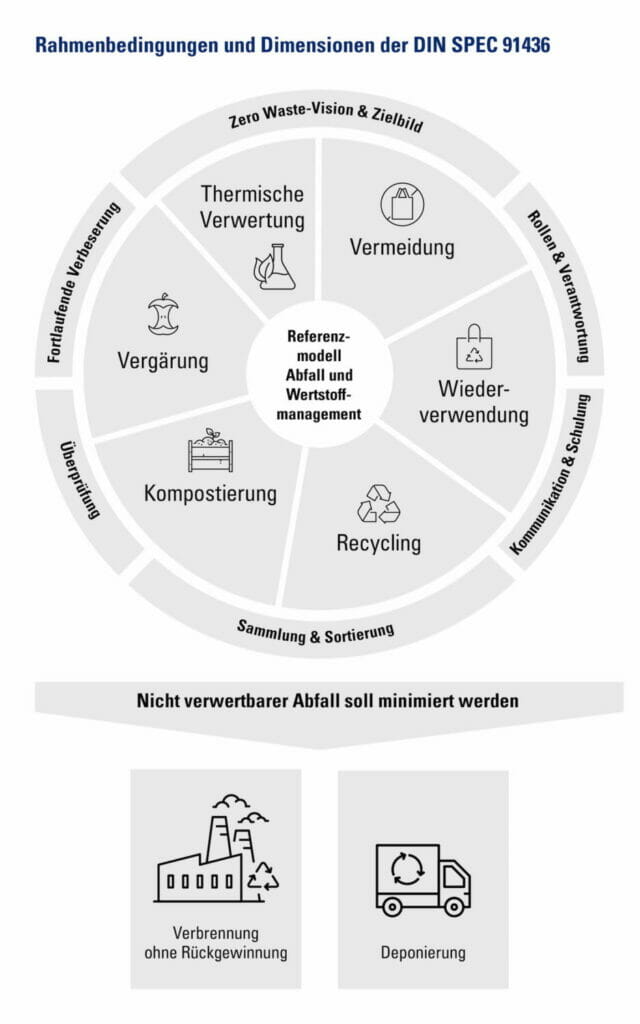
Graphic with a pie chart on waste and recycling management.
(Image: TÜV Süd)

If certification is being sought, independent experts TÜV SÜDexperts conduct an on-site audit to determine the extent to which the defined requirements and criteria for sustainable waste management are being met. To do this, they talk to the company management, the employees responsible for waste and recyclables management and other employees in various areas of work. The results are then used to determine the Maturity level and the corresponding certificate derive:

Display

  • Gold maturity level: at least 95 per cent avoidance, reuse, recycling, composting or fermentation of the relative total amount of waste
  • Maturity level silver: at least 90 per cent avoidance, reuse, recycling, composting or fermentation of the relative total amount of waste
  • Bronze maturity level: at least 85 per cent avoidance, reuse, recycling, composting or fermentation of the relative total amount of waste

The auditors also check the necessary, relevant documents such as the declaration of commitment to DIN SPEC 91436, waste prevention plans, waste balances, proof of disposal or training certificates. After a successful, voluntary audit, the company receives a certificate and authorisation to use the certification mark. In order to To maintain certification, further annual audits are required. with positive results in each case. Unannounced audits may also be carried out on an ad hoc basis.

Source: TÜV South

More news on the topic of waste