Traditional Bavarian breweries rely on solutions from Rink GmbH & Co. KG from Kreuztal in the Siegerland region of Germany: Flötzinger Bräu in Rosenheim, for example, uses a rotary uncapper for 30,000 bottles per hour, and Herzoglich Bayerisches Brauhaus Tegernsee KG has installed a rotary uncapper for its new, large filling line for half-litre bottles, which easily uncorks 50,000 bottles per hour.
In 1967, when crown corks were still being removed from bottles by hand before washing in all breweries, company founder Wilhelm Rink came to the conclusion that this task could be carried out more efficiently by machine. This was the birth of the machine manufacturer's crate uncapper: from the clocked uncapper Over 1,000 machines now in use worldwide.
Many years later, Jochen Bäcker, who had taken over the company with his wife Ursula, the founder's daughter, came up with the idea of removing the cork by means of a rotary movement, similar to a hand opener. The first machine was successfully put into operation here in 1995 and has been undergoing continuous technical development ever since.

It is possible with this principle, Uncork up to 4,500 crates or over 100,000 bottles per hour. An achievement that earned the Rink company the title of „World market leader in the removal of crown caps“ has brought in.
To date, over 300 machines of this type have been successfully commissioned worldwide. In the years that followed, the rotary concept was also transferred to the uncorking of individual bottles on the bottle conveyor, so that today three different machine types for the removal of crown corks are available on the market: the bar decapper, the rotary decapper and the single bottle decapper.
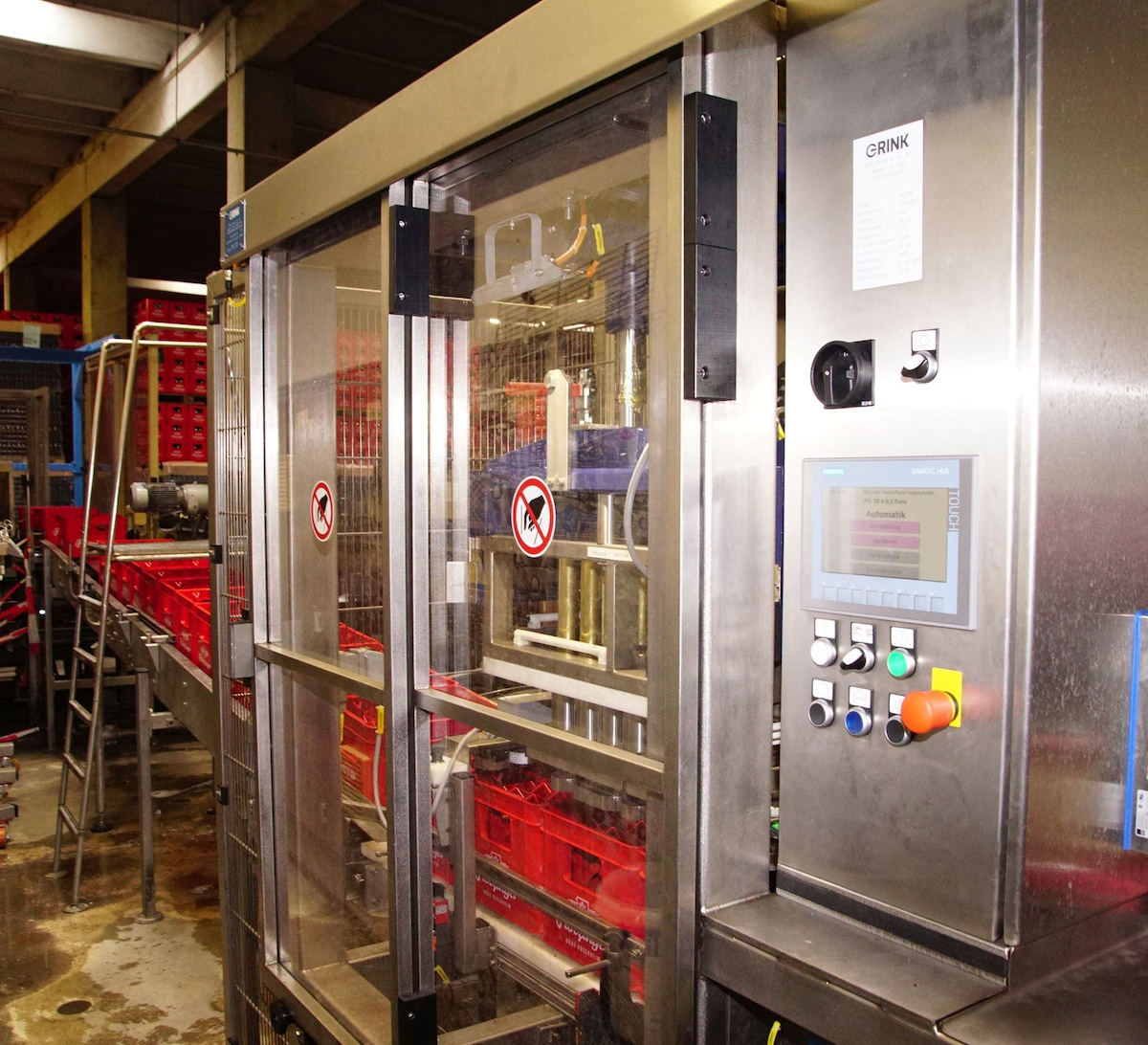
Everything runs in time
With the clocked Decork KM670/xK the crates with crown caps are stopped in the machine by means of a crate stop. The preferred area of application for this type of machine is up to 2,100 crates per hour.
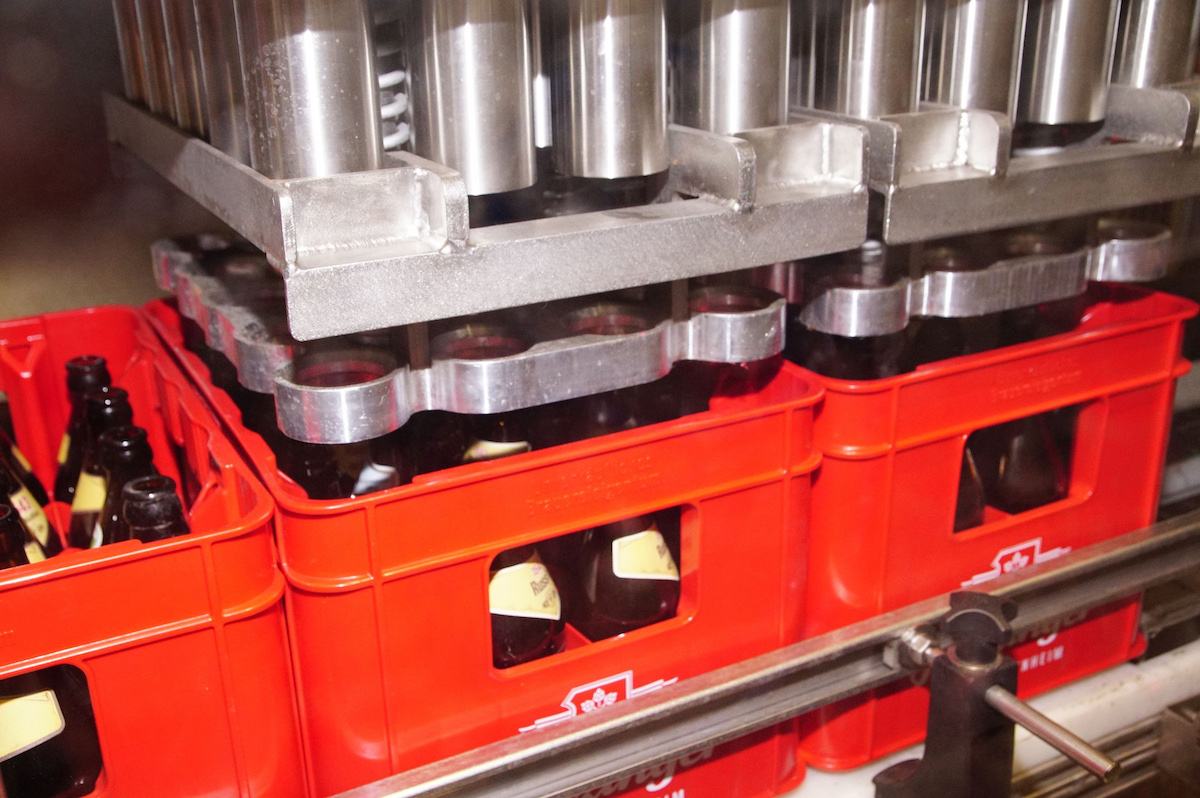
The uncorking unit moves gently into the crates electrically, and uncorking sleeves slide over the bottles. During the upward movement, the bottles are held in the crate by a hold-down plate and the crown caps are lifted off. An inductive unit recognises whether there are corks on the bottles to be processed and initiates the uncorking process.
If there are no corks, the crate continues to move. If there are foreign objects in the crate, these are recognised by the hold-down plate and are not processed. The machine is Can be combined with a unscrewing device, bottles with screw caps can also be processed.
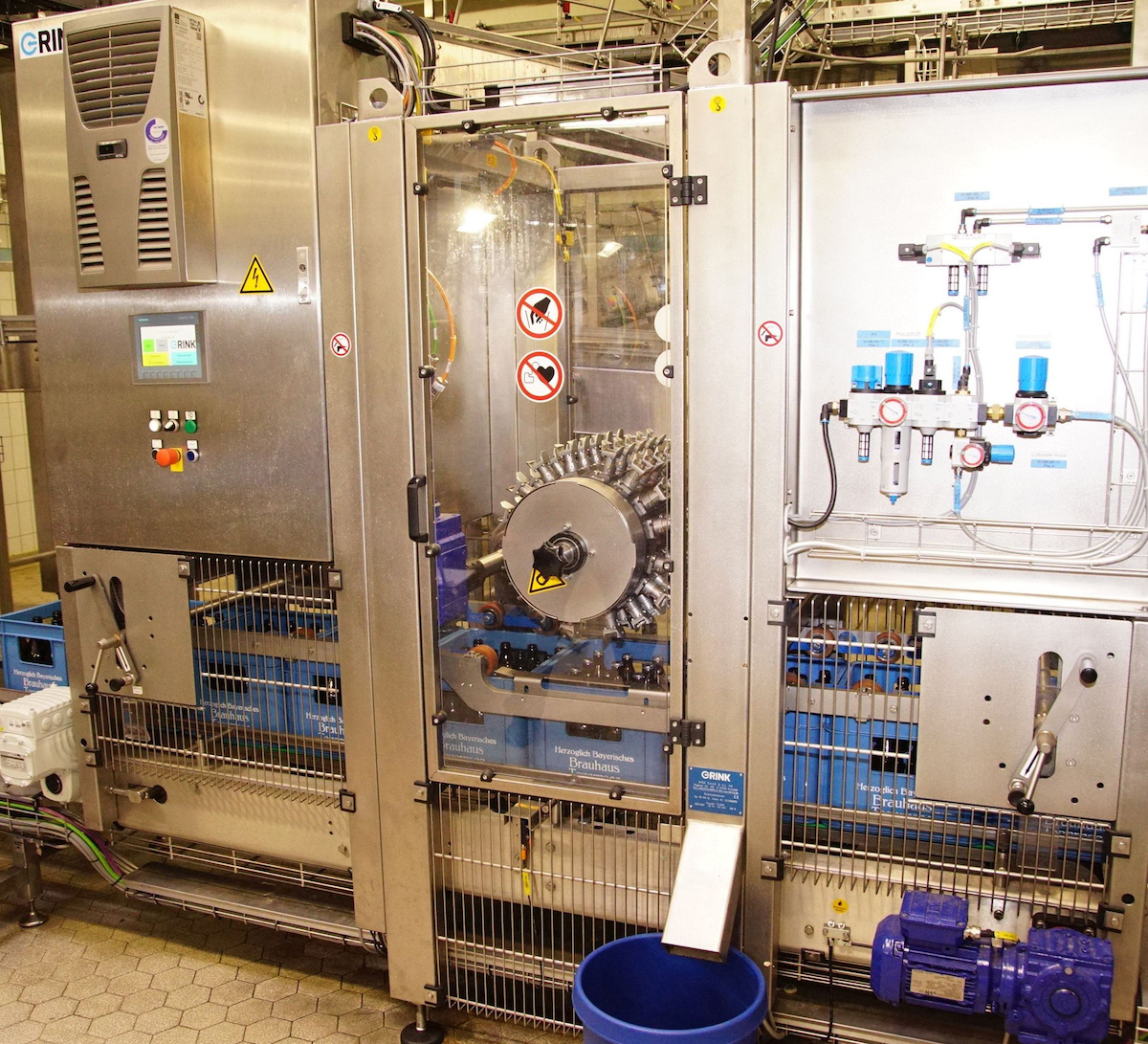
Everything goes round in circles
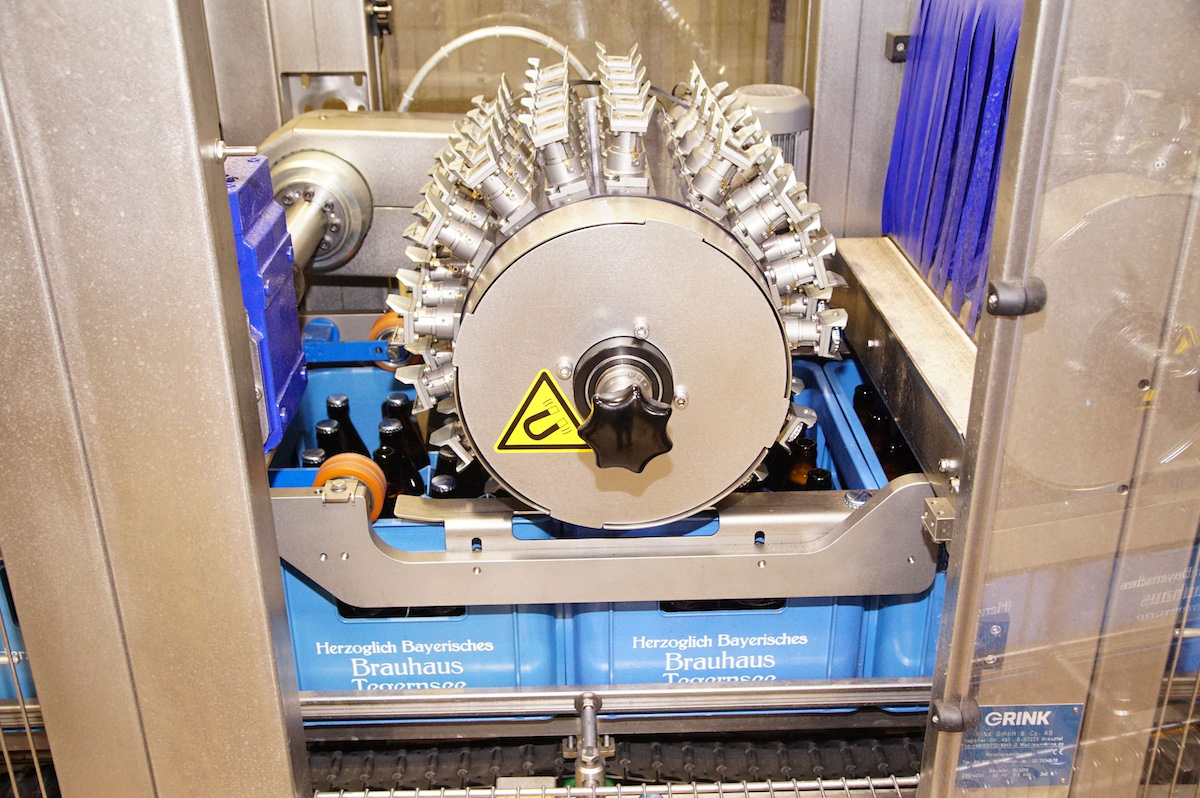
At the Rotary decapper RK 940 the crates run continuously through the machine. The focus of use is in the higher performance range between 2,100 and 4,500 crates per hour. A rotating roller removes the caps effectively and gently using the bottle opener principle. All crates are processed.
Interfering influences, such as tolerances in bottle heights and crate dimensions, are mechanically equalised and electronically controlled. Foreign objects in the crate are recognised and the roller is lifted to prevent damage and bottle breakage.
Without deceleration or acceleration processes, the machine achieves a constant, system-orientated throughput with a high output corresponding to the overall system speed. In principle, the process is very quiet. It is not possible to combine this type of machine with a de-screwing unit; a separate machine is required for this.
Flötzinger: the oldest and only private brewery in Rosenheim
The historic brewery buildings at Flötzinger Bräu, the oldest brewery in Rosenheim, which celebrated its 475th anniversary last year, are narrow and labyrinthine. It is the only private brewery in the Rosenheim area to successfully meet the challenges of the future with its motto: „Faithful to the good - Flötzinger Bräu“.
Since 1861, the Loretowiese has been the venue for the region's largest folk festival to this day, the autumn festival with district cattle show and exhibition. Johann Krichbaumer, great-grandfather of the current owner Franz Steegmüller II, buys the entire property of the Flötzinger Bräu in the same year, and his son builds the new brewery on the Rossacker until 1910.
In 1960, Franz Steegmüller II took over the brewery and has endeavoured to remain independent to this day. To this end, it has been and continues to be modernised.
The beers have received several awards, including the „Federal Prize of Honour“, with its eleven bottom-fermented, seven top-fermented and six seasonal beers, making it one of the twelve best breweries in Germany counts. The most successful in terms of volume is „Flötzinger Hell“, The various wheat beers and the seasonal Märzen and Bock beers are extremely popular.
Continuous investments
Franz Amberger has been the master brewer and technical operations manager here since 2009. Since then, almost everything in the bottle cellar has been modernised, from the filler to the cask transport, electrical cabling, ventilation, soundproofing and even the inspector. All beers are bottled on a 30,000-bottle line in 0.5-litre Euro and 0.5-litre NRW bottles.
„Since we started filling almost everything in half-litre euros again, we've hardly had any problems with third-party bottles,“ says the master brewer. „Our old decapper was getting on in years, so we were looking for a reliable replacement. The discussions and negotiations with Rink owner Dr Michael Bäcker went very smoothly, especially the Counselling, The service we were told to use was excellent. The machine was delivered on time, was quickly ready for operation and has been running flawlessly ever since“, emphasises Franz Amberger.
Long brewing tradition at Lake Tegernsee
The Herzoglich Bayerisches Brauhaus Tegernsee is also a private brewery that was granted brewing rights around 1675 and is now run by Duchess Maria Anna in Bavaria, the youngest daughter of Duke Max in Bavaria, as well as Christian Wagner and Norbert Stühmer as managing directors.
The brewery is located in the north wing of the former Tegernsee monastery. At the end of 2011, it opened its new bottling plant with storage and logistics capacities in Gmund in the newly designated industrial estate. The main product is the Tegernsee Hell, Tegernseer Spezial, Dunkles, Pils, Leicht, Tegernseer Quirinus Dunkler Doppelbock, Blauer Page - a bock that is available in the winter season - and the beer brewed to mark the 200th anniversary of the coronation of the first Bavarian king. Max I. Joseph beer.
For a long time, the beer brand was mainly available in and around Munich, but in recent years it has also become increasingly popular beyond the region.
Success with modern technology
Georg Mayr, production manager at Herzoglich Bayerisches Brauhaus Tegernsee KG, also confirms the excellent advice and service provided by Fink; bottling and logistics have been outsourced to Gmund am Tegernsee. There two filling lines, one for 0.33 litre Vichy bottles with a timed corker from Rink.
The second line only fills 0.5-litre Euro bottles, and a new rotary decapper from Rink has now been installed here. Production Manager Georg Mayr also praises the Excellent advice by Dr Michael Bäcker, who advised him to use a rotary decapper for the higher output.
„We always alternate between the 0.5-litre and 0.33-litre lines. Therefore No conversions required. The rotary uncapper runs quietly even at high speeds and uncorks extremely reliably and gently,“ says Georg Mayr. „The purchase of the decapper was as straightforward and pleasant as the installation of the machine. In the event of minor faults at the beginning, Rink connect online, or they are ready for us immediately. This decision was the right one for the future of the Tegernsee brewery,“ emphasises Mayr.