The population is growing worldwide and key raw materials are becoming scarcer. Manufacturing companies must also set the course for a sustainable future.
Scientists of the Karlsruhe Institute of Technology (KIT) investigate for these companies how they can autonomous production controlthe Reduction of wearing parts or the principles of a resource-saving production can improve the production process. They are now pooling their expertise in the new research focus area „Sustainable Production“.
The new research focus „Sustainable Production“ at the wbk Institute of Production Technology is intended to support companies in the future in their endeavours to improve their Production processes from a linear economic approach to circular approaches to a circular economy to develop. These include remanufacturing, i.e. the reprocessing of used products, with modular systems for disassembly and reassembly, autonomous production control and integrated quality assurance, as well as production networks and business models for the circular economy.

DigiPrime: Information flow in the circular economy
One of currently 15 research projects on this topic is „DigiPrime - Digital Platform for Data-enhanced Circular Economy Business Models”. As part of DigiPrime, a Digital platform developed to enable the mutual flow of information between different players in the circular economy and thus ensure that no information is lost in the course of the value chain. In particular Life cycle data such as usage statistics and common causes of errors can be used, for example, to improve internal planning processes for reprocessing in this complex and dynamic environment.
The project team would also like to Reduce barriers, The project aims to develop new concepts for the processing, sale and utilisation of products in the second life cycle by integrating industrial and social clusters. In pilot projects, new concepts are developed, tested and prepared for market-ready implementation. The European Commission funds the project over a period of four years with a project volume of around 15 million euros.
Research focus on challenges and goals of the industry
„A new research focus is being created at wbk not only on the basis of theoretical considerations, but also in very close dialogue with partners from industry. Together, we identify future challenges and goals and thus ensure that our solutions are implemented directly in industry,“ says Professor Gisela Lanza, Institute Director at the wbk Institute for Production Technology at KIT.
A topic becomes a research focus if it is of great economic, social and technological relevance and there are several research projects in the subject area. With the new research focus area, the scientists want to Making processes, plants, systems and networks in industrial companies more sustainable and thus increase resource efficiency.
The political relevance of the topic is evident - also with regard to the Germany's goal of climate neutrality by 2050 - also in the Circular economy strategy of the European Union. Among other things, the aim is to develop sustainable processes and products that are durable or can be recycled, repaired or reprocessed. The aim is also to reduce the need for new resources.
First steps towards sustainable production
Companies that initially continue to work in linear production chains will also be supported in using resources more efficiently in future by, on the one hand Develop resource-efficient components and corresponding facilities and, on the other hand Increase material and energy efficiency in manufacturing processes. A research project from the Predictive maintenance therefore aims to work as resource-efficiently as possible with screws, nuts and associated components.
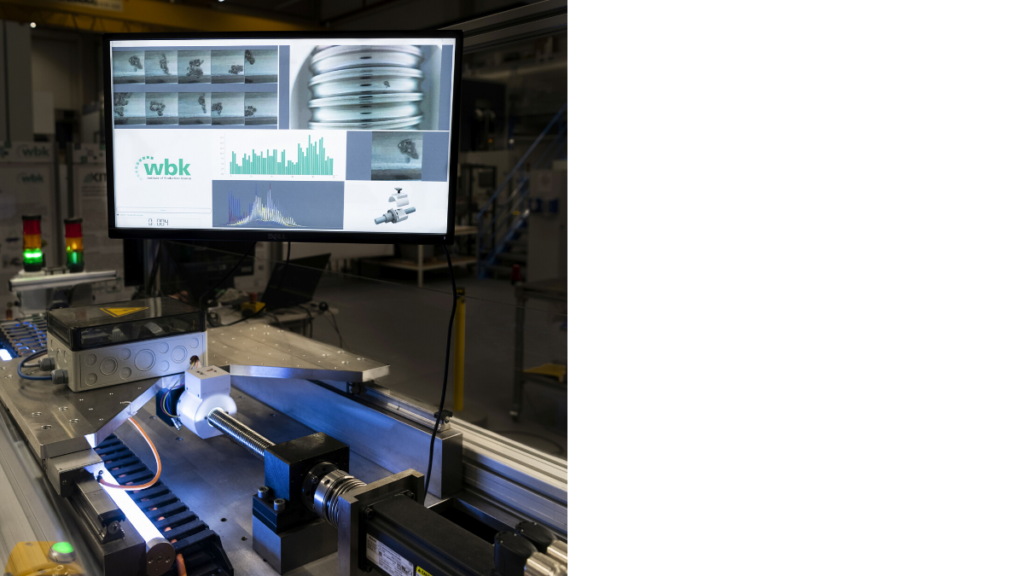
The focus of the Acoustic Emission Sensor Technology„ project“ The focus is on ball screws and the question of how they can be kept in operation for as long as possible without risk. Up to now, they have usually been replaced very early as a preventative measure, as they harbour the risk of failing and temporarily shutting down a machine tool - and in the worst-case scenario, even the entire production process.
With acoustic emission sensor technology, i.e. Sensors that detect events in the low-frequency ultrasonic range between 20 kilohertz and 2 megahertz can be perceived, the early signals for an imminent failure of the ball screw drive recognise. This makes it possible to monitor the ball screw and replace it at the ideal time in order to use fewer ball screws. The project is being supported by the German Research Foundation (DFG) in the amount of around 266,000 euros.
[infotext icon]As „The Research University in the Helmholtz Association“, KIT creates and imparts knowledge for society and the environment. The aim is to make significant contributions to global challenges in the fields of energy, mobility and information. To this end, around 9,300 employees work together on a broad disciplinary basis in the natural sciences, engineering, economics, humanities and social sciences. KIT prepares its 24,400 students for responsible tasks in society, business and science through research-orientated university studies. Innovation activities at KIT bridge the gap between knowledge and application for the benefit of society, economic prosperity and the preservation of our natural resources. KIT is one of the German universities of excellence[/infotext].Source: KIT