First returnable bottle made from thermally tempered lightweight glass

At drinktec 2022, Vetropack presented Echovai, the world's first reusable bottle made from thermally tempered lightweight glass.

At drinktec 2022, Vetropack presented the world's first returnable bottle made from thermally tempered lightweight glass. Echovai is characterised by a lower weight and less wear and tear, making more cycles possible. A pilot project has shown that logistics costs and CO2 emissions per bottle are reduced. 

Studies have shown for years that reusable glass containers are among the most sustainable and environmentally friendly types of packaging. Only the weight and resistance of glass bottles were previously considered to be their weak points. With Echovai Vetropack is now the first glass packaging manufacturer in the world to develop a solution that significantly improves these aspects. It is a stable and material-saving form of lightweight glass bottles, which are not only up to 30 per cent lighter than standard returnable bottles, but also more resistant to abrasion. „That makes Echovai bottles both economically and ecologically to a superior solution that could really revolutionise the market for reusable glass containers,“ explains Daniel Egger, Head of Innovation at Vetropack and one of the people responsible for developing Echovai.


Tempered glass is not a novelty in itself, but has been used successfully in other areas such as car windscreens for many years. In the case of glass packaging, however, the process has reached its limits to date. The thermal treatment, which ultimately makes the glass more stable, initially causes some limitations in the design of the products.


Display

Picture of a man
(Image: Vetropack)

„The biggest challenge in the process remains varying the wall thickness. However, as the bottles are thermally treated to build up internal tension, only high-quality, standardised bottles can be successfully cured.“

Daniel Egger

In fact, the Echovai process, by heating the bottles to a high temperature and then cooling them down quickly, ensures that the High demands on production. This applies to the quality of the material as well as the production process and equipment. „Fortunately, we at Vetropack work with bottles that are of a high quality,“ says Daniel Egger. „We also adjust the entire curing process very precisely to the individual container and its shape. So it's a very sophisticated, technologically demanding process, which is why we roll it out in phases.“


Picture of two different glass bottles
(Image: Vetropack)

It took around ten years of development work at the Vetropack Innovation Centre to create Echovai. The stable lightweight glass containers are still produced exclusively at the plant in Pöchlarn, Austria. Over the past three years, millions of bottles have been successfully sold and refilled by pilot customer Mohrenbrauerei and Tests have confirmed the extended service life and shelf life of Echovai bottles. In the upcoming phase, selected new projects will show how and which other Vetropack systems need to be made fit for Echovai production - the prerequisite for meeting the demand for Echovai bottles throughout Europe. In a subsequent third phase, we are talking about the possibility of licensing out the technology and our expertise to third parties in order to enable a broad market launch.

Picture of a dark glass bottle
(Image: Vetropack)

The Mohrenbrauerei brewery in Vorarlberg, Austria, is the first Vetropack customer to use Echovai containers for its Märzenbier Pfiff and Radler varieties - and is already planning to „move“ more beers into the innovative lightweight glass bottles. For the 0.33-litre returnable containers alone, the use of the Echovai solution (210 grams) will result in a Weight saving of around a third compared to the previous standard bottles (300 grams) achieved. At the same time, the lightweight glass bottles can be stacked six high on a pallet instead of five as before. This has an impact on logistics costs: for Märzenbier Pfiff and the Radler varieties, these were reduced by around 1,000 tonnes of CO2 per year - thereby reducing CO2-emissions per bottle fell to just a quarter of the normal 0.33-litre returnable bottle.

Convincing stability

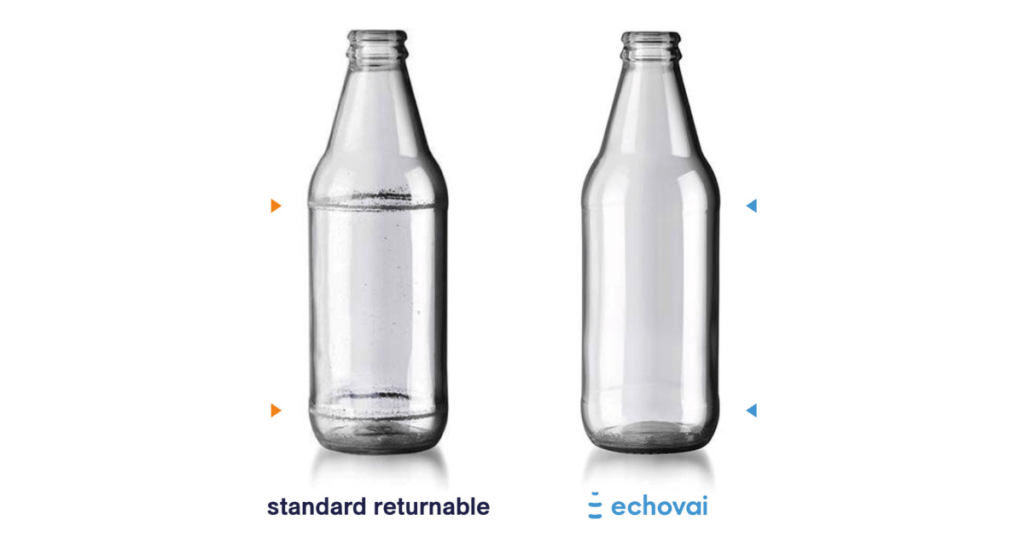
Not only do fewer bottles break during industrial use, but after three years and up to 12 cycles, the Echovai containers show hardly any wear on the contact surfaces (scuffing).

„A large proportion of them can even still be categorised as new, which is no longer the case with standard bottles after so many cycles. We therefore assume that Echovai bottles will achieve a significantly higher number of circulation cycles - which makes them an even more convincing solution compared to standard bottles.“

Daniel Egger

Echovai bottles are not only an alternative for beverage producers who already sell their products in reusable containers. Egger and his colleagues also see great potential for the new solution in the disposable glass bottle segment, as increasing weight has often played a decisive role here. In this way, Echovai could promote the switch to reusable containers, as brand owners generally want to retain their unique bottle features.

„In the long term, we are aiming for a more user-friendly return and refill system with 100 per cent bottle reuse. We are already working on a solution to optimise the traceability of our Echovai bottles. Using a specific data matrix code on each bottle, it will be possible to link any data to the product unit in future. This will make it possible to link worlds of the value chain that are currently viewed separately and to trace them back along the entire supply chain - from production to bottling to the end customer. Echovai therefore also marks the dawn of a new era of digital networking.“

Daniel Egger

Source: Vetropack

More news on glass packaging