The new EU packaging regulation provides for a ban on small single-use plastic coffee milk packaging. The Fraunhofer Institute for Environmental, Safety and Energy Technology UMSICHT has now analysed the advantages and disadvantages of reusable solutions compared to individual packaging in a life cycle assessment for frischli Milchwerke.
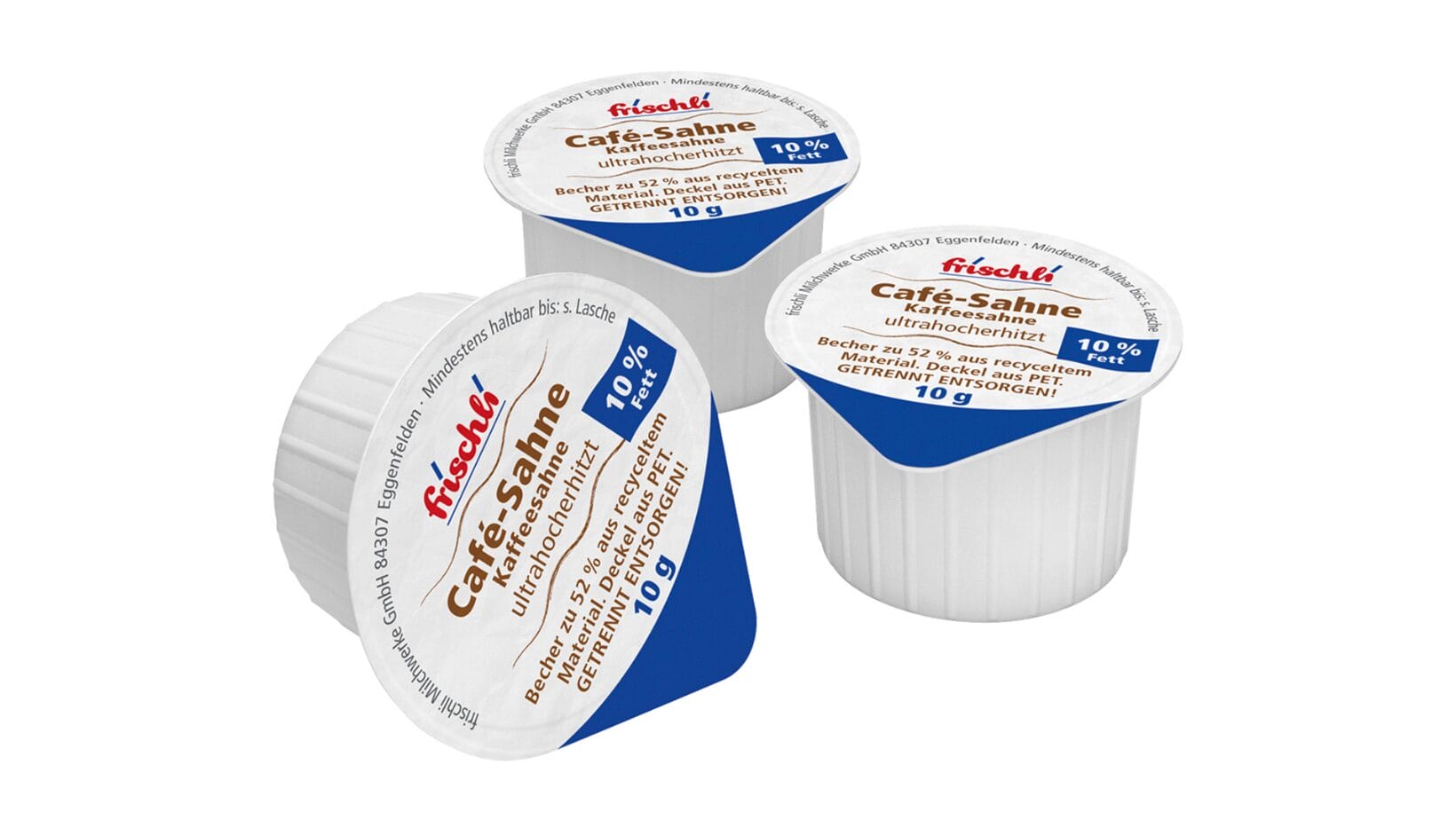
The small individual packaging for coffee creamers usually consists of a polystyrene base film and an aluminium lid, both of which are usually incinerated after use. An alternative in the catering industry, e.g. in bakeries, cafés or when travelling, are Reusable solutions such as ceramic jugs or thermos flasks.
Avoiding non-recyclable packaging or replacing it with environmentally friendly packaging is an important goal on the way to a sustainable packaging industry. In this way, the CO2-footprint significantly. However also takes into account the environmental impact of food losses which can play a greater role in reusable systems due to hygiene regulations.

In the case of perishable products such as coffee milk, for example, these require that unused coffee milk must be disposed of as soon as it has been offered to customers in a jug. Researchers at Fraunhofer UMSICHT therefore investigated at what point additional CO2-emissions due to food losses the additional CO2-emissions due to small individual packaging predominate. The reusable alternatives considered were 100 ml porcelain coffee pots and 0.5 litre stainless steel thermos flasks. For the reusable system, it was assumed that the milk is transported to the points of sale in 1-litre Tetra-Paks. For the comparison, the researchers also included innovative individual packaging designs: The aluminium lid and the polystyrene are replaced by Polypropylene or recyclable, recycled polystyrene replaced. The result: reusable systems cause without consideration of food losses compared to all individual packaging fewer greenhouse gases.
Food waste versus CO2-footprint of individual packaging
In order to investigate the relevance of food losses, the researchers calculated the Break-even point, which shows the percentage of milk to be discarded from the reusable alternatives until the CO2-footprint corresponds to that of individual packaging. The range is between 3 and 27 per cent - with the lowest value applying to the individual packaging variant made of polypropylene.
„The result shows that, depending on the type of packaging even with low food losses, the individual packaging variant is the solution with the lowest CO2-footprint can be. Even if the environmental impact of packaging should be reduced as much as possible, the trade-off with food losses should always be taken into account. Environmentally friendly packaging designs, e.g. through optimised material selection, can be a climate-friendly alternative to reusable systems depending on the application.“
Dr Daniel Maga, Fraunhofer UMSICHT
Source: Fraunhofer UMSICHT