The start-up Saperatec has developed a process with which aluminium composites can be broken down into their individual components. The first commercial recycling plant is scheduled to go into operation at the end of 2022.
In Germany, 18.7 million tonnes of packaging end up as waste every year. An innovative technology now makes it possible to break down aluminium composites into their individual parts. High-performance adhesives support the process.
Flexible packaging often consists of so-called aluminium composites - with layers of polyethylene, aluminium and PET. These are firmly bonded with a two-component polyurethane laminating adhesive. After disposal, they can often only be utilised thermally. The adhesives industry is constantly working on ways to enable material recycling, develop high-performance adhesives that also support innovative recycling processes. The current example of the start-up Saperatec shows that it can work when waste management companies and adhesive developers work together.

Saperatec process contributes to the circular economy
And this is how the process works: First, the material is shredded in order to maximise the contact surface for the Innovative release fluid to create. In the second process step, the shredded composite material is treated with it. The separation process takes place with stirring and heating and the individual fractions are present in the liquid.
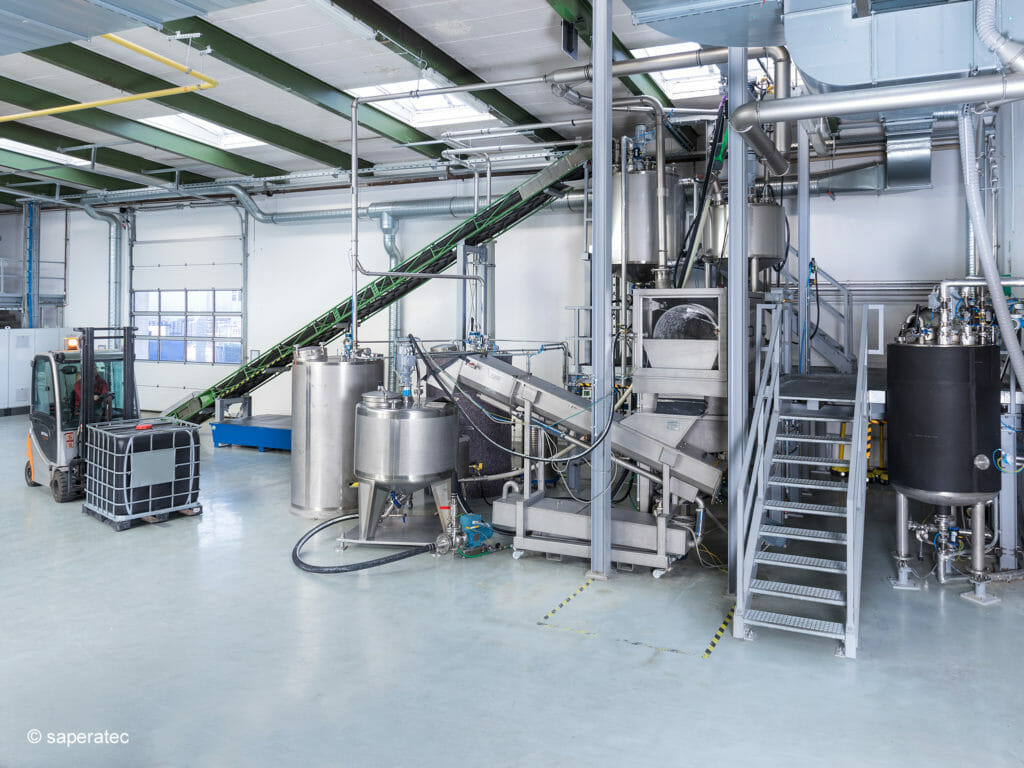
The highlight of the innovative technology: the composition of the separating liquid. It easily breaks down the path between the individual layers of the composite material in order to separate them and was formulated in such a way that it can separate aluminium foil composites, metal-coated composites and inner foils made of liquid cardboard - because these often accumulate as a mixture in household waste.
The pieces of material are then sieved off and cleaned with washing water to remove any residual adhesions. Both the separating liquid and the washing water are returned to the back into the cycle. The cleaned material mixture is separated by type using the „float/sink process“. Once dried and treated, the individual materials - both the aluminium and the plastics - are ready for a second life.
Advantages of innovative recycling technology
The advantages of the process are obvious. Thanks to the recovered raw materials, it enables a Optimised added value with an advantageous eco-balance. The individual materials are also characterised by a high level of purity and can be reused - just like the innovative separating liquid itself.
The separation process has been taking place in a pilot plant since 2014. The commissioning of the first commercial recycling plant is planned for the end of 2022. This is where the entire recycling chain takes place: from waste collection and recycling to the sale of the recyclate.
Source: Industrieverband Klebstoffe e. V.