More climate-friendly glass production: Schott takes stock

Schott has set itself the goal of sustainably transforming its energy-intensive speciality glass production. The company has now drawn an interim conclusion for the past year.

The technology group Schott has set itself the goal of sustainably transforming its energy-intensive speciality glass production. The company has now drawn an interim conclusion for the past year, in which important milestones for the gradual reduction of emissions were achieved.

In addition to the first promising research results in smelting using hydrogen instead of natural gas, the accelerated technological change has also seen the construction of the first climate-friendly electric smelting furnace. The company has also made progress in terms of energy efficiency and the use of green electricity. In addition to the plan for climate-neutral production by 2030 in Scope 1 and Scope 2, ambitious reduction targets have now been set for the entire value chain (Scope 3) for the first time - the globally recognised Science Based Targets initiative (SBTi) recently confirmed the emissions reduction target submitted by SCHOTT for all three scopes, which is based on scientific findings.

The glass industry is one of the most energy-intensive sectors in the world. The melting of glass raw materials requires temperatures of up to 1,700 degrees Celsius in huge melting tanks achieved. The main source of energy to date has been natural gas - associated with high emissions of climate-damaging greenhouse gases.

Schott has therefore made the reduction of its emissions in its own production a focus of its sustainable corporate transformation since 2020. Since 2019, the switch to green electricity and a continuous increase in energy efficiency have enabled Schott to absolute emissions are reduced by 60 per cent. Despite growth and high energy consumption, the Group kept CO2 emissions constant in the 2022/23 financial year.

Display

„In the last two years, we were able to quickly achieve the first important milestones, such as the switch to 100 per cent green electricity. Now we have to solve complex technical challenges at our furnaces. To further reduce emissions and achieve our climate targets, we have to break new technological ground. Our focus is on developing innovative technologies to melt glass more sustainably.“

Dr Jens Schulte, Member of the Schott Executive Board and responsible for the „Zero Carbon“ strategy programme“

Schott is currently conducting pioneering research into how glass can be melted using sustainable energy sources instead of natural gas. The Group is focussing on two options here: the electrification of the tanks with green electricity or the use of green hydrogen. Laboratory tests with 100 per cent hydrogen were successfully carried out in spring 2023. Further tests on melting tanks on an industrial scale are to follow next year.

Schott has recently launched several research projects for the electrical path. The aim: to investigate, whether it is even possible to melt speciality glasses with their highly complex material and process requirements using electricity.

„Our results were very promising. In the pilot plant, we were able to increase the proportion of electrical energy to up to 60 per cent for difficult-to-melt aluminosilicate glass, for example, while maintaining at least the same glass quality. We have thus shown that a „super-hybrid furnace“ with a higher proportion of electrical heating than fossil fuels is possible in principle.“

Michael Hahn, Head of Melting Research

In order to learn more about the processes in the tank, future tests will be carried out directly on the newly developed tanks. under real production conditions be carried out.
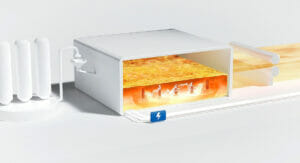
Pilot project: First more climate-friendly electric furnace

Schott is now taking the next step: in Mitterteich, Bavaria, the company is planning to build a new plant by the beginning of 2026. Electric tub in order to using electricity to melt glass for the pharmaceutical industry in a much more climate-friendly way for the first time. The pilot furnace, which is powered by green electricity, is expected to reduce greenhouse gas emissions by around 80 per cent compared to current furnaces. The use of natural gas is still necessary in some areas.

The project is to set new standards for the entire industry. The innovative approach is therefore being subsidised by the Federal Ministry for Economic Affairs and Climate Protection and the European Union with 14.8 million euros. In total, Schott will invest around 40 million euros in this innovation.

100 per cent green electricity: expansion of the portfolio

The Group was able to expand its portfolio when it comes to green electricity. Since 2021, Schott has switched to 100 per cent green electricity with the help of Energy Attribute Certificates (EACs) and Power Purchase Agreements (PPAs). The company relies on high-quality, independently audited green electricity labels. To date, the Group has concluded seven direct contracts with energy producers (PPAs). Schott supports the energy transition in Germany with these.

SCHOTT plans to cover around 24 per cent of its electricity consumption in Germany through PPAs in 2024. The aim is to conclude these contracts with suppliers of renewable energy plants. and to further expand and internationalise it.

Until now, the technology group's climate strategy has focussed on the emissions from its own production (Scope 1+2). Now, for the first time, Schott has recognised the dimension of emissions along its value chain (Scope 3) - and is also setting itself reduction targets. The Group is also working closely with its suppliers - by 2027, almost 75 per cent of the suppliers with the highest emissions are also expected to set science-based climate targets.

German Sustainability Award for ambitious strategy

The climate protection strategy with its ambitious targets still has many more steps to take, and there are many more to come. Challenges to which there are currently no answers - This is the case for all other players besides Schott who are committed to sustainable development. The measures taken to date have received their first public recognition: after winning the dena „Energy Efficiency Award“ in autumn 2022, Schott was awarded the prestigious "Energy Efficiency Award" twice in November 2023. German Sustainability Award excellent.

„Thanks to the IPO of our pharmaceutical subsidiary, we are in a good financial position for further investments. Nevertheless, like many other manufacturing companies in Germany, we are dependent on certain framework conditions. These include the availability of green energy at competitive prices and a corresponding nationwide infrastructure.“

Dr Jens Schulte

Source: Bulkhead

Schott - More news

Large companies want zero emissions in the pharmaceutical sector

The aim is to achieve greater sustainability along the pharmaceutical supply chain. Eight renowned companies in the pharmaceutical supply chain have joined forces to achieve this. They have founded the non-profit „Alliance to Zero“ to support pharmaceutical and biotech companies in their transition to net zero emissions in line with the Paris Climate Agreement.
Read more "