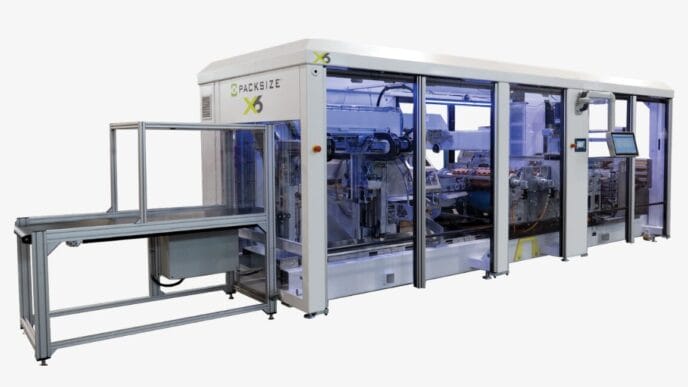
Meggle AG commissioned a new case packer for butter tubs in order to be able to respond better to increasingly differentiated customer requirements. Schubert developed a TLM packaging machine with a freely programmable mixing function and flexible changeover options between different pack formats, which has since proven itself in day-to-day production.
Schubert and Meggle have been in contact for years. Schubert sold its first case packer with a mixing function to the company in 2012. This already essentially fulfilled the same function as the new system: the packaging of butter tubs in a tray. However, other types of packaging have since been added at the request of the food chains supplied by Meggle and the packaging process was to be improved in various ways.
Two years later, Schubert again supplied a case packer for butter in various cup formats, which, in addition to the Tray packaging also the packaging in „Zip-and-crack cartons is mastered. These are cartons that can be torn open in the centre and broken apart to present the cups on the side of the shelf. The packaging process has been optimised thanks to the patented TLM transmodule automated and further optimised using simple tools.

Preparation of the cardboard packaging
The butter tubs are fed from the pre-machine in four lanes in different varieties. Different types of tubs can be divided up, e.g. two lanes of butter without salt and two with salt or three with, one without salt or a combination of all types. Metal detector and a Libra, so that cups that are not filled correctly can be ejected.
Parallel to the delivery of the butter tubs, a three-axis robot pulls the carton blanks out of the magazine. The advantage of the F3 robots compared to two-axis robots, as used by other packaging machine manufacturers, is better destacking of the cardboard packaging, as it is not simply removed, but peeled out with the third axis. Even slightly damp or bent cardboard boxes do not cause any problems. A two-axis robot takes over the Cutting, from below with Hot glue presses it through a folding frame and positions the erected carton directly on the Transmodul.
Transmodule as a key
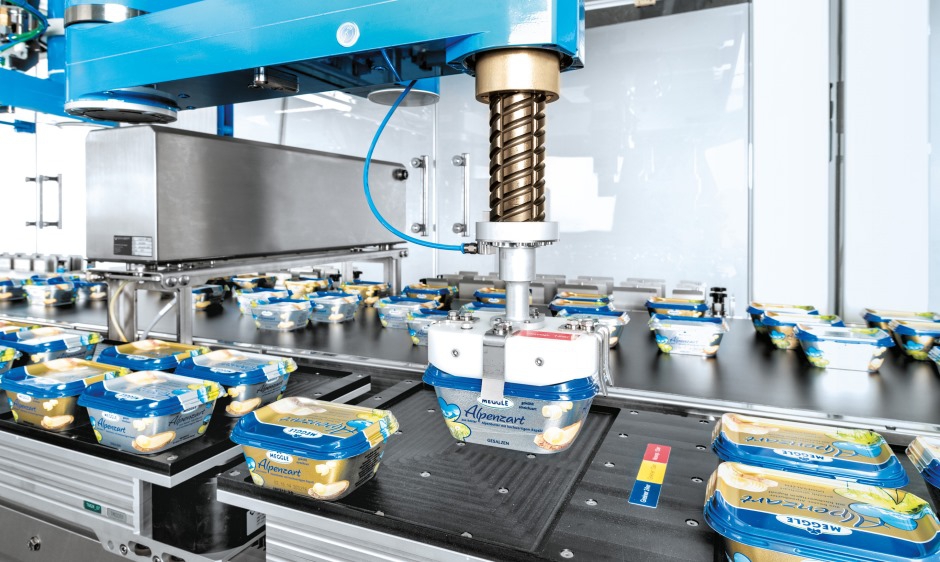
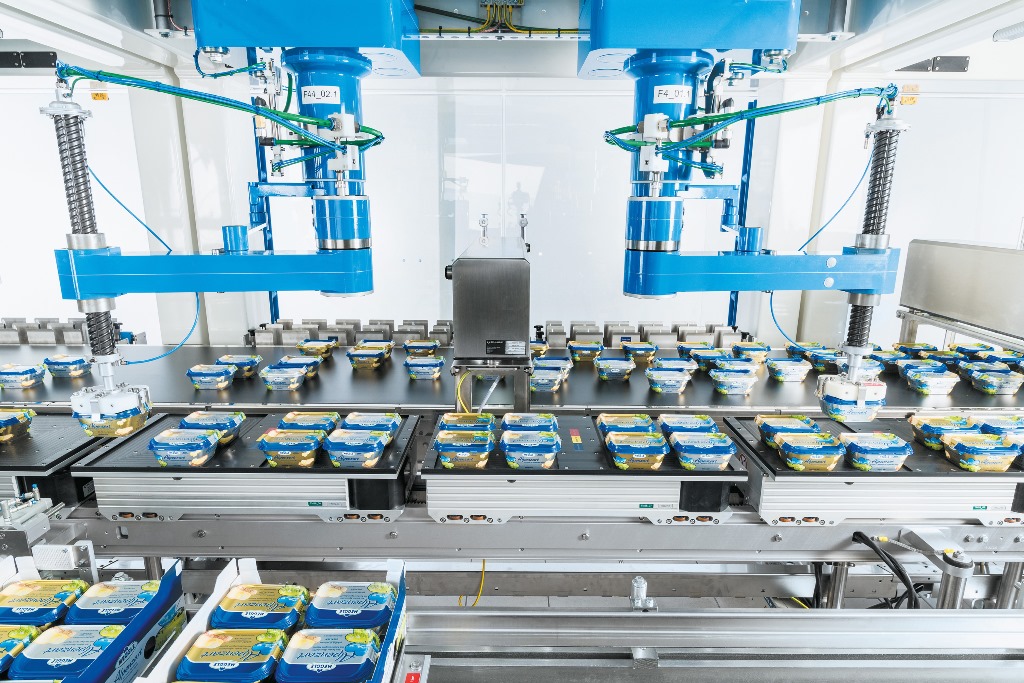
The system has two Transmodul lines. The cartons are transported on the first line, while the transmodules on the second line transport the cartons. Cup formations are formed. The tubs pass through the Schubert incident light scanner, which recognises the contour and position of the butter tubs. It communicates this data to the two four-axis pick-and-place robots, which are responsible for pre-grouping the tubs layer by layer. The use of the Image processing is important because, in addition to quality control, the correct orientation of the cup print image in the packaging must also be ensured. As soon as the position of the products corresponds to the packing scheme, the Transmodul moves on to the filling area. An F2 robot picks up two formations of the cups from the Transmodul by sucking them in using an appropriate tool and fills the two cartons next to it on the first Transmodul section simultaneously, layer by layer. During this step, it is important to push the cups as close together as they need to be in the box.
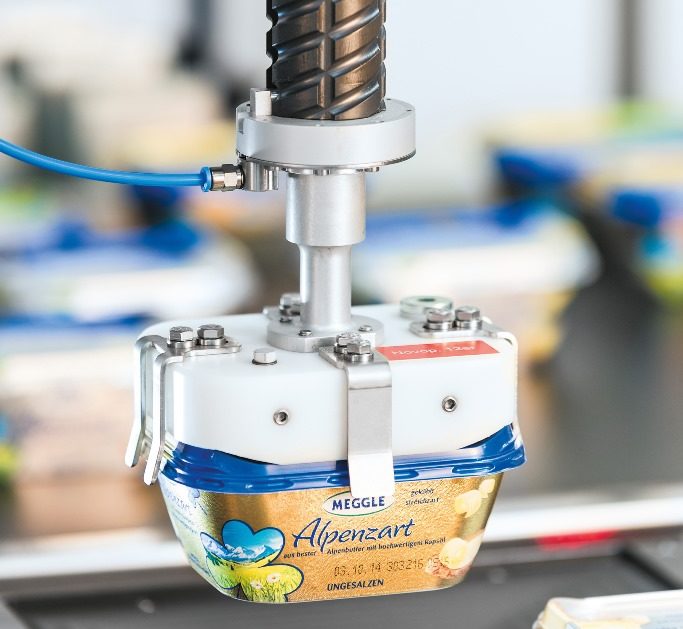
Schubert utilises the Intelligence of the transmodule, which transports the cups loosely on a plastic plate. The Transmodul (unlike a product conveyor) is freely programmable in its travelling motion like a robot. While up to this point it was linked to the other Transmodules and moved continuously, it switches to synchronised movement to load the cartons. After a short stop, it moves to the correct position and communicates this to the robot. A simple mechanism on the robot's tool now pushes the cups together. The key technology here is F44 robot in combination with a transmodule section. The close cooperation between the two units is what makes this simple solution possible in the first place, whereas this step would require a more complicated mould for a constantly moving belt.
Palletising and format changeover
Once the cups have been placed in the cartons, they are glued together using aggregates and then glued by an F2 robot. closed. The cartons are then transferred to the outfeed conveyor. Palletising is currently still carried out manually through a Machine operator, which is also responsible for reloading the cardboard boxes into the magazine. Schubert could also integrate fully automatic palletising into the system at the customer's request.
The changeover between the two carton formats, trays (which are used in sizes 12 and 24) and „zip-and-crack“ cartons (with twelve products), is carried out at Schubert, unlike at competitors, without spindle adjustment and therefore without the need for a spindle. tool-free. Only fixed format parts, which are connected to the machine via plug-in connections, are exchanged. Energy and data are transferred without contact: an important feature for the high availability of modern end-of-line packaging systems. The format changeover requires only one employee. RFID chips in the tool and in the robot arm check the tool and report whether it is the correct one.
Special outer packaging
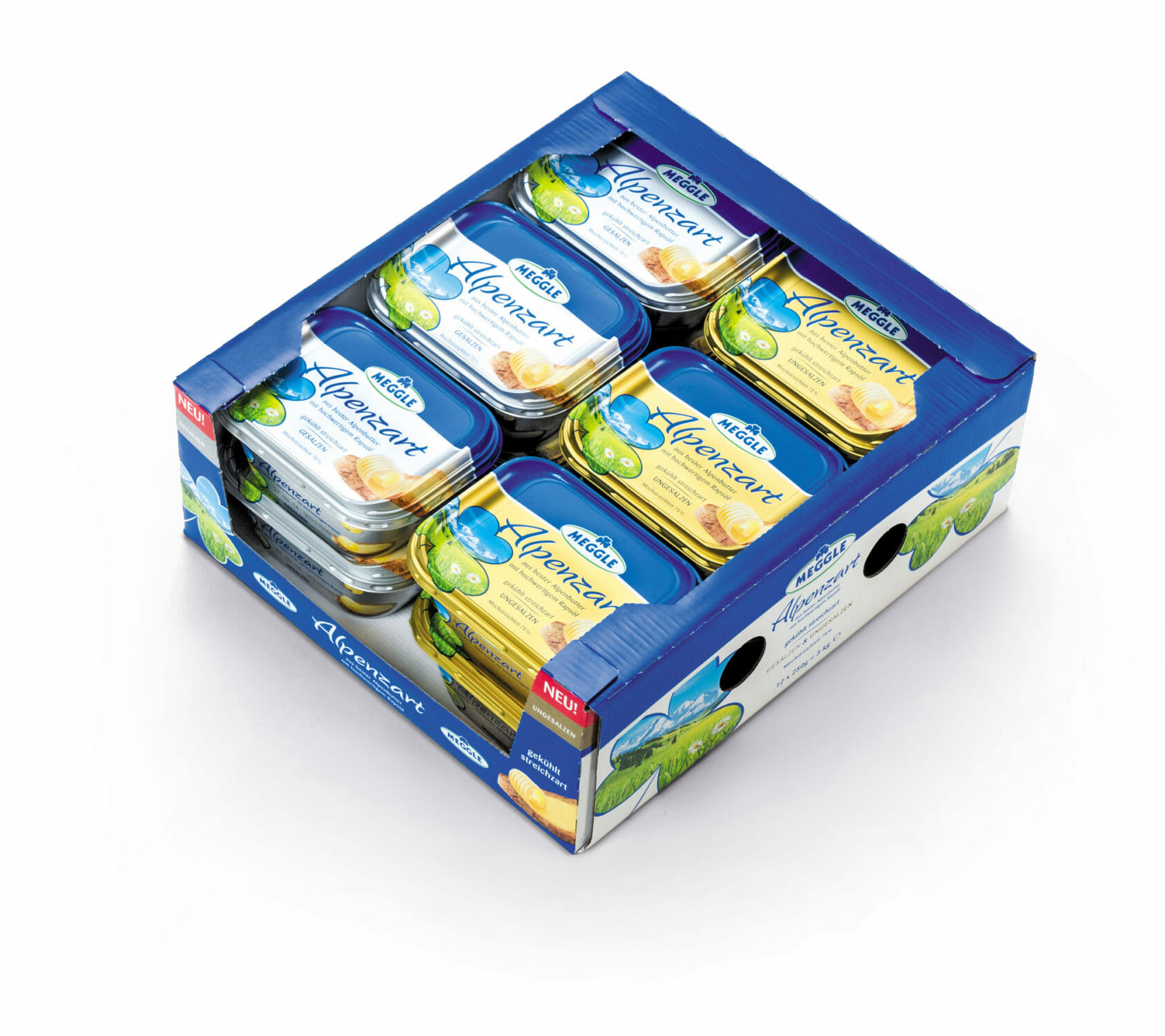
Schubert developed the cardboard packaging together with Meggle's supplier in accordance with the specifications of the food discounters to be supplied. They wanted integrated injury protection so that their customers could not cut themselves on the sharp edges of the cartons while shopping. Normally, automatic packaging processes in which the machine erects, fills and closes the cartons use so-called „open flutes“, i.e. cartons with open carton edges.
The cardboard boxes used by Meggle, on the other hand, are characterised by a folded edge out. To produce them, the blank is mechanically inserted into a folding unit and glued; the edge is then folded over and glued. When developing these cartons, it was important that they could still be processed by machine despite the very complex facings.
Buffer compensates for production fluctuations
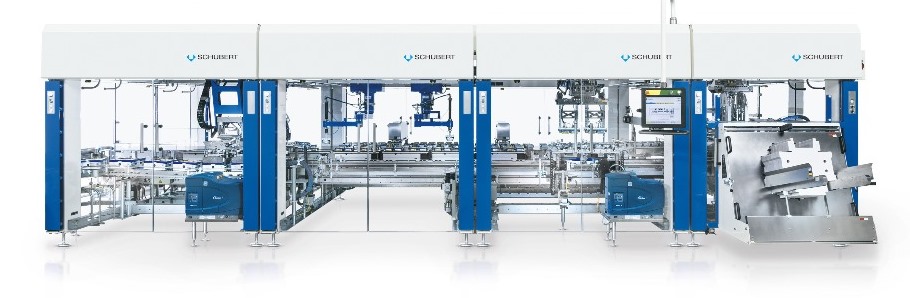
Another special feature of the machine is its integrated buffer, which performs a storage function for surplus butter cups. If the mixing ratio is not correct because the upstream filling machine rejects individual tubs and consequently delivers too few tubs of one type to the packaging machine, the pick-and-place robot places the excess tubs in a buffer. At the same time, it sends a signal to the upstream filling machine so that it controls the filling process in such a way that the Production ratio corrected becomes. The robot then accesses the cups waiting in the buffer accordingly.
Despite fluctuations in production, the correct ratio of salted and unsalted butter per pack can be maintained at all times. Synchronisation between the machines and components is made possible by the open VMS control architecture. The two-axis, three-axis and four-axis robots as well as the scanner of the Schubert system communicate in the same programming language and are therefore compatible with each other.
„With systems from other packaging machine manufacturers, the robot, camera and peripherals are usually from different manufacturers,“ explains Kanellos Tzinieris, Area Sales Manager at Schubert. „If the customer needs service, in the worst case scenario they have to deal with all of these companies individually. Schubert offers the service for all modules from a single source.“
Wide range of variants
There are no limits not only to the mixing ratios, but also to the cup shapes: they range from round to produced Meggle cups with a content of 125 grams or 250 grams. The system can pack up to 200 butter cups per minute and has an efficiency of over 97 per cent.
Meggle is very satisfied with the result: „From the construction of the robots to the simple format change, from the Buffer function to the open VMS control architecture this machine is clearly superior to competitors“ offerings,„ says Holger Kühner, Technical Manager at Meggle. “The machine has now also proven itself in our day-to-day production. Schubert has exceeded our expectations in many respects."