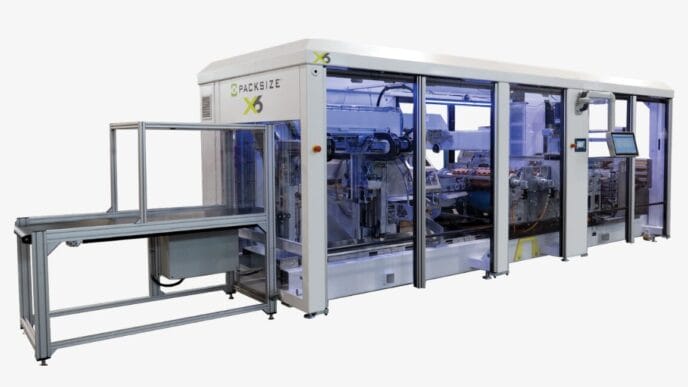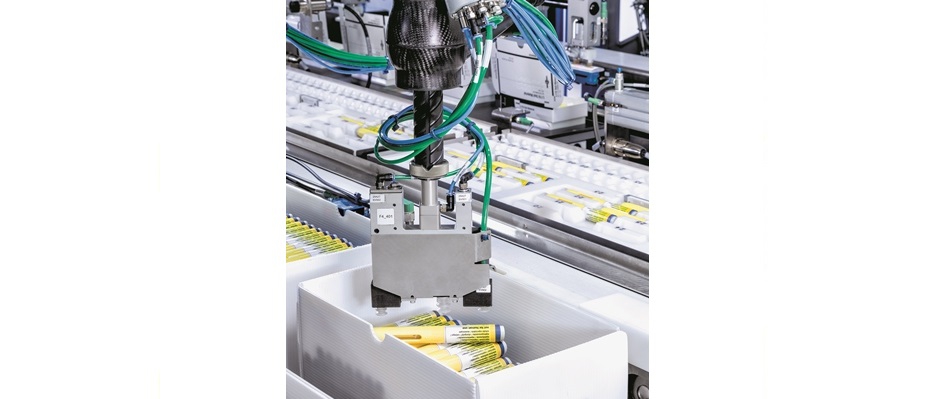
Gerhard Schubert GmbH has developed a new 3D camera based on its tried-and-tested 3D scanner, which reliably picks up even disorganised products from the crate by precisely determining their position. Whether unsorted, out of place or stacked - with the new 3D image recognition system, fed products are precisely recognised and accurately picked up by the robot tool.
With the new camera, Schubert not only impresses in terms of precision, but also further increases the efficiency of pick-and-place applications and the degree of automation in secondary packaging. The Schubert 3D camera complements the portfolio of Schubert vision systems specifically for Pick-and-place applications. Each time the robot reaches in, the working area is recorded using the 3D camera and the position and orientation of the next product to be picked up is calculated. The current position data enables the robot to pick up the product with pinpoint accuracy, even if the products have slipped or are stacked on top of each other.
Similar to the Schubert 3D scanner, the technology of the new camera is based on the Stereo approachTwo high-resolution surface sensors and integrated LED lighting ensure that grey-scale images are captured at two different angles (stereoscopy). In addition, a coded light pattern is also used here to emphasise low-structure surfaces of the 3D objects.

Individually customisable parameters
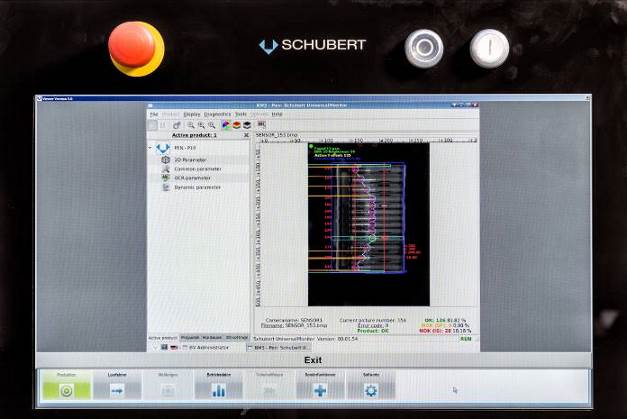
The image data and the evaluation are visualised on the operator terminal. Both the grey scale images and the height profile of the 3D objects are used for this purpose. Each product to be detected is characterised with a corresponding parameter set, which can be accessed by the system operator via an associated menu. Type and number of Parameters are application-dependent and can be customised. Depending on the task, they are defined in advance and stored in the control system. Therefore, no settings or new adjustments are necessary during operation. The operator terminal provides the machine operator with information on object type, rotational position, surface analysis, the height profile on the surface, quality features relating to surface and height, etc.
During the development of the 3D camera, particular emphasis was placed on ensuring that the hardware and software components are as identical as possible to those of the Schubert 3D scanner. Thanks to its user-friendliness and seamless integration into the TLM packaging system, the new development is in line with Schubert's philosophy of modular system technology „from a single mould“.
„By using the latest hardware and optimised, high-performance image processing software, we have now been able to take a decisive step towards our long-held goal of optical 3D recognition,“ explains Dr Abdelmalek Nasraoui, Head of Image Processing Development at Schubert.
Universal use
The aim of ongoing developments is to equip the 3D camera for universal use in different sectors and applications. All sectors of the manufacturing industry can Benefit from 3D recognitionThe elimination of complex sorting and separating systems as far as possible thanks to intelligent „reach into the box“, height control based on qualitative assessment of the products, optimisation of resources thanks to controlled masses and volumes, high flexibility and fast changeover of production as well as protection of downstream process components from malfunctions caused by products outside the tolerances are just some of the promising fields of application for Schubert's 3D recognition.