The systematic insertion of coffee cream portion packs using Schubert packaging machines allows the space in end-of-line packaging to be optimally utilised. This goes hand in hand with significantly reduced packaging, transport and storage costs.
Portion packs ensure that the contents of sensitive foods are available fresh and as required. These practical packaging formats however, require the most efficient production processes possible in order to be able to offer the portions at market prices. One of the largest producers of portioned coffee creamers in Europe also wanted to organise its production more efficiently: Interesting optimisation opportunities arose here, particularly in the final packaging.
Space is money
The manufacturer's Portion packs previously poured into boxes for despatch. That was quick and didn't require much effort. The downside became obvious when looking into the boxes: a lot of space remained unused. With such a large quantity of products, this added up to unnecessary costs. If the individual cartons contain fewer products than possible, this continues across the pallet right through to the entire warehouse. Overall, this leads to considerable higher storage, transport and packaging costs. When Schubert first suggested to the dairy customer's plant manager during a consultation that the organised insertion of the cups was an alternative to pouring, he was initially critical. However, when he heard about the potential savings, he immediately reached for his pocket calculator and the decision in favour of a Schubert machine was made.

Different formats efficiently packaged
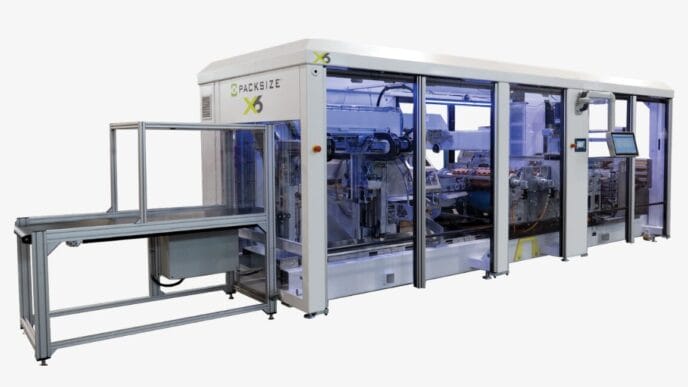
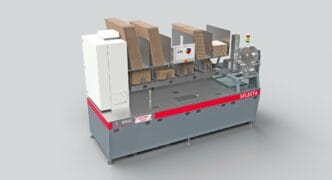
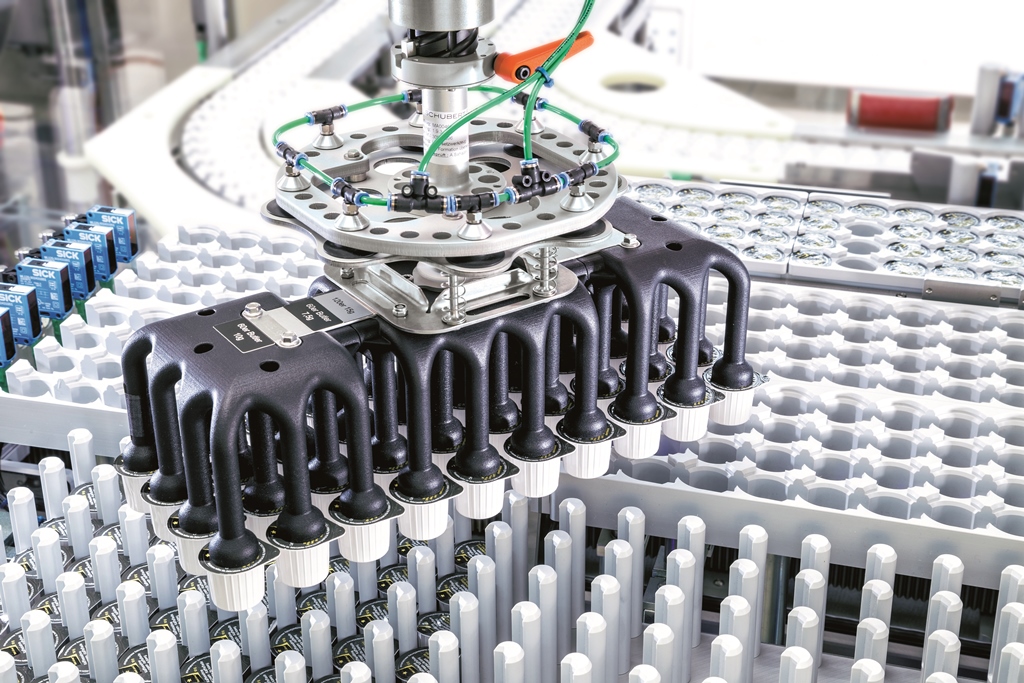
With the new TLM system, consisting of seven modules and equipped with five F2 robots, one F4 robot and two transmodule lines, the portion packs are now stacked in layers in the cartons. The project had to be realised, Different heights and weights of the portion packs must be taken into account when setting the format.
The individual portion packs are fed into the system by the pre-machine. by means of a cycle chain fed. In the first sub-machine, an F2 robot removes the portion packs from the cycle chain in groups of 16 rows of ten cups each and places them on the format plates of the transmodule. This rail-based transport robot then transports them onwards for grouping by an F2 robot with a changeable format mould.
The robot then picks up groups of 8 x 5 or 4 x 5 portion packs according to the respective specifications and places them in layers of three, six or eight in the final packaging. The capsules are orientated and inserted in shingled form, whereby the orientation of the capsules is already determined by the pre-machine. The flat carton blanks are unstacked from the magazine using a TLM-F3 robot and presented for transfer.
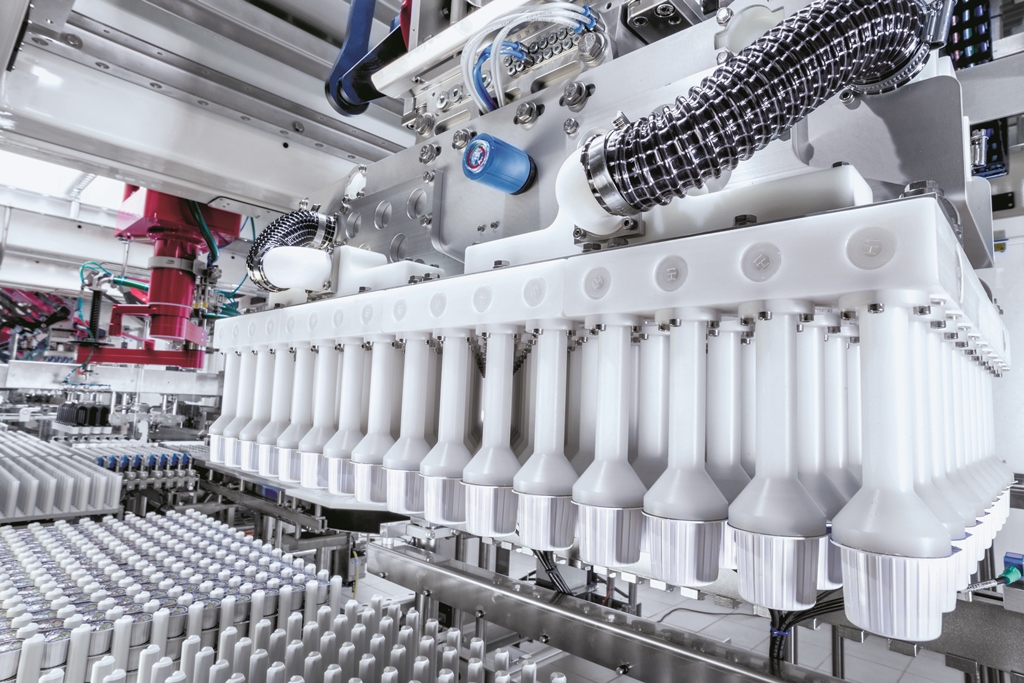
[infotext icon]The robot tools were specially manufactured for use at the customer's premises. In combination with the Transmodul, they enable a hand-in-hand transfer: once a product has been gripped, it is not released until it is placed in the carton[/infotext].An F2 robot takes the blank, guides it past glue nozzles in a defined movement, presses it through a folding frame and places the erected carton on a prepared transfer module. Vacuum suction cups on the format plates ensure that the cartons are held securely during transport to the filling station. Another F2 robot closes the cartons in the last sub-machine and passes two cartons per work step to the weighing belt, which checks whether a cup is missing. If the Correct weight of the carton is promoted to Elevator.
Significant improvements
It was important for the dairy company that the machine had an infeed and outfeed station so that cups for Quality controls can be removed from the overall system and then reinserted. For this purpose, the TLM system is equipped with an additional conveyor belt that can be used to manually feed portion cups into the ongoing packaging process. An F4 pick-and-place robot takes these groups and then places them on the transport carriage of the transmodule line before they are fed to the final packaging. In total, the system loads 15 different cardboard formats with 60, 120, 240, 320 or 360 packs per carton and with portion packs containing 5 to 15 g. Depending on the content, the system can handle five to 28 cartons per minute, with a constant output of 1,600 cups per minute.
The economic advantages due to the efficient arrangement are expressed in clear figures for the customer. As the company can now use smaller boxes, there is space for around 35 per cent more boxes on a pallet and the customer has been able to reduce its packaging material requirements by 17 per cent. As a result, the company needs up to a third less storage capacity for the same amount of product.