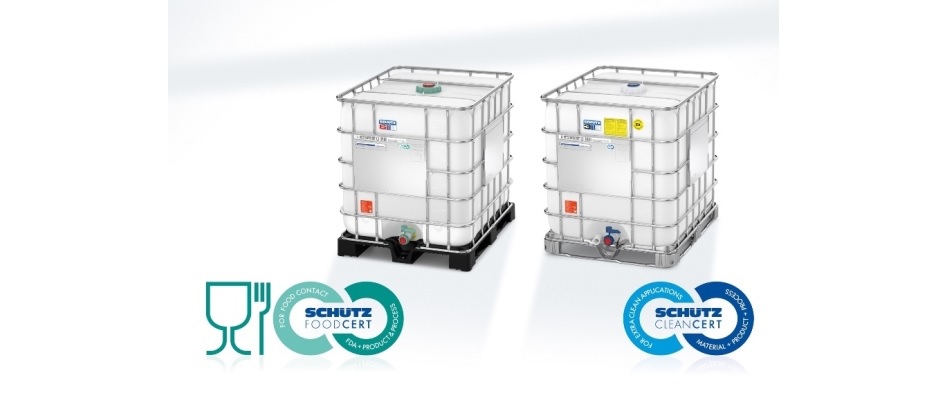
The products of Schütz GmbH & Co. KGaA, Selters, stand for maximum safety, globally standardised quality and sustainability. The company regularly presents special innovations at important trade fairs. Current examples include the Foodcert line, the Ecobulk HX, the Impeller and, at FachPack 2016, the Recobulk. How do these innovations perform in practice?
The Schütz Packaging Systems division combines all activities related to the development and production of IBCs (Intermediate Bulk Containers), plastic and steel drums under one roof. The overall concept for packaging and transport also includes the environmentally friendly Schütz Ticket Service for the collection and reconditioning of emptied containers.
We have Veit Enders, Business Unit Manager EMEA at Schütz, on market developments and the response to the current packaging solutions.

pj: Mr Enders, with the Ecobulk, Schütz has developed the world's most widely used IBC system. What advantages are decisive for this success story?
Veit Enders: The modular design is the basis for global success. Depending on the filling product and requirements within the supply chain, the individual components of the container can be customised: from the pallet to the inner container to the fittings. Various accessories such as the Contactor impeller, The range of applications has been extended by the addition of a disposable stirrer for highly viscous media. Another advantage is the reusability, which is made possible by the modular design. We collect emptied containers around the globe through the Schütz ticket service and put them back into circulation reconditioned with replaced original parts.
The removed plastic components are internally recycled and flow completely back into the cycle, for example as IBC plastic pallets. Production and recycling take place worldwide in compliance with the highest standardised environmental and safety standards as well as quality management specifications. Our packaging can therefore be used globally and is one hundred per cent compatible. This is precisely what is crucial for our customers. Due to increasing globalisation, some of them ultimately serve numerous markets on all continents via widely ramified, complex supply chains.
pj: Where is the Ecobulk used?
Veit Enders: Constant further development contributes to Specialisation of the Ecobulk and make it particularly attractive for a wide range of industries, from food, pharmaceuticals, cosmetics, chemicals, paints and coatings to automotive. For example, the Ecobulk HX is ideal for the high-quality, viscous paints required in the automotive industry. The conical shape of the container with its sloping base, closed, dimensionally stable support cushion, optimised discharge geometry and low-set fitting enables the container to be used even with highly viscous products. Residual emptying of less than 0.3 litres.

A still relatively new area of application, at least in Europe, is the use for Wine ageing. A successful series of tests carried out together with the Australian Wine Research Institute and a local winery has shown that our Ecobulk MX - equipped with an EVOH barrier layer as permeation protection - is not only very suitable for transporting and storing wine, but also for maturing it in premium quality. In contrast to the food industry, however, the use of IBCs in the numerous wine-growing regions around the world is still in the starting blocks.
pj: What is the overall concept behind the new Recobulk brand name?
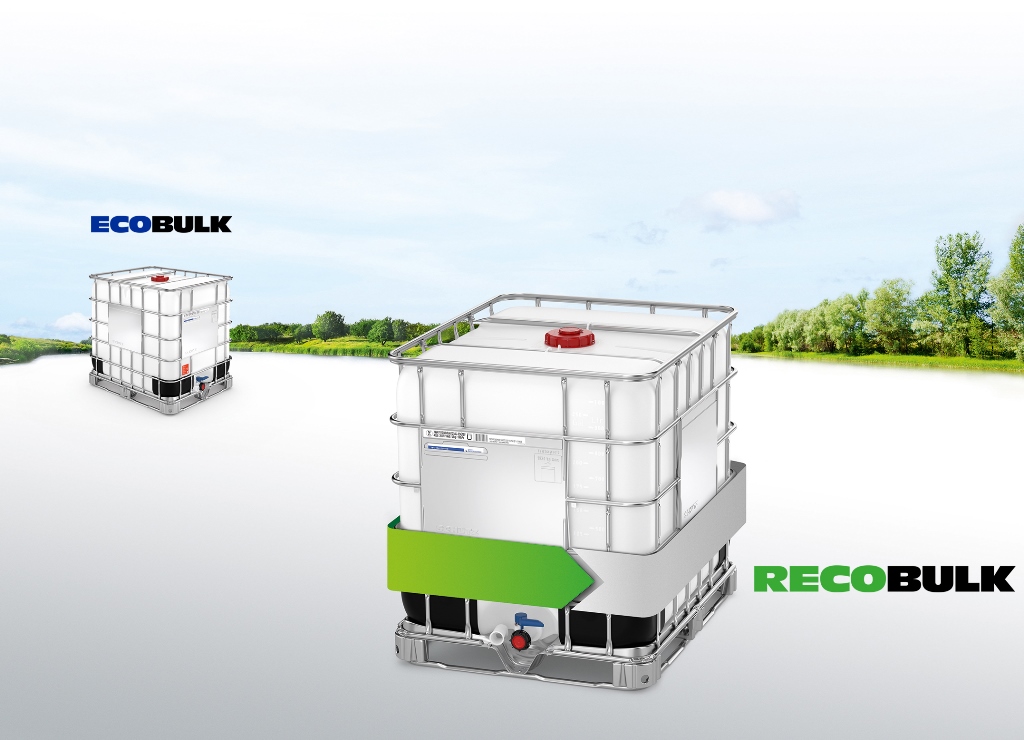
Veit Enders: Ecobulk has stood for outstanding quality, product performance and reliability in newly produced IBCs for decades. We have developed our reconditioned IBCs We have consistently optimised our Reko standard in recent years so that we can now also guarantee a globally uniform standard for this packaging. With Recobulk, Schütz has given this Reko standard an independent brand name. This means for our customers: Regardless of whether they use an Ecobulk or Recobulk - even in a mix - they always benefit from the identical original quality and maximum safety without any restrictions, including UN approval. This is because both products have the same specifications and are therefore One hundred per cent compatible.
pj: What has been the response from customers and interested parties so far?
Veit Enders: Very positive! Our customers can understand the advantages in terms of flexibility, reliability and sustainability. This system also supports them in improving their own Eco-balance and therefore also in the documentation and communication of sustainability in their companies. After all, each of the reconditioned IBCs saves around 100 kg of CO2 emissions during production compared to a new IBC.
pj: Your company has implemented extensive preventative measures and also offers a premium standard for food packaging that is certified in accordance with FSSC 22000. It not only stands for full material conformity, but also provides the necessary safety in terms of production processes and product properties. Has the Foodcert IBC been able to establish itself in practice?
Veit Enders: Absolutely! In recent years, the legal requirements for food transport packaging have been drastically increased worldwide. It is definitely no longer sufficient to focus solely on material compatibility. The global big players in the food sector have also greatly increased their own requirements, in some cases far beyond the legal requirements. Even after the Industry standard FSSC 22000 certified and also require the correspondingly certified packaging for their products.
We fulfil this need with our Foodcert IBCs and drums. They are not only compliant with all legal guidelines, but also take into account additional factors to minimise risk. After all, transport and storage packaging can influence and ultimately maintain or even improve the quality, shelf life and safety of foodstuffs throughout the entire supply chain. Our customers and their customers do not want to take any risks in this respect and can rely on our high standards.
During the market launch, we were often asked why customers should now use this new product. This also applied to Cleancert, the alternative line for Highly sensitive products industrial application. In the meantime, the technical and legal requirements of the markets have become so stringent that this question no longer even arises for most customers.
pj: What results for the company have you just brought back from FachPack?
Veit Enders: In addition to our standard packaging, which we are of course constantly optimising, our customers focus on specialisation in connection with their own products. The range of filling goods is constantly growing, which means that the requirements for their packaging are also constantly increasing. This is why topics such as Complete traceability In addition to the material basis and individual components, purity, cleanliness, permeation and oxygen barriers, conformity and usability are playing an increasingly important role. We consistently orientate ourselves on this when developing new packaging or individual components.
pj: Schütz is always setting trends. How does the market influence your current projects?
Veit EndersOur customers expect us to recognise developments in the market at an early stage, help shape them and offer convincing solutions. Our Foodcert line is a fitting example. A DLG study from last year, for example, shows that consumers who focus on transparency and background knowledge about food also have an increased need for safety.
Of course, producers also have to react to this. With the FSSC certification packaging meets these expectations of consumers and manufacturers. The successive auditing of our plants worldwide took two years. However, we have not rested on our laurels. With the new Premium packaging we have developed our own standard that even exceeds the requirements of this industry standard.
pj: The time until the next industry highlight is only short: What can your customers expect at interpack 2017?
Veit Enders: Further highlights for effective applications in everyday use. We are working on projects that are even more specialised according to the individual requirements and suggestions of our customers, which we continuously identify. It goes without saying that Schütz will be attending the world's leading trade fair for the entire packaging industry with numerous innovations, as always. We are already looking forward to this trade fair!