
Sustainable sealing and labelling of fruit and vegetable trays

In addition to full wrap labelling, Multivac Marking & Inspection now offers two further sustainable labelling solutions for fruit and vegetable trays: top wrap and top close labelling.

Today, fruit and vegetables need to be packaged and labelled sustainably and be particularly safe. In addition to full wrap labelling, Multivac Marking & Inspection now offers two further sustainable labelling solutions for fresh produce trays: top wrap and top close labelling.

In Germany, around 60 per cent of fresh fruit and vegetables sold in shops are packaged. Two thirds of this packaging is made of plastic, while one third is made of paper, cardboard and paperboard. Plastic packaging in particular is criticised - but wrongly so. This is because packaging protects food along the process chain. It preserves freshness and an appetising appearance. It extends shelf life and thus significantly prevents food loss due to premature spoilage. And the latest studies show: The ecological footprint of processed food is usually up to 30 times higher than the footprint of its packaging. In Germany, their share in the food segment is just one to three per cent.

Nevertheless, every gram of packaging material that is saved helps the environment. Just like every conventional packaging material that is replaced by a material-efficient and recyclable solution. With its full-wrap labelling, the Multivac already has a solution for optimising packaging and labelling concepts in its portfolio. Just in time for FachPack 2022, two further concepts for sealing and labelling fruit and vegetable trays are now available in the form of top wrap and top close labelling.

Multivac top close
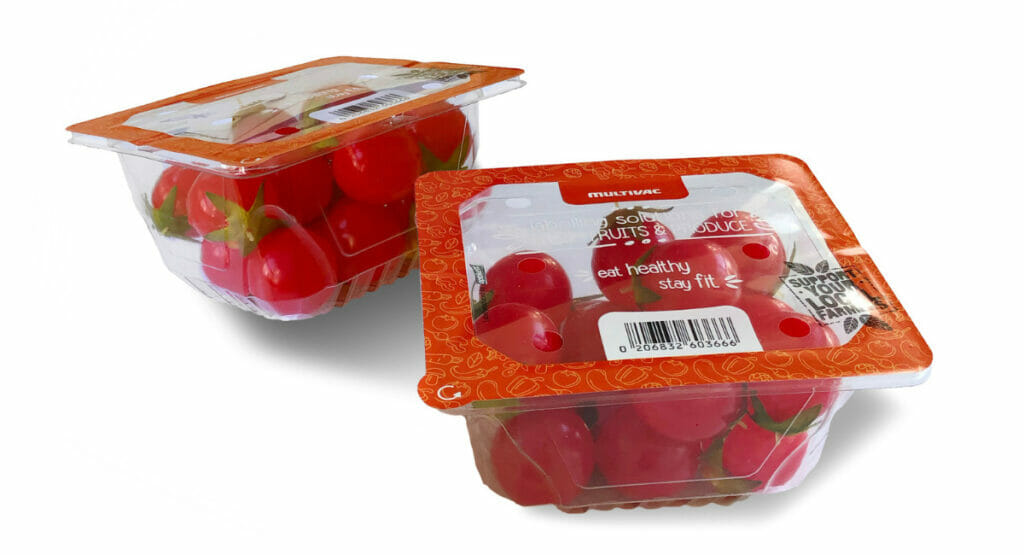
Top close labelling closes the tray with a label from above. (Image: Multivac)

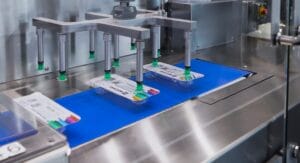
Whereas with top wrap labelling, a label is applied from above and over both sides of the tray, the top close labelling closes the tray with a label from above. Both concepts are an ideal choice for all fresh products that do not require modified atmosphere or airtight vacuum packaging. This means that trays can be sealed with labels and labelled at the same time.

Display

What both labelling solutions also have in common is that they provide the attractive label and recyclable packaging for strong incentives to buy.

The Self-adhesive labels on carrier material not only offer plenty of space for customer information and marketing - They also open up a wide range of product presentation options in terms of material thickness and shape. Punch-outs are possible, as are adhesive-free zones to prevent contact with the product. Perforations serve as opening aids and make handling easier for the consumer.

Multivac Full Wrap
Full wrap labelling for closing and labelling fruit and vegetable trays. (Image: Multivac)

With top wrap labelling, the label ensures that the contents cannot fall out of the tray or be removed by the customer. In contrast to full wrap labelling, however, it is not completely around the pack, but only up to the two side surfaces. This saves material and ultimately resources - and fulfils its purpose to the same extent.

"A combination of cardboard trays and standard self-adhesive labels made of paper or renewable raw materials also results in single-variety packaging that is optimally recyclable."

Michael Reffke, Product Manager for labelling technology at Multivac Marking & Inspection in Enger

Top wrap labelling is also Polypropylene film labels can also be used. The PP labels offer the great advantage that a transparent window in the upper area of the tray provides an optimum view of the product. This is because the backing material is not removed in this area and the tray contents remain protected from contact with the labelling adhesive. According to Michael Reffke, "the Depending on the label material, the proportion of plastic in such packaging is less than 10 per cent. In addition, the label can be easily removed so that the consumer can easily separate the materials for different recycling channels."

No contact with the food

With top close labelling, plastic or cardboard trays with a wide edge or even round trays can be closed easily and securely from above and labelled at the same time. The label only sticks to the edge of the tray. An adhesive-free zone or keeping the backing paper in the centre of the label ensures that the product does not come into contact with the adhesive. Transparent labels also allow an optimum view of the product, while ventilation holes ensure air circulation. In addition, the label can be printed directly on the labeller, for example with a best-before date, and the print can be checked.

With a With an output of up to 200 products per minute, top close labelling is particularly efficient. Labelling takes place automatically in a continuous flow, whereby the trays can be fed manually or taken from an upstream module. Compared to complex manual packaging solutions, this ensures noticeable cost savings and an efficient process.

With the powerful conveyor belt labellers such as the L310 FW or the L 312 FW presented for the first time at Anuga FoodTec 2022 With price labellers, various solutions can be implemented depending on the type and content of the tray and the packaging materials used. The models can be seamlessly integrated into packaging lines or used as a stand-alone solution with manual product infeed.

Since Multivac Marking & Inspection current celebrates its 50th company anniversarycustomers who decide to purchase a conveyor belt labeller by the end of 2022 will receive an attractive birthday bonus.

Source: Multivac

Multivac - More news

Pet food sustainably packaged

The pet food industry is responding to the increasing demands of pet owners and is not only promoting healthy products, but is also switching to more sustainable, recyclable packaging.
Read more "

MULTIVAC Group reports stable turnover

The MULTIVAC Group reports a turnover of 1.5 billion euros and will be presenting new solutions for automated, digital and sustainable food packaging at IFFA 2025 - including investments in smart factories and AI technology.
Read more "