Securikett relies on UHF and NFC applications for product protection. The company's „VOID label for bottles with integrated NFC chip“ won the FINAT award in the security category in 2019.
16 October 2020
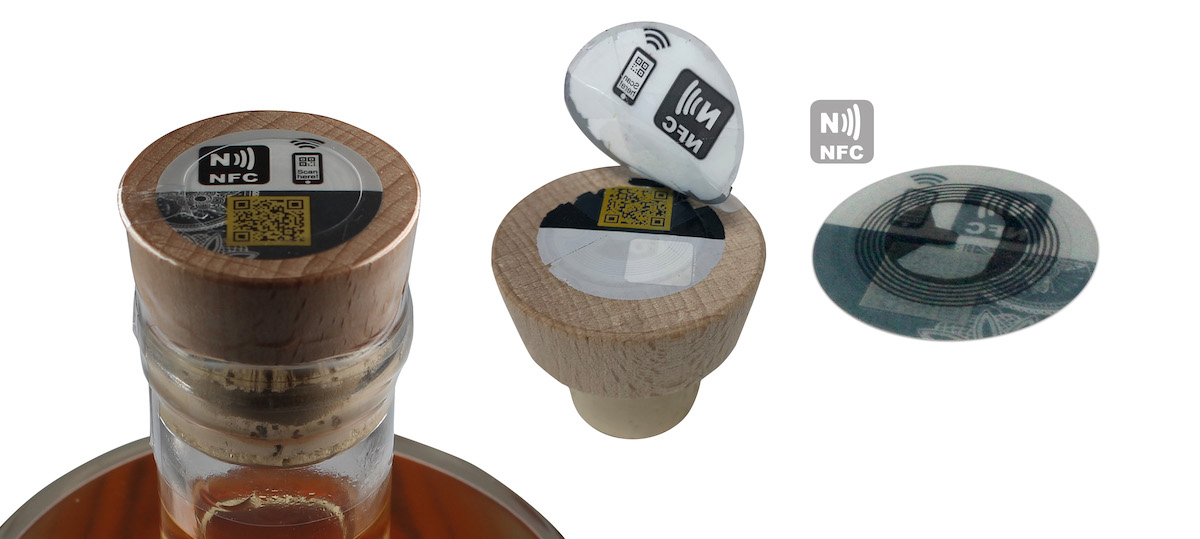
The award-winning „VOID label for bottles with integrated NFC chip“ (Image: Securikett)
Digitalisation has arrived in product and brand protection. IoT, the Internet of Things, has moved into the world of individual products and is no longer limited to the world of electronic products. With the help of unique codes, one-off combinations of letters and numbers that are either printed as QR codes or stored in an RFID chip (LF, HF, UHF), it is possible to identify products at item level. This enables digital communication with and between products.
RFID (Radio Frequency Identification) is a Automatic identification procedure, which enables contactless communication between a data carrier (transponder or TAG) and a reader.
Active transponders, The battery or power supply-operated sensors can transmit large amounts of data over distances of up to 100 metres (e.g. toll payment in lorries). The continuous power supply also makes it possible to record environmental parameters such as vibrations, air pressure or temperature (e.g. when monitoring the cold chain).
Passive transponder are only supplied with energy via the reader's electromagnetic field. They are completely maintenance-free and more cost-effective. Their range is usually ten millimetres to ten metres.
Display
RFID technologies are also categorised according to their range: Ultra High Frequency (UHF RFID), High Frequency (HF) and Low Frequency (LF). In common parlance, the terms NFC (HF-RFID: 13.56 MHz) and RFID (UHF-RFID: 860-960 MHz) are often used. (Pictures: Securikett)
UHF RFID and NFC in practice
In the case of UHF RFID, the electromagnetic waves Packaging made of plastic, wood or cardboard. As readers can receive signals from several transponders at the same time (bulk reading), passive RFID tags are primarily used for Improvement of logistics processes used.
With NFC (Near Field Communication), contactless communication is only possible over a distance of a few centimetres. NFC chips are used, for example, for access control and payments with credit or debit cards. With the help of smartphones, NFC applications also contribute to Improving customer communication and interaction with the user.
Securikett Ulrich & Horn GmbH, Münchendorf (Austria) is already using RFID technologies in the Product and brand protection one. RFID chips are integrated into a label and linked to the proprietary CODIKETT® code system.
The unique CODIKETT® codes enable consumers to authenticate products and fulfil their demand for Transparency about origin and originality to do it justice. He can access the information in real time via his smartphone.
Marriage of code and chip
The transition from QR code-reading to NFC-reading smartphones is in full swing. However, as not all smartphones have the NFC function yet, or the chip could be defective, Securikett also prints a QR code with identical code content on the label.
The system, which was installed in autumn 2018, first reads the content of the QR code, a unique code generated by the CODIKETT® system. The same content is then stored on the chip, the so-called Marriage of QR code and chip takes place.
During this process step, it is also possible to store the chip's unique serial number in the CODIKETT® code. As only one combination of the two is possible (match once), a Code cloning excluded.
If the CODIKETT® code is stored on the chip, it can also be protected in such a way that the chip can no longer be reprogrammed afterwards. Due to the software architecture, the Dynamic response pages, and all information can be changed at any time.
Tamper protection
To prevent the label and therefore the code from being transferred to another (counterfeit) product, a Proof of tampering of the label important. If the detached label and code were to be reused on a counterfeit product, the counterfeit would be mistaken for an original.
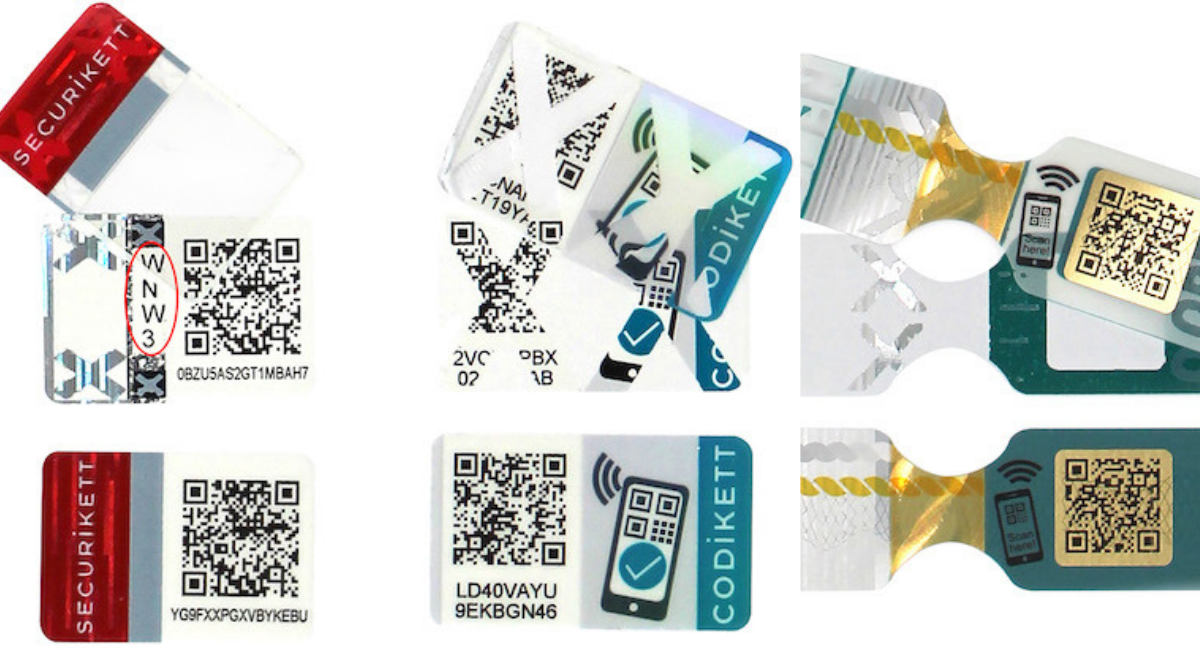
In a first step, Securikett prints VOID labels with a unique QR code. The proprietary VOID effect separates several layers of colour from each other when the label is peeled off, whereby a previously unrecognisable font or pattern appears.
A previously invisible PIN code can also be revealed. By entering the four-digit PIN codes On the response page, the system checks whether the overt and covert codes match. This means increased security, which at the same time appeals to the consumer's curiosity. [infotext]Thanks to tamper protection, it is not possible to remove an intact label without triggering the VOID effect. The code either remains on the product (left image), is destroyed (centre image) or is removed with the label (right image), depending on the requirements. (Images: RFID: Securikett) [/infotext]In the second step, the RFID chip is placed under the „AdhesiveVOID“ and then personalised. This means that the chip cannot be removed from a product without triggering the VOID effect on the label.
VOID label with NFC chip
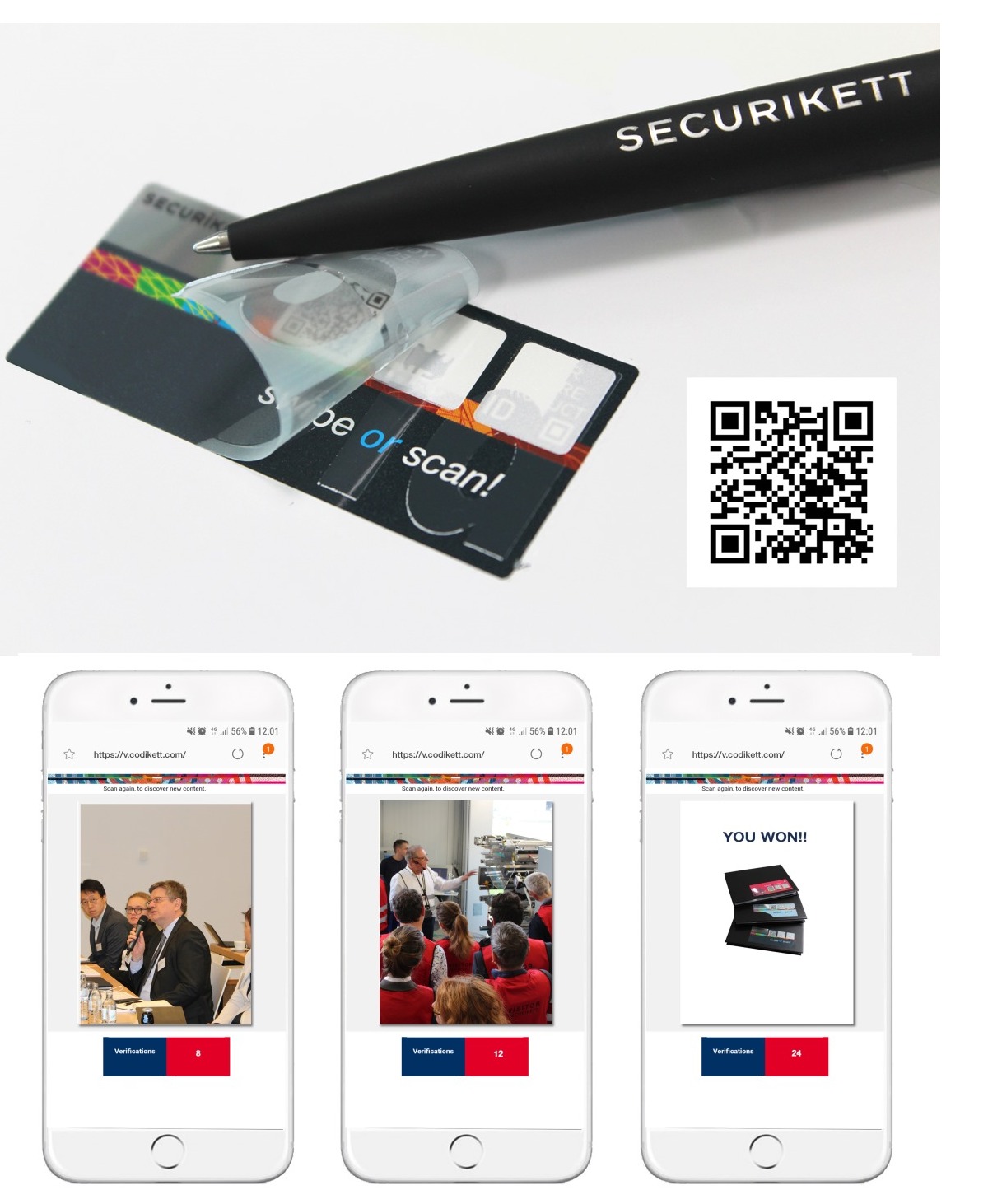
A VOID label with NFC chip was presented at the 3rd Forum Unique Codes, an event organised by Securikett®. international congress, on 23 May 2019, where experts, users, technology providers and other stakeholders were able to discuss the importance, benefits and security of unique codes and their storage media such as RFID chips.
These VOID labels with an integrated NFC chip were presented at the 3rd Forum Unique Codes on 23 May 2019. The dynamics and interactivity of the code could be tested live as a user experience. Photos of the event could be accessed a few minutes later on the response page. The image changes with every scan. A prize was also hidden among the numerous images. (Pictures: Securikett)
The right chip must be selected depending on the application and the associated requirements. The possible risks are compared with the hoped-for benefits (Benefit-cost analysis).
Pilot projects for the beverage industry
Securikett is currently working with a major beverage manufacturer on a NFC pilot project for the Asian market. The brand manufacturer already uses the company's security labels. The proof of first opening is intended to prevent counterfeiters from collecting empty bottles in order to refill them with counterfeit alcohol.
Jose Tojo, Project Manager at Securikett (Image: RFID Securikett)
„It is important to the customer to be an innovative company on the market and to constantly improve solutions. We have been working closely with the customer for years in order to constantly improve the Counterfeit protection and customer communication to increase security. Multiple codes (concealed and visible) not only increase security, but are also successfully used for various end customer activities such as more secure authentication, competitions or bonus programmes thanks to PIN code entry,“ emphasises Jose Tojo, project manager at Securikett.
Another project, also for the beverage industry, is currently underway. The aim is, Simplify logistics processes thanks to UHF RFID. The empty bottles are collected from bars and restaurants in return for a deposit, also to avoid refilling. Thanks to the unique code on each bottle, the brand manufacturer can check whether the bottles are their own.
A UHF RFID chip is now to be integrated into the label so that an entire carton can be scanned at once. It takes considerably less effort to logistically record how many bottles of which type are in the carton.
Securikett is not only working on pilot projects in Asia to get its customers' refill problem under control. A bottle label originally made from paper is converted into a Tamper-proof security label converted.
In a first step, this was replaced by a label with a VOID effect, whereby the original look had to be retained exactly. Recently, an NFC chip with tamper function was also installed. When the bottle is opened, the tamper loop is interrupted. The chip therefore recognises that the bottle has already been opened or tampered with and sends other information.
FINAT Prize 2019, winner in the security category: „VOID label for bottles with integrated NFC chip“ (Image: Securikett).
Development honoured internationally
The innovative integration of RFID technologies in the labelling sector was recognised at the FINAT awards ceremony in Copenhagen on 5 June 2019. The „VOID label for bottles with integrated NFC chip“ from Securikett won the Award for the best security label, and the company was once again able to demonstrate its market leadership.