In addition to the protective function, product information and brand message, a good pharmaceutical packaging solution must ensure that the contents are easy to remove and that the packaging can be easily resealed and reopened. Children must also be protected from accidentally ingesting the contents.
20. June 2018
Less force is required for simultaneous pushing and tilting than for other movement sequences or combinations. Image: Sanner
A good pharmaceutical packaging solution must fulfil many requirements: In addition to the protective function, product information and brand message, it must ensure that the contents are easy to remove and that the packaging can be easily resealed and reopened. Children must also be protected from accidentally ingesting the contents.
Children often show unsuspected skill when it comes to getting at the contents of pharmaceutical packaging. On the one hand, some packaging looks like sweets. Secondly, many tablets and pills taste quite sweet in the first few seconds. However, this childish thirst for action and knowledge can have serious consequences. Particularly at risk are Infants, who get to know their environment by touching, sucking and chewing. Between the ages of just under one year and around four and a half, they are most likely to put things in their mouths or even swallow them when exploring.
Child-resistant packaging
Accordingly, child-resistant packaging (CR packaging) is required to minimise this risk as far as possible. This is because a certain trick must be known in order to open such packaging. This is difficult for most young children to learn. For example, a three-year-old child is unlikely to be able to easily figure out how to open a package whose closure must also be tilted when it is pressed open.
At the same time, it is important not to make access excessively difficult for patients who are dependent on medicines. Therefore, child-resistant packaging must always be designed according to the motto „As easy to open as possible, as difficult as necessary“ also be designed to be senior-friendly.
Display
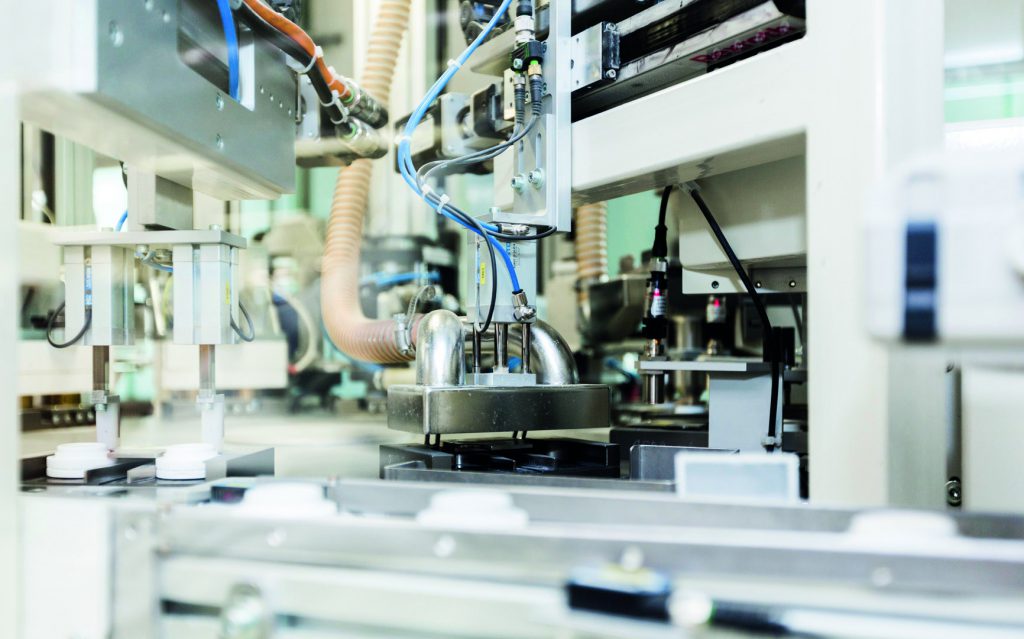
The production of CR closures also includes an established quality management system. (Image: Sanner)
Different international regulations
The use of CR packaging is already mandatory for many products that pose a health risk to young children under national and international legislation - although not on a standardised basis everywhere. This applies in particular to pharmaceutical products.
The USA is playing a pioneering role here: As early as 1970, the „Poison Prevention Packaging Act“ (PPPA) due to the increasing number of poisonings caused by toxic chemicals in the home. The regulation US 16 CFR § 1700.20 defines standardised rules for hazardous chemical-technical and pharmaceutical products. In addition, the regulation specifies which requirements apply to child-resistant packaging and which tests must be carried out.
The test standards and norms of the European Union are similar to those of the USA in many respects, but are less comprehensive in the pharmaceutical sector. In Germany, on the other hand, the Medicinal Products Act (AMG) makes the use of child-resistant packaging mandatory. The Federal Institute for Drugs and Medical Devices maintains a list of active ingredients for medicinal products to be packaged in child-resistant packaging. Packaging for products containing these active ingredients must comply with ISO and DIN standards.
Small modifications, big effect
There is no doubt that CR packaging can save lives. That is why many medicine manufacturers are not waiting for cross-border regulations, but began actively looking for packaging solutions years ago.
But what do pharmaceutical companies focus on when choosing suitable packaging? It should Cost-efficient, user-friendly and childproof be. In order to fulfil all three criteria in the best possible way, it is advisable to work with a supplier who is able to develop an optimised result within the framework of the regulations, even with minor modifications, thanks to good packaging engineering.
Manufacturers of primary packaging with many years of experience are well versed in the subject matter and have defined clear processes. In addition to efficient project management, this also includes an established quality management system. During product development, a Stage-gate process ensures that the packaging fulfils all requirements through regular retests. Documentation and the associated reproducibility of CR features play an equally important role in this context. Once these basic requirements have been met by the partner, it is time to choose the specific CR solution.
Ursula Hahn, Sanner GmbH. Picture: Sanner
„A clear upper and lower limit for the required force should be defined early on in the development process. In this way, even relatively simple changes to medication packaging, such as the pressure points mentioned above, can ensure a high level of additional safety,“ explains Ursula Hahn, Head of Product Management at Sanner GmbH.
Combination of strength and cognitive components
Two aspects must be fulfilled: the purely „Mechanics“, i.e. force-based security and the cognitive component. On the one hand, a certain learning effect is required, for example if the fastener can only be opened by a certain sequence of movements. On the other hand, the required Power The packaging opening process plays an important role.
In addition to the push-twist variant, which is particularly popular in North America for large tablet packaging, there are numerous other options for making the primary packaging child-resistant using a sequence or combination of movements. For example, less force is required when pressing and tilting at the same time. This in turn makes the packaging more user-friendly for adult consumers, especially senior citizens.
The premise of „as easy to open as possible, as difficult to open as necessary“ comes into play here once again: two pressure points worked into the clasp, for example, allow adults to open it easily and relatively self-explanatory. As desired, children find it much more difficult here, especially as the pressing movement is followed by an additional tilting movement.
In recent years, a number of corresponding solutions have been developed and launched on the market. These not only show how important child-resistant packaging is. They also illustrate that safety and user-friendliness can still be easily combined.