We decide quickly. Very quickly. It only takes a few seconds from visual perception to deciding how something appeals to us. This is taken into account when developing and creating a packaging design.
At least it should, because the packaging also acts as a brand ambassador. And please do this as successfully as possible and, in digital times, via All sales channels across the board, i.e. in both bricks-and-mortar retail and e-commerce. However, this raises the question of whether the packaging requirements for online shops are different to those on supermarket shelves and which differentiated possibilities of packaging development could result from the different distribution channels.
Multi-sensory and „unboxing experience“
Sensory experience through touch or smell is naturally absent in the digital environment. Multi-sensory product packaging therefore scores much better in the „real“ world. Online shops also often use the primary packaging material and not the outer packaging familiar from the trade. Here the Recognisability of the brand be guaranteed.

But at the same time, potential can be tapped, because in which outer packaging and with which Unpacking experience, The „unboxing experience“, i.e. when the consumer finally holds their product in their hands, can be reimagined and redesigned here. And not just in terms of the materials used, but also in relation to other aspects. Formats and packaging sizes. At the same time, you should be aware that, depending on the chosen distribution partner, a company no longer necessarily has ultimate control over how its goods are dispatched.
Contact and communication
The environment for making contact with a product or brand is different in e-commerce. Products can be purchased without effort and loss of time with wFurther information in the desired font size and with an additional (moving) image be enriched. In bricks-and-mortar retail, tools such as QR codes or an app are (still) required. The term „Smart packaging“ stands for this change.
At the same time, however, the manufacturing company is no longer the only source of information for the consumer. Alternative sources, testimonials and product reviews can be called up in a matter of seconds. The Consumers are becoming more responsible.
But what does this mean for branding and brand management? Is it necessary to produce different, cost-intensive packaging for the various distribution channels? How can companies benefit from this development?

We discussed this with Arne Fehlhaber spoke. He has been a partner and managing director at the Hamburg-based creative agency Brandpack since 2018, where he is responsible for creation. In his opinion, the packaging industry has recognised that something needs to change.
pj: Mr Fehlhaber, even the fashion magazine Vogue addressed the question in 2018, How Instagram is changing the packaging of cosmetic products has. In your opinion, what significance does digital development with increasing e-commerce and the growing influence of social media actually have for packaging design?
In my experience, it is and remains crucial that a packaging design is strategically developed and designed to suit the brand and target group. Then it works across all channels. After all, both „worlds“ offer, display and distribute a product, so strictly speaking it is a „Shelf & Digital“. We don't have to put something in competition that is actually a valuable addition.
pj: So the visual recognition value remains decisive?
As consumers, we experience an approach to the product or brand both on the shelf and in the digital space. And it's best if the consumer doesn't have to rethink. So a resounding yes from my side. The biggest, partly still unused Potential in e-commerce I tend to see it elsewhere. It gets really interesting for the brands with the two points: Transport (to home) and storage (at home).
pj: What potential do you see here?
Reusable transport crates enable the use of less robust, but therefore also more resource-efficient materials and production processes. In addition Larger and transport-optimised units and formats possible. More goods and less air are moved. That brings us to the topic of sustainability. This also opens up new perspectives for consumers at home. Products can be stored better, can be used more „practically“ and may not need to be bought again as often.
pj: So you can play with the factors of packaging size, materials and storage? Do you have an example for us?
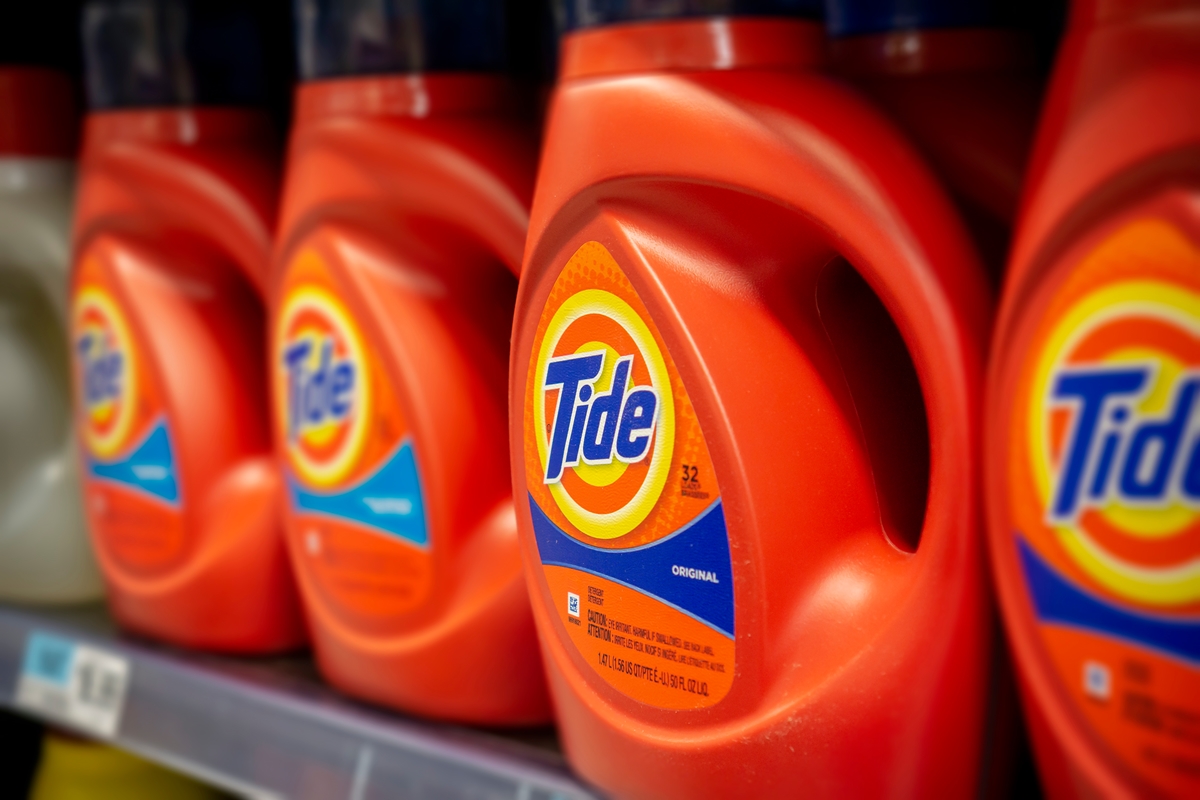
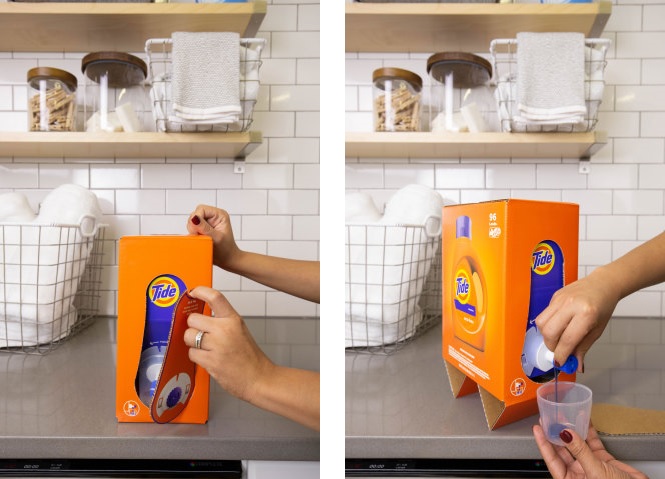
A good example is the Eco-Box for Tide liquid detergent: a bag-in-box solution with an integrated rotary tap. This also saves 60 per cent plastic. This example clearly shows the differences, but also the advantages. Possibilities of both channels on.
The robust plastic bottle with a customised shape and correspondingly bold design works in retail. The Eco-Box with a larger content and less (robust) packaging material is more efficient in the supply chain because it saves space and is ideal for use at home thanks to its convenient removal. However, this example also shows the need for overarching design language - Here, the plastic bottle was printed on the Eco-Box as a key visual for the brand - to ensure that the brand and the product are recognisable.
pj: In this context, what role does the Shelf-Impact, the visual impact of packaging on the shelf?
„Shelf impact“, one of the buzzwords in marketing offices around the world, is slowly being replaced by „unboxing experience“. So it's all about the moment and the experience of unpacking. Ancient early childhood emotions and joys (hopefully) come into play here. This also opens up new opportunities for us designers. We can work in a more subtle, refined and, in our eyes, also more appreciative way than simply through the momentum of the size and volume of the design.
pj: Branded companies such as Coca-Cola rely on personalised Coke bottles, Ferrero launches a promotional pack with „Your face on children's chocolate“. To what extent does this pay off at all, and will the individualisation of products or „production on demand“ play an even greater role?
Of course, digitalisation opens up many interesting new opportunities. And such campaigns are certainly not necessarily initiated purely on the basis of facts and figures. They can certainly involve special challenges at the logistical level. Ultimately, the decisive factor is the answer to the question: „What value do they bring to the brand?“ As consumers, we also need constants, constant things that we can rely on and orientate ourselves by.
Promotion, an entertaining way of breaking through these constants with the help of individualisation, works very well. It creates attention, can show a new facet of the brand or the product, in order to also make something of the Attitude of the brand - a level that is becoming increasingly important. The direct approach, „oh, the brand appeals to me personally“, can create sympathy and corresponding brand loyalty. However, the brand must then find its way back to its possibly slightly different constant.
pj: Speaking of brand value. What does the „empowered consumer“, who informs and exchanges information digitally, mean for brand management?
The time it takes to absorb information digitally is generally much longer - but therefore also more critical. And the opportunities for consumers to share their experiences with other consumers at the same time and thus scrutinise statements are many times greater. It is not only the consumer who is becoming more „transparent“ - the Less room for interpretation of the sender's statements and therefore also the room for error. Trust in the brand and product, painstakingly built up over years and decades, can now be reduced to rubble in no time at all. Is that a bad thing? No! In this case, the pressure to be honest can only be positive.
pj: You are a communications and graphic designer with over 15 years of agency experience, but of course you are also a private consumer. To what extent have digital possibilities changed the industry? And of course this question should not be left out: How do you see things developing in the future?
As in the vast majority of sectors, the speed - or „hectic pace“, as it were - has also increased in our industry. But here too, digitalised networking offers new opportunities. In this context, the term „phygital“, which describes the merging of the physical and digital worlds. The boundaries between shelf and digital will continue to blur.
The value of well-founded, holistic brand work with a clear message and attitude will continue to increase in this respect - and will hopefully also be recognised. For our clients, but also for us agencies, this will mean that we can and, above all, must work more closely together for this brand. This means that the different expertises (diversity) in order to get as complete a picture as possible, so that the different „trades“ can also develop towards a clear brand image.
[infotext icon]Brandpack is an owner-managed creative agency in Hamburg that specialises in brand development and packaging design as well as their technical feasibility. The strategic and content-related formulation of ideas determines the foundation of the project work. Designers, engineers and programme managers combine their commercial, creative and technical expertise to achieve strong and feasible results together with the client.