Shipping packaging of the future

What if the packaging of the future could heal itself? This is the futuristic vision of the innovation experts at DS Smith. 

The first corrugated cardboard packaging was produced 150 years ago. To mark this anniversary, DS Smith takes a look at the future of shipping packaging. What if packaging could heal itself? This is precisely the futuristic vision of the company's innovation experts. 

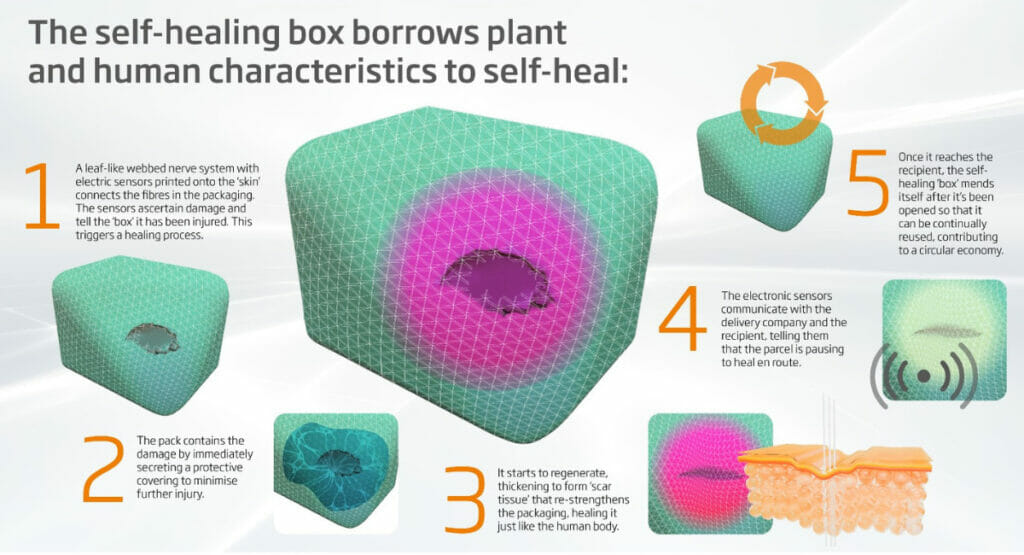
On the occasion of the 150th anniversary the corrugated board packaging, the innovation experts from DS Smith presents a futuristic concept of how packaging could develop over the next 50 years. The concept shows how packaging could be made from organic, programmable fibres that have the ability to heal themselves - like our skin, if it is damaged.

The features of the self-healing packaging include a woven nervous system that is orientated towards the texture of leavesSensors are printed on the „skin“ of the box and connect all the fibres in the packaging so that they can detect and report damage.

The packaging also has a Regenerative „scar tissue“: it heals itself Like the human body, the surface stretches and thickens to cover the injury and sends data to the delivery company and the recipient to communicate the current condition of sensitive freight. The packaging is also sustainable because it can be reused: After opening, the packaging has the option of resealing itself. This allows it to be reused and extends its service life.

Display

Graphic for packaging the future
(Image: DS Smith)

„There is already a trend for everyday objects that we use to act autonomously - self-driving cars are the obvious example. Packaging that heals itself so that it can be used again and again is of course a futuristic concept. However, we are already applying our circular design principles to avoid waste and recycle the fibres we use up to 25 times. We are therefore closer than we realise to a circular economy in which materials remain in use for much longer.“

Wim Wouters, Innovation Director at DS Smith

In addition to the concept for self-healing corrugated board packaging, the innovators at DS Smith also expect Developments in the areas of self-adapting packages and spray packaging

„I think that at some point we will see intelligent packaging that actually adapts its size independently to its contents, making optimum use of material and space. In addition to self-adapting packaging, spray-on packaging could also become a reality, even if this may still sound unrealistic from today's perspective. The reality is that corrugated cardboard packaging can already be high-performance items today. It is possible to develop them to be water and moisture resistant and antimicrobial and to track and trace them throughout their journey. The self-healing box is still a long way off, but we need to look to the future to find the next innovations that will help us use materials as sustainably as possible. We will only achieve this with fresh thinking and new ideas. We are already looking for partnerships to accelerate the journey to a circular economy and would love to hear from experts who can support us.“

Wim Wouters

The history of corrugated board

To mark the 150th anniversary of corrugated board packaging, DS Smith has produced a review of the development of corrugated board. It describes how it has over the centuries have made their way through society has. The retrospective honours past and present achievements in the race for innovative ideas.

  1. 1600: The first inspiration for corrugated board is born. The frilled collars from the fashion of the 16th century, centuries later, inspired inventors to corrugate paper in order to use it as corrugated cardboard.
  2. 1871: A first patent. In 1871, the American Albert L. Jones patents machines for manufacturing corrugated cardboard to package glass bottles and becomes the grandfather of the modern corrugated cardboard industry. He initiates the corrugated cardboard revolution that will lead to the development of the material as we know it today.
  3. 1886: Corrugated cardboard enters the world of brands. In 1886, the jeweller Tiffany & Co. introduces its Tiffany ring setting and develops the patented blue ring packaging. This becomes one of the most recognisable trademarks in history. For fans, the iconic packaging is still a highly coveted object today. However, it is only issued when the ring is purchased.
  4. 1939The Second World War begins and gas masks in corrugated cardboard packaging are issued throughout Great Britain. It is a legal requirement to carry them with you at all times. This sparks competition between schoolchildren as they make their own modifications to personalise their packaging.
  5. 2020Many countries are starting to roll out vaccines against the Covid-19 pandemic. The DS Smith team is helping to transport the first vaccines to hospitals and clinics in corrugated cardboard packaging in the UK and around the world.

Source: DS Smith

More news about corrugated board and paper packaging