In 2017, Weber Maschinenbau made the strategic decision to include packaging in its portfolio of solutions and thus position itself as a full-service provider. The aim is to offer customers the world's best complete solution for slicing and packaging.
20. June 2018
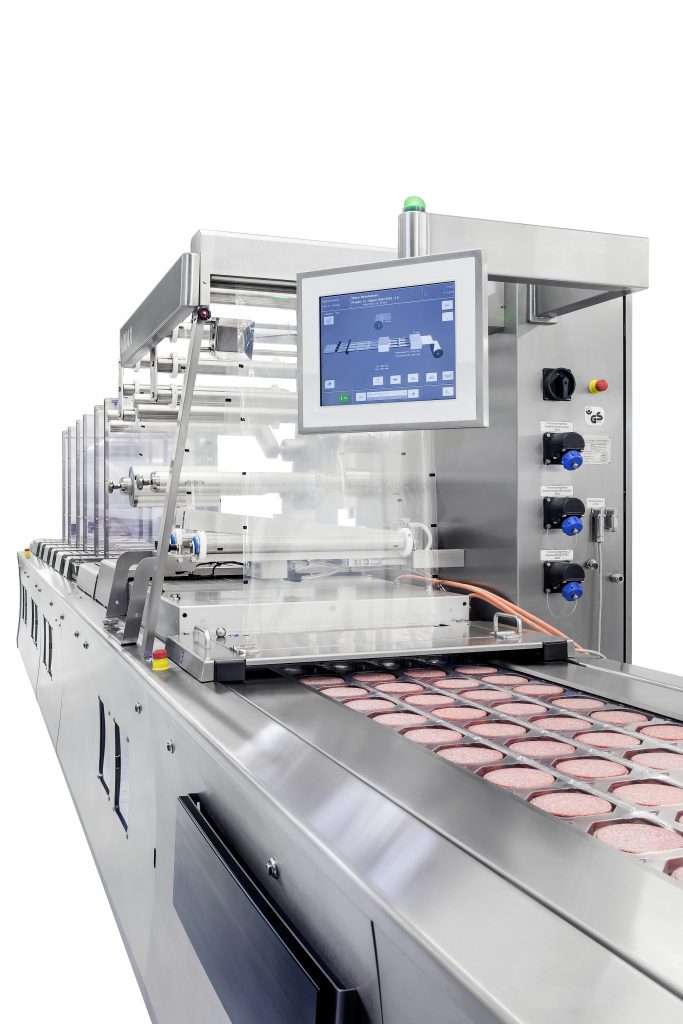
Standardised modules work within the frame of the VMAX thermoforming machine - individually combinable for customised production.
Picture: Weber Maschinenbau
The production lines used for industrial slicing and packaging of sliced meat must not only meet the highest hygiene standards, but also enable high throughput rates, fast product and format changes as well as short set-up and maintenance times. Weber Maschinenbau shows what an integrated production system looks like in practice.
Supposedly effective advertising terms such as „natural“, „authentic“ or „made from the best ingredients“ have lost all value in today's consumer behaviour. Studies by market research companies show that it is not the authenticity advertised on the packaging, but the genuine authenticity is what counts. Instead of explanatory slogans, it's about the convincing performance of visible technical quality, regionality and natural origin. If you want to buy good products in the supermarket, the real product benefits must be easily recognisable. Nature and technology are not a contradiction in terms.
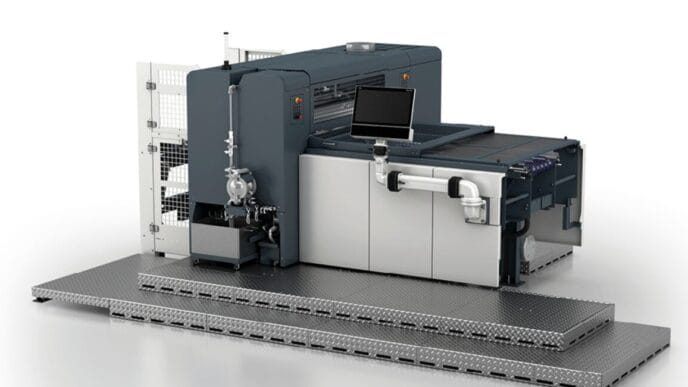
Weber Maschinenbau is now the point of contact for the entire slicing process chain. Picture: Weber Maschinenbau
Italian sausage and ham specialities finely sliced in mixed packaging are an apt example of this, and such packs can even be found in the refrigerated counters of discounters today. They want to get away from their cheap image and are therefore focussing more on Quality and regionality. This goal results in a combination of excellently processed products and packaging that emphasises precisely this demand for quality and taste.
Merging cutting and packaging
And just as the discount sector is becoming increasingly sophisticated, so too are the demands on the efficient processing of high-quality food into ready-to-sell packaging units. For good reason, Weber Maschinenbau launched the Strategic decision to also include the Packaging in the solution portfolio and thus position itself as a full-service provider. Weber's aim is to offer customers the world's best complete solution for slicing and packaging.
Display
Consistent linear architecture
Current business shows that large food processors and SMEs in particular are looking for integrated end-to-end solutions. One-stop shopping is the goal: with a single point of contact from processing and packaging to subsequent service. However, Weber does not simply want to follow this trend through vertical concentration, but through a genuine fusion of cutting and packaging. Implementing this technically and economically requires high-performance and, above all, fully automated high-tech solutions - with a consistent line architecture.
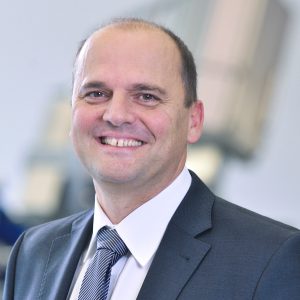
Michael Brandt (Image: Weber Maschinenbau)
„Weber has issued the strategy of merging slicing and packaging into integrated, fully automated solutions. In doing so, we are setting new standards for future-oriented slicing production“, summarises Michael Brandt, Head of Packaging Technology at Weber Maschinenbau, to the point.
This strategy becomes tangible when compared with mechatronics. The dissolution of boundaries and the holistic approach to a task to be solved have also brought noticeable synergies and improvements here for years, because mechanics, electronics and software are no longer viewed and developed separately from one another.
Dissolving boundaries means taking a close look at the interfaces that once separate areas naturally entail.
Best conditions for modularisation
The solutions of tomorrow are Complete automation, that do more and take up less space. To achieve this, interfaces that no longer exist need to be virtually redefined. The VMAX series thermoforming machines developed with the trend-setting segment concept offer the best prerequisites for this. The entire outer frame is divided into standardised modules with prepared mechanical interfaces. In addition, the three core areas Deep drawing, sealing and Cutting are designed as independent stations with their own control cabinet and decentralised electronics.
This paves the way for truly modular machine construction with maximum customisation options for lines to suit the customer's task, including the prevailing spatial conditions. This is associated with shorter commissioning times and the easy adaptation of existing systems to future products. This is supported by innovative automation solutions such as the Weber Shuttle System for the material flow of products within the line.
Simple standardisation
Another advantage of modular machine construction is that the individual modules can be standardised much more efficiently as a tried and tested series product and can therefore be produced more quickly. The possibility of pre-assembly in turn leads to faster delivery times and enables food processors to act more quickly in view of ever shorter product life cycles. Weber is now pursuing this strategy in the Overall network in the sense of a fully integrated and automated line for slicing, transporting, inserting and packing sliced products.
[infotext icon]The company will be demonstrating what such a complete solution can look like in practice at the Anuga FoodTec live on several lines for different areas of application. The Weber Slicer S6, for example, stands for high-performance slicing with numerous innovations such as the quadruple track-independent interleaver and new vacuum grippers. They halve the remaining end pieces of sausage and cheese and thus increase the product yield. The Slicer S6, in combination with a particularly compact infeed system and the VMAX thermoforming packaging machine, will show where the future of production lines in food processing is heading.