Companies can no longer afford to base their packaging decisions purely on costs or processes. Nowadays, they have to take into account many different effects on a product's recyclability, carbon footprint, supply chain transparency and market access. What is needed are solutions that fulfil growing ecological, technological and digital requirements - throughout the entire life cycle of a packaging.
Smart packaging is the strategic approach to these complex requirements: Packaging is designed from the outset to ensure product protection, to be resource-efficient and regulatory-compliant and to be recyclable at the end of its life cycle.
Smart packaging as a holistic lifecycle approach
Multivac, an innovative solution provider for food processing and packaging, sees smart packaging, one of its focus topics at interpack 2026 (Hall 5, Stand A23), as an end-to-end lifecycle approach - from the initial design decision to the recycling point. At the centre of the innovations and consulting services is always the question of how packaging systems can be developed in such a way that they combine ecological responsibility, industrial efficiency and digital transparency. The company brings together global expertise in product, material and machine technology: Through close cooperation with raw material and packaging material manufacturers, institutions and international partners, market and consumer trends as well as current regulations and developments in the end-of-life sector are incorporated. This enables Multivac to provide its customers with comprehensive advice and support in the design and realisation of the necessary packaging systems - all from a single source.

„The focus of our smart packaging approach is the circular economy: the use of recyclable packaging materials and a packaging design tailored to this are crucial to closing material cycles. Another element is the consistent reduction of materials. The use of raw materials can be significantly reduced through optimised packaging design, reduced film thickness and innovative forming and machine technologies - without compromising on product protection, process stability or line performance. This approach is complemented by digital features such as the digital product passport, which also makes sustainability traceable along the entire value chain.“
Marina Schedel, Project Manager at the Multivac Innovation Centre
Consultancy replaces later corrections
The course must be set early on for smart packaging. At Multivac, customer consultation therefore begins with comprehensive packaging advice - not as a supplementary service, but as an integral part of the development process. „The starting point is always the requirements of the customer and the product as well as current market, consumer and regulatory trends,“ explains Marina Schedel. „These include regulatory requirements from the PPWR, individual retailer style guides or specific sustainability goals such as recyclability and CO₂ reduction. The aim is to create a resilient packaging concept that can be optimally integrated into the recycling cycle. Based on this, we develop a customised packaging solution together with the customer in the second step.“
The next step is the realisation as a sample pack and testing under practical conditions. Aspects such as technical feasibility, product protection, functionality, appearance and machinability are checked here. This step makes it clear at an early stage whether the design, material and technology actually fit together.
„The importance of this conception phase cannot be emphasised enough, as the initial design decision influences the entire life cycle of a packaging. In an increasingly complex packaging world, mistakes or simplifications in early development phases - such as not carrying out in-depth market and sustainability analyses - often lead to higher follow-up costs, loss of time and costly reworking,“ explains Marina Schedel. Practical examples show the potential that early consultation can unfold: Switching from trays to flexible thermoformed packaging or from hard trays to foldable packaging enables material savings of over 80 per cent in some cases, without sacrificing product protection or presentation at the PoS.
Think packaging solutions in a closed loop
Once the packaging has been designed, the central question arises: how can it be realised as efficiently and recyclably as possible? The biggest challenge lies in combining sustainability, product protection, costs and design in one concept. Switching to sustainable materials - especially recyclable monomaterials or thinner films - brings its own challenges, as Marina Schedel explains: „Depending on the type of material, the shaping, sealing or cutting processes for the packaging must be adapted without compromising the barrier properties, look and feel.“
With its machines, Multivac offers a broad portfolio of solutions to address these challenges in a holistic and customised way. An optimised packaging design, for example an adapted shape at the corners and packaging base, can achieve the same stability and functionality as thicker materials. In addition, stabilising rib structures, for example, can significantly reduce the amount of material used. Down gauging - i.e. reducing the film thickness while maintaining the same packaging stability - makes it possible to find the minimum required material thickness that still fulfils all performance requirements.
Innovative moulding and heating technologies further enhance this effect: „With the help of the new pixelHEAT matrix heating system, thermoformed packaging can be produced with up to 50 per cent less material, lower energy consumption and significantly shorter heating times. In addition, the digitally and precisely controllable pixelSEAL contour sealing system ensures highly precise, tight and monitored sealing seams - even with recyclable films,“ says Marina Schedel.
Another approach is the moulding of thermoformed packaging with stamp support, which allows the production of complex, deep pack shapes while reducing the film thickness at the same time. The material is utilised efficiently thanks to a more even film thickness distribution, especially in the corners. The reduction of edge strips and the bars between the packaging also offers potential savings. „At first glance, a saving of one to two millimetres at these points may seem small, but extrapolated to industrial production volumes, this adds up to considerable material and CO₂ savings,“ explains Marina Schedel.
Digital traceability along the supply chain
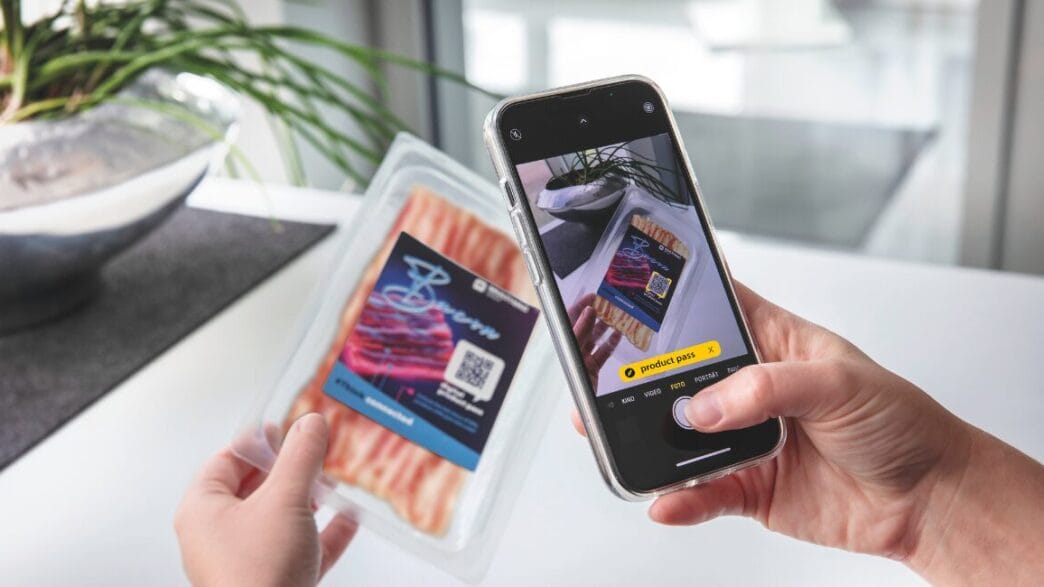
Once the smartly designed packaging is in circulation, the focus shifts from material and process optimisation to digital transparency and traceability. With the help of the Digital Product Passport (DPP) in accordance with the GS1 standard, the product, packaging material and process data can be recorded and assigned to each pack or batch. A customised QR code with GS1 Digital Link is applied to the packaging, allowing any additional information to be included - from product origin and processing steps to preparation tips for consumers. Individual packs can be precisely assigned to their best-before date, making stock management easier and reducing food waste. This provides producers with information on the whereabouts of specific batches, while recycling companies receive details on the material composition and recyclability of the packs. At the same time, the carbon footprint of the packaging can be determined. The use of materials, processing steps, transport routes and disposal routes are converted into CO₂ equivalents.
Multivac supports customers in these steps with advice and standardised track-and-trace solutions. Modern identification technologies ensure that each pack is securely labelled. The information can be displayed either at batch or individual pack level. It can be stored locally on the line or sent to customised systems via open interfaces. This kind of digital transparency is the only way to ensure that the smart packaging approach achieves its intended effect.
Conclusion: Smart packaging as a closed approach
Smart packaging is not created through individual measures, but through the close integration of consulting, material design, machine technology and digital transparency. This is the only way to create synergies that go far beyond the sum of the individual parts. „By recognising potential sources of error at an early stage and being able to adapt more quickly, efficiency and product safety increase. In addition, product quality remains constant and can be reliably reproduced across batches and lines,“ summarises Marina Schedel. „Furthermore, this smart packaging approach opens up Financial savings potentialRejects, downtimes and energy and material consumption can be reduced through data-based decisions and targeted process optimisation. This not only has an economic impact, but also strengthens sustainability along the entire life cycle.“
Last but not least, this integrated approach in close cooperation with packaging experts such as Multivac creates an innovative edge and trust: Customers benefit from the unique global network of local innovation centres and a holistic range of expertise and technology that enables new packaging possibilities. Smart packaging thus becomes a strategic instrument that advances processes, quality, cost optimisation and sustainability in equal measure.