Survey of growers: fruit in groundwood trays has the longest shelf life / transport packaging also favoured by customers
The strawberry harvest is in full swing. On street stalls, at weekly markets and also at discounters, the popular sweet fruits are sold as Seasonal goods offered. Consumers are taking an increasingly critical look at the packaging and are also apparently more willing to spend a little more money on it. Plastic is out, Eco is in. Ecologically sound wooden packaging is also at the forefront of producers' favourites. This was revealed by a survey commissioned by the GROW Association for Environmentally Friendly Wooden Packaging. It also shows that strawberry crates are the best packaging for preventing premature spoilage and mould, even in the current heat.
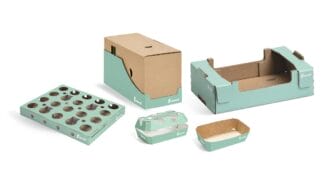
„Producers continue to use wooden crates as transport packaging and wooden pulp trays and chip baskets as packaging for end consumers, not only for ecological reasons, but also because of the better shelf life of the fruit“,
explained GROW Managing Director Uwe Groll.
Wooden crates and cardboard are currently used for harvesting, but plastic crates are also still used, even if these heat up the most in the sun, as the survey revealed.

Producers found that cardboard and corrugated cardboard had the lowest strength and the greatest sensitivity to moisture. In terms of quality, there is therefore no way around the Wooden packaging over. This is also in line with previous studies, according to which wood is at the forefront when it comes to sustainability, environmental protection and freshness or microclimate for the contents.
However, strawberry producers alone cannot decide on the choice of packaging. Ultimately, it is the buyers and, ultimately, the huge food chains that determine on a large scale how the fresh produce reaches the intermediate warehouses and ultimately the consumer.
„We therefore still have a lot of work to do to convince people of the quality and environmental sustainability of wooden packaging.“,
explained Uwe Groll.
In the production chain, whole poplar and beech logs from regional forestry offices are used to make crates or chip baskets of different sizes, depending on the customer's requirements. To ensure the legally required traceability of the packaging, each new crate is given a serial number that guarantees traceability. This means that the production of each crate can be traced from the tree to the finished crate. Wooden packaging is particularly suitable for recycling.
Collected and processed separately, they are a valuable secondary raw material for the wood-based materials industry for the production of chipboard. Through the utilisation of waste wood for the manufacture of sustainable products and the production of climate-friendly energy 5.8 million tonnes of CO2 are saved in Germany every year.
The survey was carried out by the agency plantamedium in Warendorf, which specialises in the areas of agriculture, nutrition and animals. A random sample of strawberry growers throughout Germany were surveyed on the following topics „Current transport packaging for strawberries“.
Source: GROW GmbH