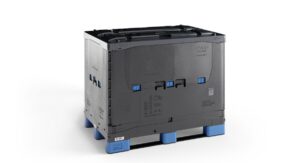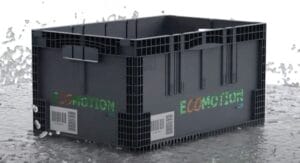
Container systems for the future of intralogistics
The reusable container solutions from Bito-Lagertechnik Bittmann GmbH are regarded as pioneering for sustainable logistics processes.
Read more " 





Since 2017, the development team at BASF, consisting of packaging consultancy, safety technology, product development and polyurethane sales in Lemförde, set about satisfying the long-standing demand for a dissipative film. The solution: Elastostat, a dissipative polymer, based on TPU (thermoplastic polyurethane).

„Adding our additive to the film to increase conductivity was not feasible straight away. This is because we not only had to achieve the required surface resistance, but also maintain elasticity and note that the film is very thin.“ - Anja Oltmanns, TPU Sales, BASF
The film is colour-coded with red flashes, so that the pallets packed with it are clearly recognisable. and suitability for the relevant areas can be ensured.
Source: BASF