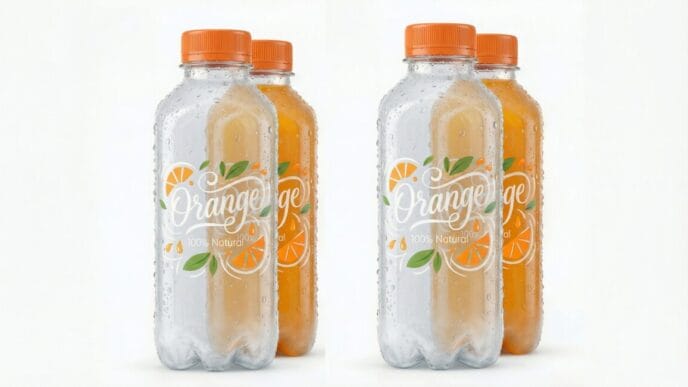
How do consumers perceive the quality of products that have recycled material in their packaging? Researchers at the University of Bonn have investigated this using the example of orange juice.
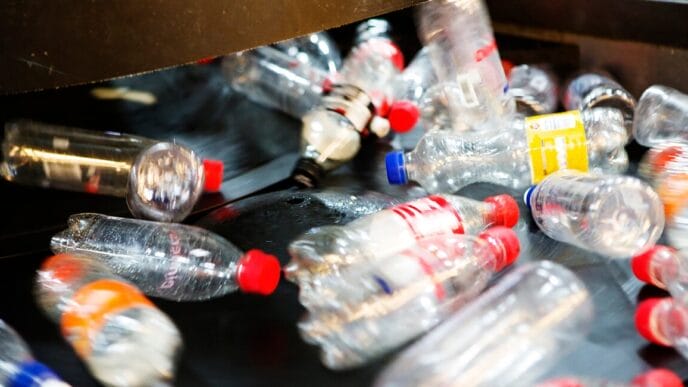
Single-use PET bottles in EU member states must contain at least 25 per cent recyclate from 2025, and this legally stipulated proportion is to rise to at least 30 per cent by 2030. Companies can voluntarily label the recycled content on their products. However, it is unclear how consumers perceive the quality of products with recycled content in the packaging.
Madita Finke, Institute of Food and Resource Economics (IRL), Janine Macht and Prof Dr Monika Hartmann, IRL and members of the Transdisciplinary Research Area (TRA) „Sustainable Futures“ at the University of Bonn, have therefore conducted a study to investigate how consumers assess the quality of orange juice in PET bottles. with a 25 per cent or 100 per cent recyclate label compared to bottles without a recyclate label rate.

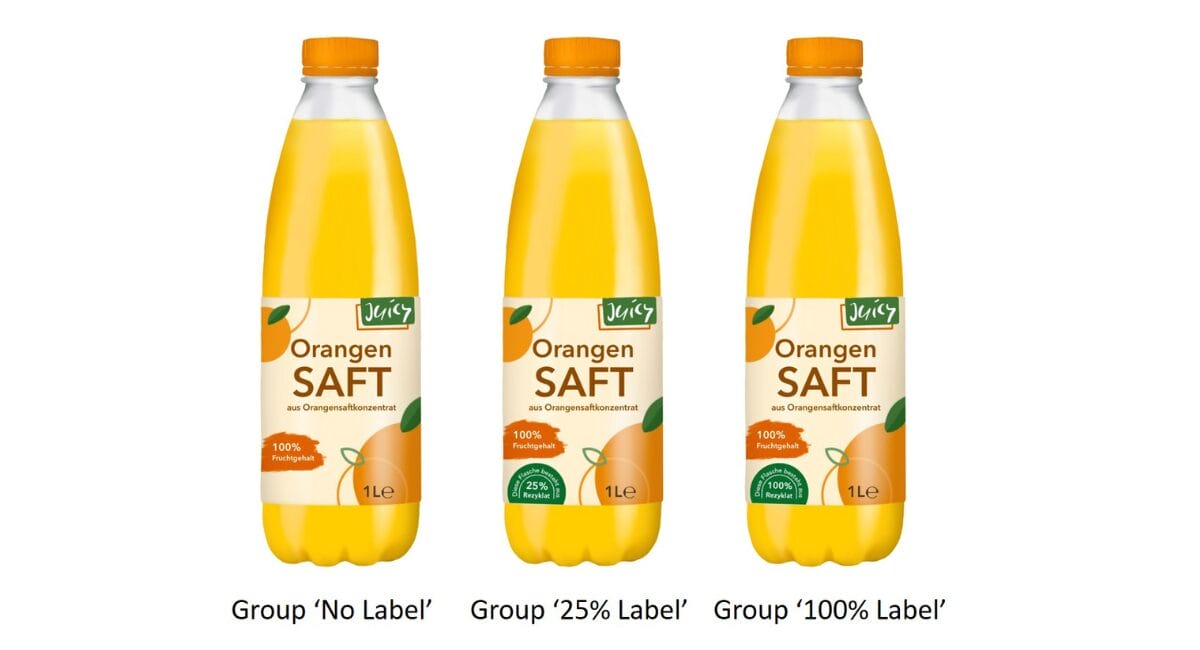
For the study 1080 German consumers in an online survey randomly assigned to one of three groups. Each group saw a picture of a fictitious orange juice in a PET bottle: either without a label, with a 25 per cent recyclate label or with a 100 per cent recyclate label.
Recyclate label raises expectations
A recyclate label on PET bottles for orange juice triggered a so-called „halo effect“: It increases the expected product quality - primarily by increasing the expected sustainability. The higher the environmental awareness of the test subjects, the stronger the effect. In addition to the expected sustainability, expectations with regard to flavour and safety also contribute positively to the extent to which a recyclate label improves the expected product quality of the orange juice.
When a product is labelled with a sustainability label, this positively perceived information is transmitted often also on other quality characteristics - an effect that has already been proven in various product and packaging contexts. According to the researchers, the influence of the recyclate label on taste perception is likely to be similar for other juices, but could be less pronounced for more neutral-tasting drinks such as water.
Communication pays off
The proportion of recycled material in PET bottles in Germany is already above the legally prescribed minimum value. The results of the study show that it could be worthwhile for companies to introduce a actively communicate a higher proportion of recyclates to consumers. The study was funded by the Ministry of Culture and Science of North Rhine-Westphalia as part of the Transform2Bio project.
SourceUniversity of Bonn