With a new sealing machine, Wolf Maschinenbau GmbH demonstrates how packaging can be transported particularly gently and flexibly with B&R's SuperTrak systems.
18 March 2020
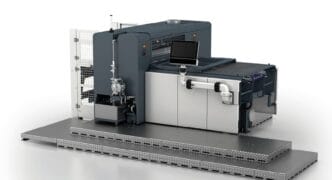
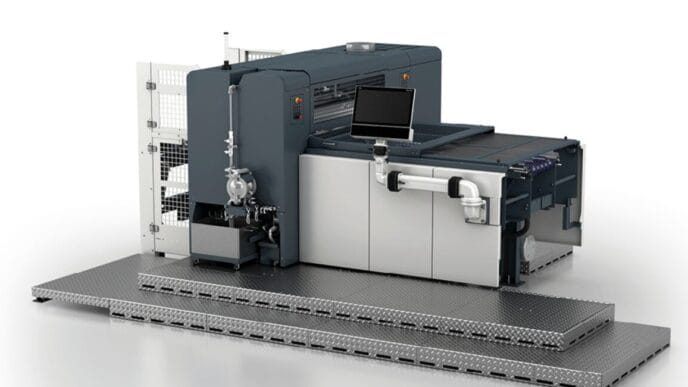
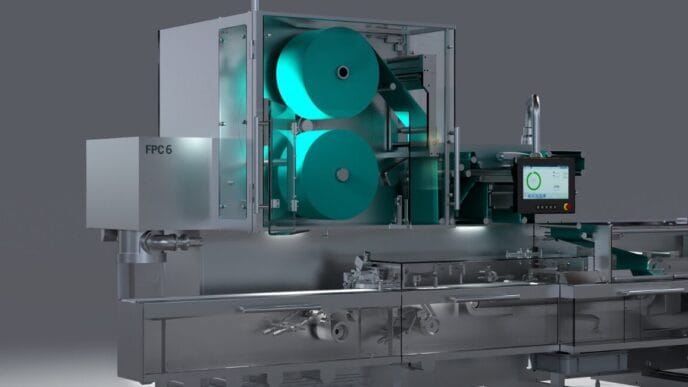
The head sealing machine was specially developed for the higher output range. (Image: Wolf Verpackungsmaschinen)
Short product cycle times and the unbroken trend towards individualisation are increasingly pushing conventionally designed assembly and production machines to their limits. New packaging forms and materials are exacerbating the situation. Wolf Maschinenbau GmbH is now using a new machine to demonstrate how packaging can be transported particularly gently and flexibly using B&R track systems.
„The major retail chains and global players in the packaging industry have set themselves the goal of moving to environmentally friendly packaging change,“ emphasises Markus Schmachtel, Head of the Design and Engineering Department at Wolf. The company has delivered more than 3,000 filling and packaging machines since it was founded in 1988 and has made a name for itself in the food industry in particular. Schmachtel has also been involved in packaging technology for just as long and has experienced many upheavals in this sector.
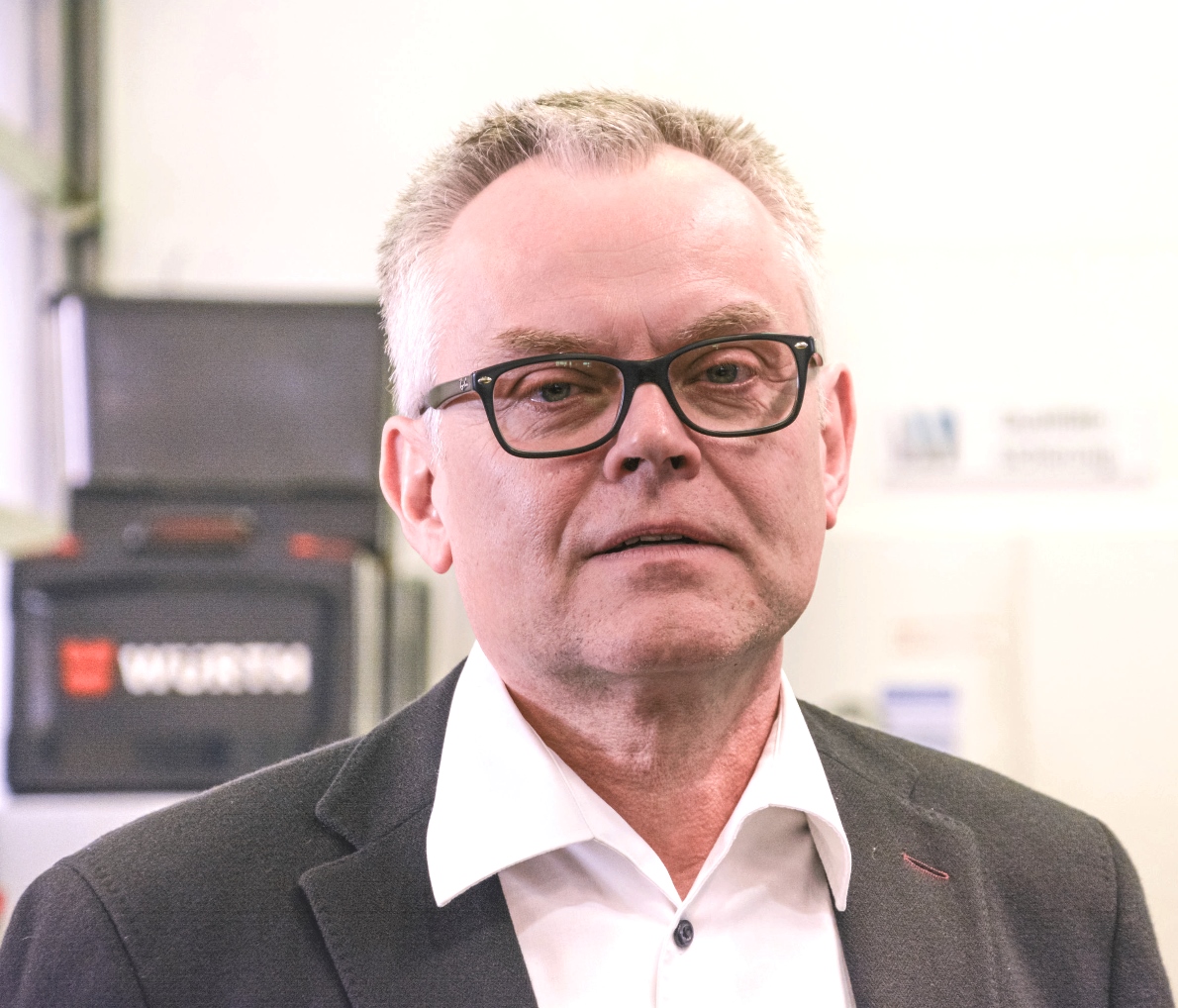
Markus Schmachtel, Wolf Verpackungsmaschinen GmbH (Image: Wolf Verpackungsmaschinen)
„In general, a designer tries to solve new requirements using appropriate mechanics. However, the increasing number of new packaging shapes and materials require Transport solutions, which are significantly more flexible and gentle on the product than the purely mechanical chain systems that have been used up to now.“ Markus Schmachtel, Head of the Design and Engineering Department at Wolf Verpackungsmaschinen GmbH
The company has launched a vertical form fill and seal machine that is suitable for all standard bag shapes and in which the Conversion effort is kept within limits. The machine can be used for flat or gusseted bottom bags as well as stand-up pouches with edge sealing.
Display
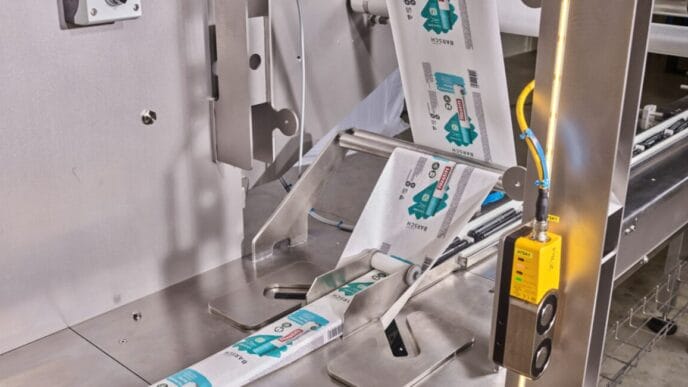
With the coupled Head capping machine (KVM), product transport was optimised with the help of Connected take-away chains realised. The transport chains form compartments for holding the bags. With this concept, the pouches are pushed along together with the complete transport mechanism with each cycle in synchronisation with the flow-wrapping machine. The pouch base slides over the sheet metal of the transport system substructure.
Gentle transport of sensitive eco-packaging
With paper packaging, which is increasingly found on the shelves for marketing and environmental reasons, the base could be subjected to too much stress at higher transport speeds, for example, or the entire packaging could even be deformed. Rough and stiff paper is particularly at risk.
„The problem of bag deformation could be minimised by applying special coatings to the sliding surface,“ explains Schmachtel. „However, this coating is subject to increased wear when the outside of the film is rough and leads to unwanted abrasion on machine components. I assume that our customers will use the safe, gentle and at the same time almost wear-free will gladly accept the transport of their products.“
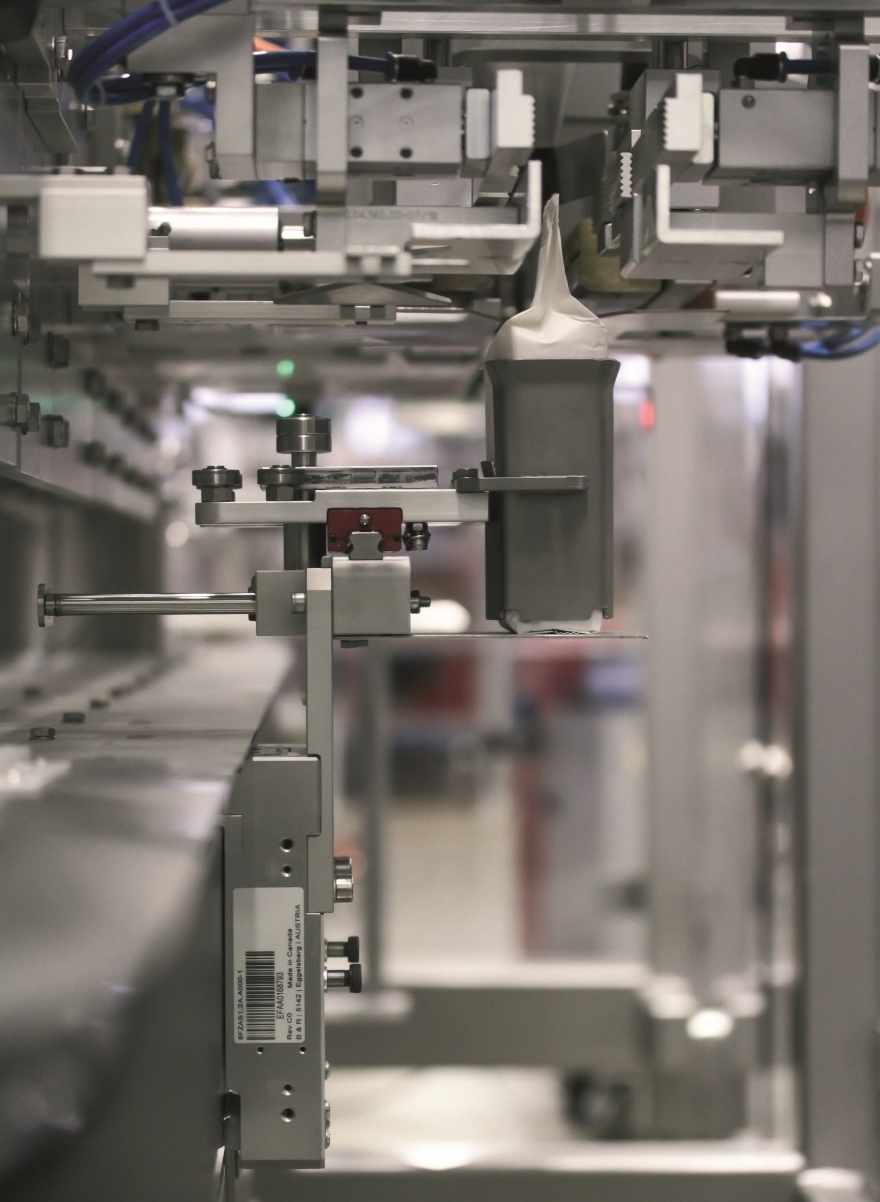
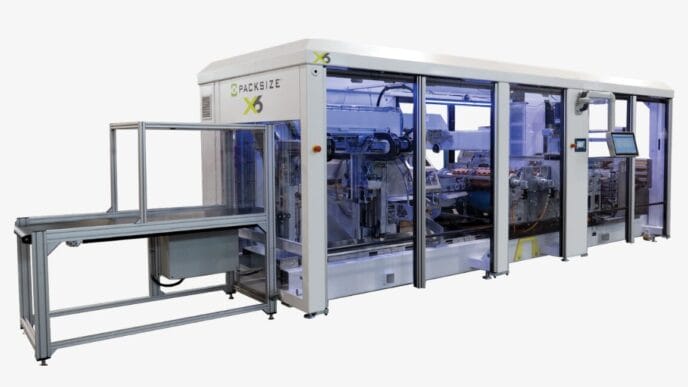
The new head closing machine works with a decoupled transport system based on B&R's SuperTrak system. (Image: Wolf Verpackungsmaschinen)
In order to meet the emerging challenges at an early stage, those responsible at the machine manufacturer decided to develop a new head capping machine. For this purpose, various Decoupled transport systems compared with each other in terms of payload, handling of the shuttles and supplier support. B&R came out on top with its SuperTrak long stator linear motor system which was specially developed for the higher power range.
The aim was for the KVM-S in combination with one or two flow-wrapping machines and a corresponding dosing unit up to 80 bags per minute in the single version should be able to produce, fill and seal. In the duplex version it is up to 130 bags per minute.
Retrofitting with minimal effort
The machine had to be able to handle the transport of a wide variety of bag shapes made from different materials and also enable a wide range of sealing processes without major conversion work. This would allow plant operators to react flexibly to market requirements and switch between Closure variants such as label, gable, clip or tab top.
To achieve this, the bag formed, filled and initially sealed by the flow-wrapping machine must be transferred to the transport system of the KVM-S and then transported to the various process stations. There, in the case of a block bottom bag with a label closure, the head is remoulded, pressed, cut, sealed and folded over. In this way, a compact bag shape can be achieved without unnecessary head space. Finally, the folded head flap is attached to the block bottom bag with a label.
[infotext]SuperTrak was specially designed for 24/7 operation in harsh industrial environments developed. The system works safely and allows very high payloads. SuperTrak also optimises the Changeover times between different products that are manufactured on one system. All you have to do is select a different option and the track system automatically adjusts to the new product. The shuttles of the track system can be easily exchanged individually; the track does not need to be dismantled for this.
Flexible thanks to individually controllable shuttles
In contrast to permanently linked chains, transport with SuperTrak is carried out with individually controlled shuttles on which a cassette matching the packaging is mounted. This allows the shuttles to be fed through the process stations of the KVM independently of the cycle of the flow-wrapping machine. As the bags are fed through the machine with the cassette, there are no lateral forces on the floor. Each individual shuttle is programmable and can be controlled individually. This means that the traversing profiles can be customised to the requirements of the packaging and the filling. This enables even more efficient and gentle production than before.
The shuttles can also backwards drive. The Wolf designers have used this option to incorporate a vibrating movement into the KVM-S's travel profile. This eliminates the need for a separate jogging process station for compacting the bulk material. The vibration process is no longer subject to a specific cycle time and can therefore be designed to be gentler or more effective than in a conventional vibration station.
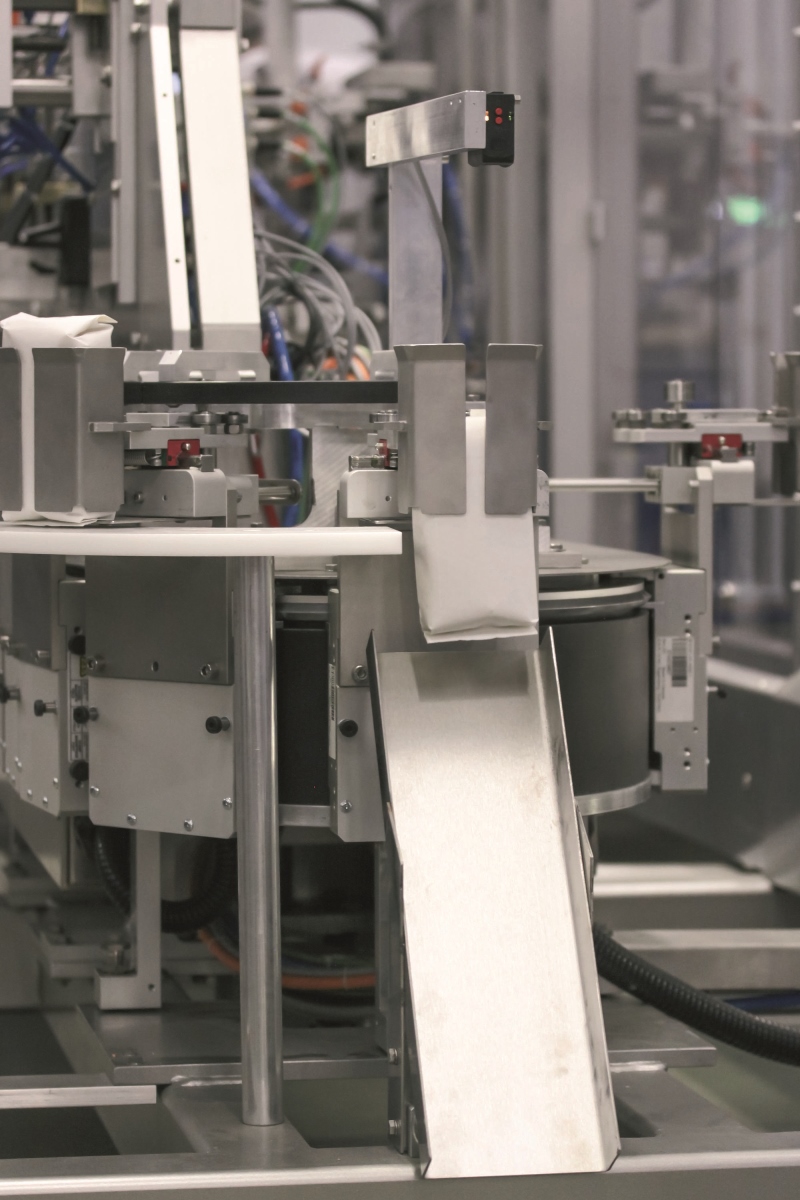
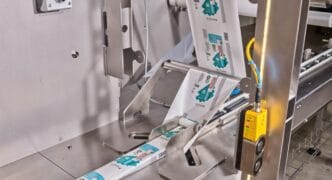
The transport system of the head sealing machine moves the individual bags to the various process stations. (Image: Wolf packaging machines)
Increase throughput
Thanks to the freely programmable travel profiles, the system manufacturer can freely arrange stations or additionally approach or skip stations. This can be used to Time-critical stations to double. This can, for example, increase throughput or guarantee the targeted cycle time. However, not all stations need to be duplicated, as would be necessary with a permanently interlinked transfer system.
The programmable traversing profiles also offer the option of adding or omitting process steps for certain pouches, allowing different packaging materials or types to be processed on the same machine with little additional effort. This makes the KVM-S with SuperTrak the ideal counterpart to Wolf's flexible flow-wrapping machine:
„With SuperTrak, it is possible to find an investment-saving way of Variant production or the Increased throughput and integrate the system more easily into the user's production line,“ adds Schmachtel. „The flexible design of the travel paths also means that we have more degrees of freedom when positioning the transfer stations for the flow-wrapping machine or the packer. This makes it easier for us to adapt the layout of the entire system to the conditions on site.“
The machine manufacturer has additional freedom in the design of the machine layout thanks to the modular structure the rails of the SuperTrak high-speed track system. „This allows us to lengthen or shorten the KVM-S as required and flexibly change the number of shuttles,“ says Schmachtel. The flexible definition of the running direction of the entire system enables easy adaptation to new requirements.
Thanks to SuperTrak's freely programmable travel profiles, the system manufacturer can freely arrange stations, move to additional stations or skip them. (Image: Wolf Verpackungsmaschinen)
System layout with many degrees of freedom
For the first machine of the new generation built by Wolf, a simple SuperTrak oval consisting of two 180-degree curve segments and six straight segments, each one metre long, was sufficient to meet the specifications. This was mainly due to the fact that the SuperTrak curve areas can also be utilised.
„With the Simulator from B&R can be used to check in advance whether the planned construction or expansion of a system fulfils the Target cycle time is achieved. The number of planned shuttles and process stations as well as the respective pouch shape are decisive factors here. This avoids unnecessary investments and minimises the risk of a new development,“ explains Schmachtel.
Another cost-reducing factor for the operator is the High energy efficiency of the system: As the SuperTrak solution only requires the shuttles to be moved with the cassette structure and therefore with significantly lower masses than with permanently coupled transport systems, the acceleration and braking energy required is also lower. In addition, the braking energy is fed back and used to accelerate the shuttles.
A breeding ground for innovation
The potential of the new transport solution is far from exhausted and gives Wolf room for further ground-breaking innovations, as Schmachtel notes with satisfaction: „As far as the possibilities of SuperTrak are concerned, we are only at the very beginning. at the beginning. For example, two shuttles can be controlled so that they grab a bag and pull it up while travelling to the next station. The payload can also be increased by combining shuttles. This opens up further interesting approaches in the design of trend-setting filling and packaging machines."