Sustainable strategy for the design of packaging machines
Sustainable packaging machine construction must consider people, the environment and technology as an overall system - this is the attitude of the manufacturer of end-of-line packaging machines Somic. But which interrelationships are particularly important here?
15 June 2021
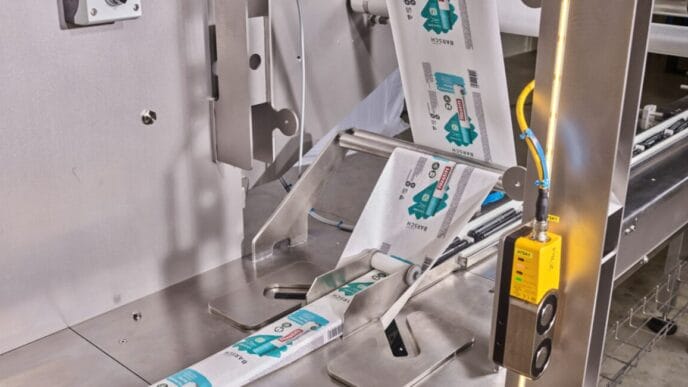
Conversion to different formats is based on easy-to-use QuickChange connections. (Image: Somic)
Sustainability in packaging machine construction is only successful if you think beyond the machine itself - this is the attitude at Somic. People, the environment and technology must be considered as an overall system. But which interrelationships are particularly important here?
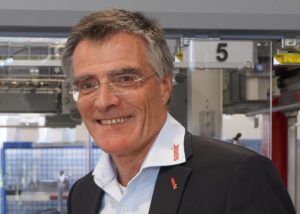
The well-known three pillars of sustainability - economy, ecology and social responsibility - require us to consider not only the manufacturing process but also the customer's use and ultimately the subsequent utilisation of a machine right from the design stage. Right from the start, the People at the centre. „We put ourselves in the operator's shoes during the design phase and think about how we can optimise their workplace,“ explains Dr Johann Härtl, Head of Design at Somic, a manufacturer of end-of-line packaging machines. But what does this mean in practice?
Focus on people
The operator uses a clearly structured touchscreen panel and benefits from the Intuitive visualisation of all work steps. By default, the instructions are stored here in the customer's respective national language; other languages are available as an option. This ensures that the machine functions are easy to understand and is supplemented by a help function with information on the meaning of the various parameters.
The changeover to different formats is based on easy-to-use QuickChange connections for the change parts. Operators are provided with clear process instructions that are easy to follow with the help of part codes and the control panel.
Display
In addition, the Ergonomics as a fundamental design feature. „The heaviest part that the operator has to replace on the machine during a format change usually weighs no more than five kilograms, and accessibility is already assessed in CAD using a dummy,“ explains Härtl.
The design team also pays attention to the Accessibility of the machine, to provide the operator with a gentle working posture. During commissioning, Somic offers detailed training to help you get started with operating the machine.
And if required, different groups of people can be familiarised with the machine in a very targeted manner or trained together in the steps required for maintenance work. Operator stress in production operations is also measured in terms of emissions.
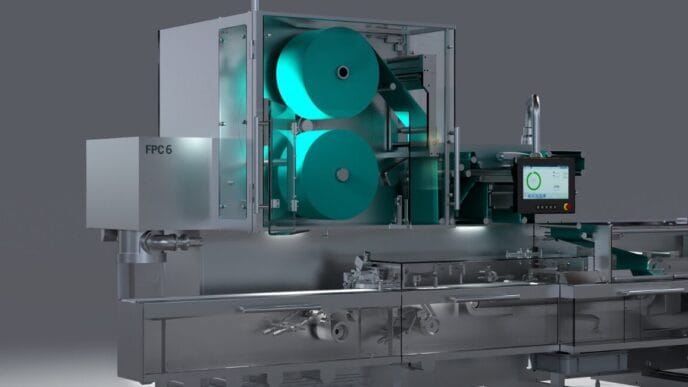
(Image: Somic)
„We are well below the specified maximum sound pressure level for industrial workplaces of 80 dB(A). Thanks to specially optimised movement curves for the robot axes used, we achieve a noise level that is hard to beat, even at maximum packaging output. Smooth running. This also ensures extremely gentle handling of the products and minimises machine wear.“ Stefan Julinek, Sales Manager at Somic
Economical consumption - robust construction
The power and compressed air consumption of a machine is largely influenced by its design. Here Somic replaces as many Pneumatic functions through servo technology. This means that the movement behaviour can be better controlled and leaks in the compressed air network are no longer an issue. The functionally required negative pressure in all transport systems is not generated with Venturi nozzles, but with electronically controlled side channel blowers, which are extremely energy-efficient.
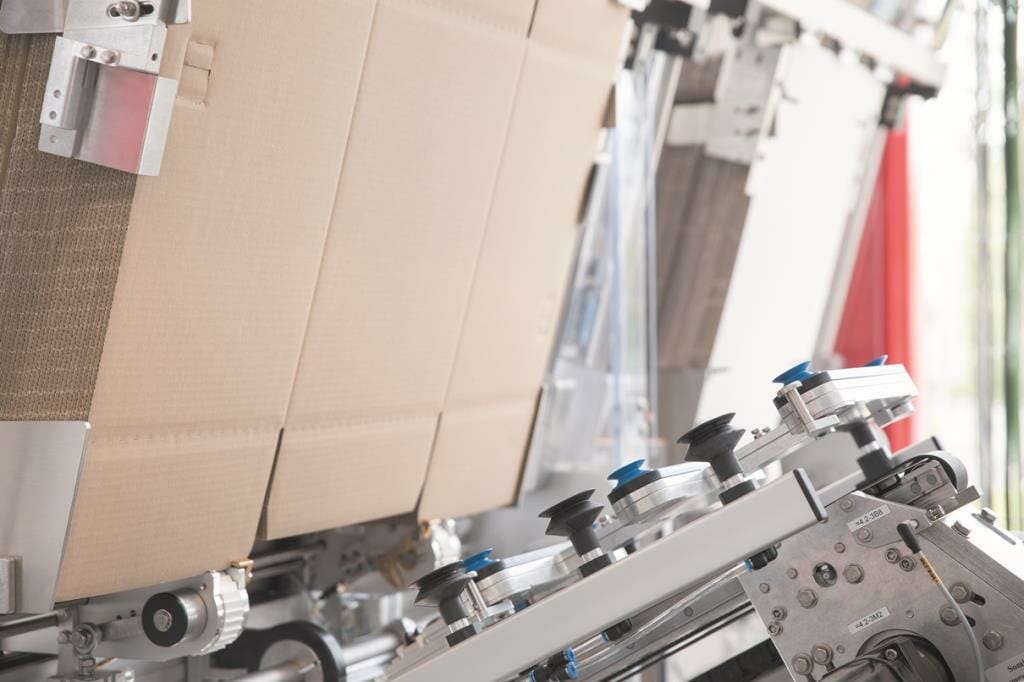
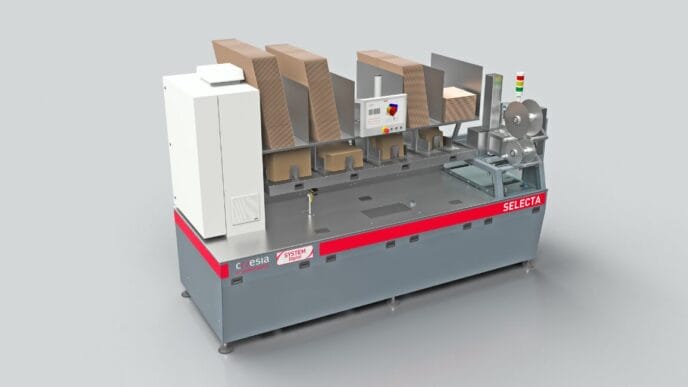
In addition to the consumption values for electricity and compressed air, it is worth checking the Material consumption in the packaging process to scrutinise them in detail. The team utilises several approaches. When specifying the packaging and designing the carton, the customer can reduce the amount of material used while still ensuring the necessary product protection. The company's own cardboard plotter can be used to compare format variants and work out the most material-saving cutting variant possible.
Cardboard cutting in the cutting magazine (Image: Somic)
In addition to the cutting design, the Glue consumption a decisive factor when it comes to conserving resources. In the machines, high-precision glue nozzles ensure glue application in the millimetre range. The glue nozzles are controlled in the high-speed cardboard forming processes with a cycle time of less than two milliseconds. The glue dot is placed exactly where it is needed.
Julinek calculates what additional consumption at this point means: „If the glue line is just one millimetre longer than necessary, the glue requirement for 16 gluing points on a wrap-around carton increases by seven per cent - that's an additional 35 cubic millimetres per carton! This can equate to an additional consumption of around ten litres per week.“ It therefore pays to work with the utmost precision at this point.
How do the Somic experts determine the sustainability of their machines during ongoing production operations - apart from the consumables? „To obtain information about the robustness of our machines, we only have to look at our ‚books‘,“ says Stefan Julinek. This information is important for two aspects. Firstly, it allows the Total cost of ownership for the machines, and on the other hand they allow a statement to be made about them, How durable are the installed assemblies and parts.
Both experts summarise the results as follows: „Our data speaks for itself. Because when we ask our customers, they can't even quantify their spare parts requirements.“ Conserving resources therefore means - as unfortunate as this is for Somic - very little spare parts business. Nevertheless, there is still plenty for the Service and Aftersales department to do.
Between five and 20 formats are usually stored in the customer-specific processing programme when the machine is delivered. With these formats, many customers already achieve a Long service life. Should market changes require additional formats, this is not a problem. „We recently built a new format set for a machine that was more than 20 years old. This shows that our machines always sail under the flag of sustainability in terms of service life. This means that retrofit parts can also be supplied for older machine models,“ reports Julinek.
Quality and regionality
The Company based in Amerang, Upper Bavaria relies on over 90 per cent to suppliers from the region. „What is often ridiculed as „steeple sourcing“ ensures short response times and maintains our quality standards,“ explains Härtl. The short distances avoid environmental pollution and delivery delays due to disruptions during transport. In addition, the suppliers know the machines, they know where their parts are installed and what is important.
Consistent steps in terms of sustainability: Somic's experts are convinced that sustainable action only works properly if all topics are consistently scrutinised for this criterion. „We don't have a special sustainability programme for this, but we are taking these steps because we are convinced of this. Strategy have always been convinced,“ says Härtl. And Julinek adds: „We can also see that this is exactly what the market wants.“