Tailorlux has developed invisible marking pigments that are applied to products and ensure greater protection against counterfeiting. One user: EPAL.
14 August 2018
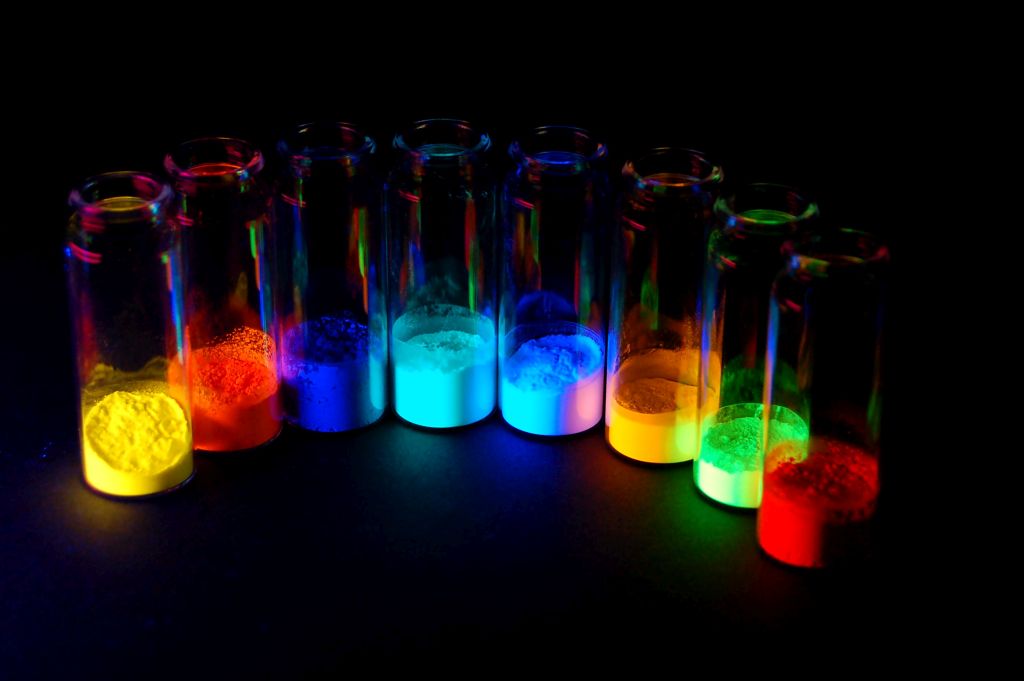
Tailorlux integrates marking particles in all possible colours directly into plastics, lacquers, paints or adhesives. (Image: Tailorlux)
Product protection and counterfeit protection are becoming increasingly important. A company from Münster has developed a method for labelling products with tiny particles. The particles can be incorporated into printing inks, paints, adhesives or directly into fibres, among other things. One of the users is the pallet pool operator EPAL.
Counterfeit products cause considerable economic damage. Manufacturers are therefore making considerable efforts to make their products counterfeit-proof. Barcode markings, QR codes, RFID labels, artificial DNA, engravings, holograms and much more are currently being used for this purpose. The pharmaceutical industry is particularly active. This is because from 9 February 2019, medicines must be labelled with a unique serial number and be clearly traceable in accordance with the EU Falsified Medicines Directive.
The „secret“ of Tailorlux's marking pigments is that they reflect unique light wave patterns. (Image: Tailorlux)
Many of the existing security features are visible on the product. „Visible product protection has the advantage that it is easy to integrate. However, visible markings are neither a deterrent nor a hurdle for counterfeiters,“ explains Alex Deitermann, co-founder and Managing Director of the Tailorlux GmbH from Münster, to consider.
Many solutions are not very practical. Often the Authentication process very complicated and time-consuming. Counterfeit protection with chemical, biological or radioactive markers can be toxicologically questionable or cannot withstand acids or high temperatures.
Display
Marking pigments can be integrated into all product components
The founders of Tailorlux wanted to make counterfeit protection faster, safer and simpler when they spun the company out of the University of Münster in 2009. This led to the now patented „Tailor-Safe“ product: Marking pigments are covertly integrated directly into the products. „This creates a unique optical fingerprint that is forgery-proof, can be digitised and can be used in court. The requirement is that no additional equipment is needed and the solution can be integrated into existing processes,“ explains Alex Deitermann.
Alex Deitermann, founder and managing director of Tailorlux (Image: Tailorlux GmbH)
„For counterfeiters, visible markings are neither a deterrent nor an obstacle.“
The following can be implemented optical markings into almost all product components, with the exception of liquid glass and metal. Plastics, adhesives, inks or paints are most frequently labelled. Integration into printing inks is also practicable. It is even possible to „hide“ the markings so well that they can only be detected forensically using mass spectrometry analyses, says Deitermann.
Tailorlux has also taken precautions to make the Tailor-Safe pigments themselves tamper-proof. They are „encrypted“, so to speak. The light wave spectrum is uniquely coded in each case and can only be decoded with specific key-lock sensors at the customer's premises. While normal colour sensors may still be able to indicate the presence of colour pigments, the sensors equipped with a special Cryptography module equipped customer devices to check whether the measured reflections are correctly coded and originate from the genuine product.
Authentication directly on the production line
The marking pigments do not change the properties of the products to be protected because they are only added in extremely low concentrations. In addition, the inorganic, ceramic Phosphors chemically „inert“. They do not react with any other substances and are Toxicologically harmless. This is particularly important for use in the food and pharmaceutical industries.
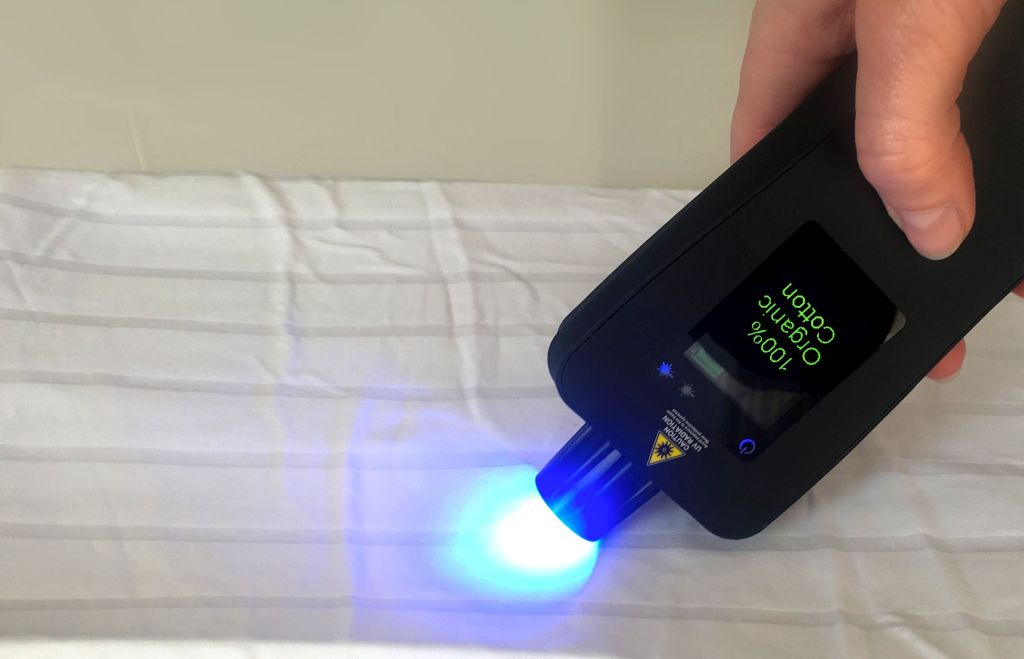
At the hotel textiles service provider „Dibella“, the sorting devices immediately recognise whether the fabric is really made from sustainably produced cotton. (Image: Tailorlux)
For the Authentication process there are various possibilities. Originators of protected products want to continuously check the security features during production and further processing. This ensures that only original products are dispatched. For an initial check during production, Tailorlux offers Easily integrated test sensors as a cost-effective inline variant directly in production lines. The data obtained during measurement can be documented via the variable interface and transmitted directly to other systems.
The realisability of „genuine traceability“ based on factual data is supported by Internet-enabled sensors which can be operated using a special „app“ on practically any tablet, laptop, PC or scanner checkout. All measurement data is stored centrally on a server and is available to customers via interfaces or visualisation software to document the integrity of the product in question.
Two product protection elements in EPAL mesh boxes
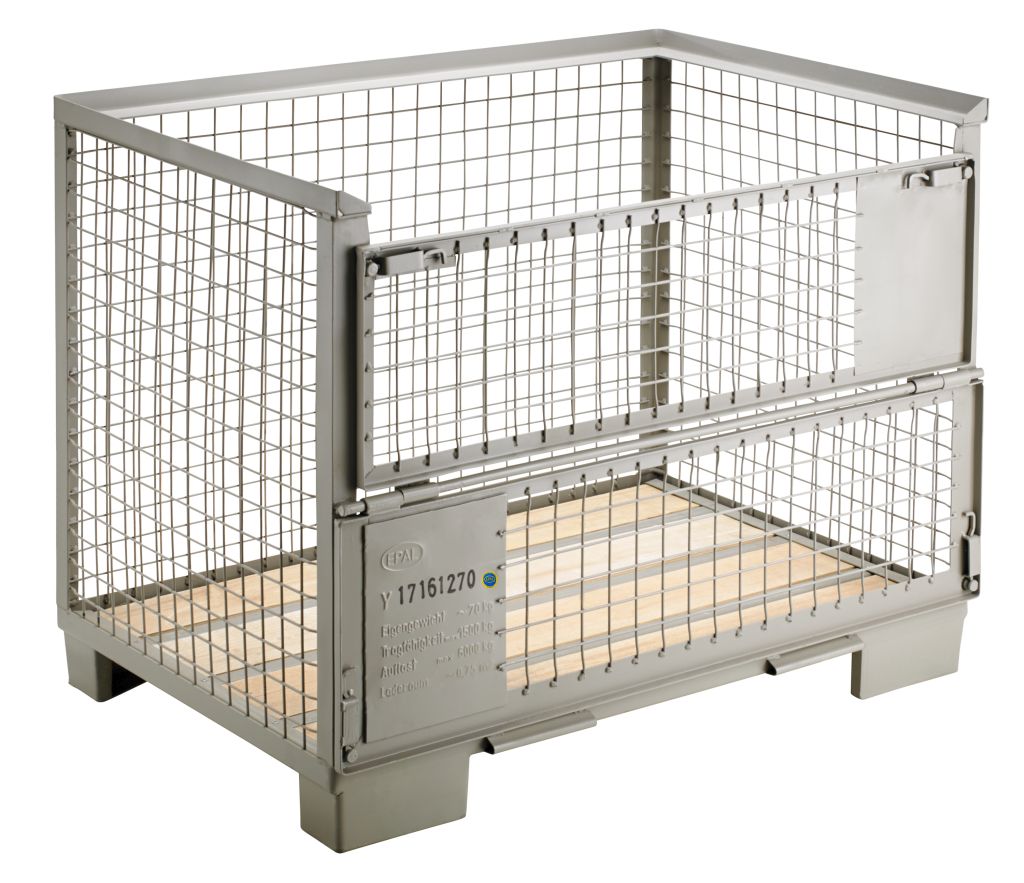
Tailor-safe solutions are already being used in many industries. For example, the European Pallet Association (EPAL) from Düsseldorf received a seal of approval for its Pallet crates one. It contains two Tailor-Safe product protection elements. For EPAL, this solution represents a further milestone in ensuring the originality of the products, summarises the pallet association. Four DAX companies are also among the customers of the Münster-based company, but are keeping a low profile about the specific protective measures.
Pallet cage boxes from EPAL feature two concealed Tailor-Safe markings. (Image: EPAL)
Directly into the Plastic housing of their products, the tool manufacturer Jokari from Werne and the Berlin battery producer „Greenpack“ Tailor-Safe. Each individual Greenpack rechargeable battery is now labelled with an invisible pigment to indicate its authenticity. It is particularly important for Greenpack that the labelling can be reliably identified even after a fire and thus provides effective protection against unjustified complaints.
Further potential in the recycling and pharmaceutical sectors
For several years now, the textile industry has shown a strong interest in invisible product markings. Manufacturers such as „Dibella“ from Bocholt, for example, want to prove that they only use high-quality, sustainably produced cotton. Tailorlux has therefore incorporated a mark that refers to the „Cotton-made-in-Africa“ seal directly into the fibres in Dibella hotel textiles. Alternatively, the marking can also be implemented during dyeing, printing and post-processing of the fibres.
Alex Deitermann sees further future potential for Tailor-Safe safety markings in the Recycling market. The markings could contribute to faster identification of ingredients and properties and thus support material control and recycling.
Deitermann's further attention is focussed on the Pharmaceutical market. In future, it is conceivable that medicines could be labelled beyond the packaging directly in the pill. Counterfeit medicines could then be recognised much more reliably than before.