The principle: nobody knows everything

Consumers find it difficult to distinguish between genuine digitalisation and fake digitalisation. Dr Marietta Ulrich-Horn explains the latest developments at.

How transparent do you become when shopping for goods if you scan product codes? How secure is all this nonsense? Do you scan a product and then return to a landing page? At first glance, consumers find it difficult to distinguish between genuine digitisation and fake digitisation. But what can you do about it? Dr Marietta Ulrich-Horn provides information on these developments.

The In the world of packaging, the Internet of Things (IoT) means that every product is serialised with a unique code, This is a megatrend for proof of authenticity and product traceability. This is a megatrend for proof of authenticity and product traceability, but it can easily lead to undesirable developments. Counterfeiting systems, duplicate codes and data protection should be considered strategically. For many years now Dr Marietta Ulrich-Horn, Managing Director of the Securikett Ulrich & Horn GmbH in Austria, with interoperable systems in connection with IoT and provides our trade magazine with insights into various solution approaches.

Image of a woman
Dr Marietta Ulrich-Horn Managing Director and owner of Securikett Ulrich & Horn GmbH (Image: Securikett)

Why is this issue so important to you and your company?

We focus on quality and sustainability, including in software development. In our view, producers, retailers and online shop operators are still not giving enough thought to the extent of product digitalisation and the associated systems. If standards are not set from the outset to ensure the security of systems and their users, this can easily lead to misuse and setbacks. We believe that IoT does not make everything more complicated, we are absolutely in favour of it and as a company we offer it as a matter of course: with a cloud solution for track & trace and product verification and with a platform for „UID issuance“, i.e. the secure issuing of unique codes. However, where it makes sense, we advocate the decentralisation of power over data and are committed to interoperable solutions.

How should we understand this?

It is foreseeable that counterfeiters can not only recreate a hologram, but also an entire digital system including a landing page. Even a customs officer cannot always recognise which landing page he is being directed to and whether it is genuine. A small change or one more letter in the URL and you end up on a replica landing page on a platform operated by counterfeiters. Consumers also often don't know where they are being taken when they want to check the authenticity of a product or call up information about a product. We only want to offer things that are truly reliable and future-proof and have set ourselves the goal of always being two steps ahead of the counterfeiters with our products. We believe that it would be very damaging if digital parallel worlds were to emerge on a large scale. This would undermine consumer confidence in product digitalisation, which has many advantages. If several systems are interoperably connected, a counterfeit system cannot enter the landscape so easily.

How could this be prevented?

We rely on the principle of separation of powers, which is already anchored to some extent in European tobacco regulation. There, the unique codes for tax stamps are issued by a non-governmental and independent institution in order to ensure that no abuse can occur in the allocation of codes and that more codes than desired are not mistakenly put into circulation or issued twice. With our in-house developed UID issuance platform, for example, we can guarantee this independence from the use of codes where desired.
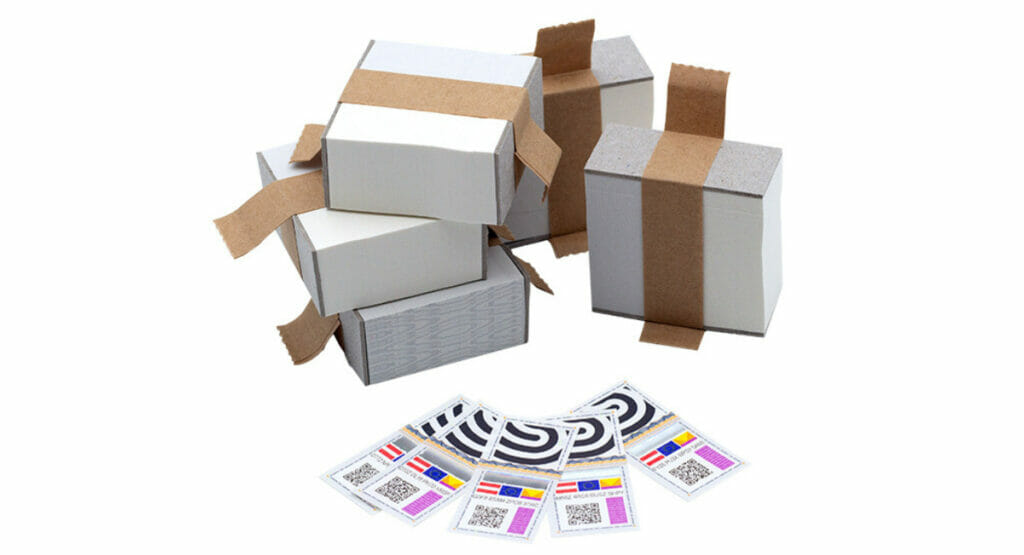
Image of cardboard packaging and labels
Each individual tax stamp contains its own QR code. Paper-based tax stamps are used in Europe to seal cigarette packets. (Image: Securikett)

How does this work in practice?

Let me briefly explain an example of the use of the UID Issuance platform, detached from tobacco regulation: a group that sells several brands commissions us to issue codes. These codes are issued to the respective local producers for application to the product in the form of barcodes, QR codes etc. and for further use, for example for product traceability. This avoids having to generate a separate code for each brand with different providers. It is a clear advantage for brand owners if there is an independent issuing entity for these codes that is detached from the company, and local providers benefit from the after-sales customer communication that is only made possible by IoT. Another example of the separation of powers is the use of a trusted entry point, a reliable verification app that is based on a „chain of trust“, a publicly registered trust provider, so to speak. You have to think of it in the same way as digital signatures. Access or the digital signature, which is placed around the code, is only obtained via the Trusted Entry Point. It was our pioneering achievement to realise a project together with ATT, a friendly company, to demonstrate this Trusted Entry Point using a control band pilot. Only when a code is verified as genuine by a third party can it be assumed that the UID on the product is genuine and that the product delivers what it promises. In the pilot project, we were also able to show how important it is to combine digital identification with physical authentication: the „trusted“ landing page explains exactly what you need to look out for so that the QR code alone cannot be reprinted. Non-copyable security elements are suitable for physical authentication, but detailed explanations would go beyond the scope of this article.

Can you give us another example of functioning interoperability?

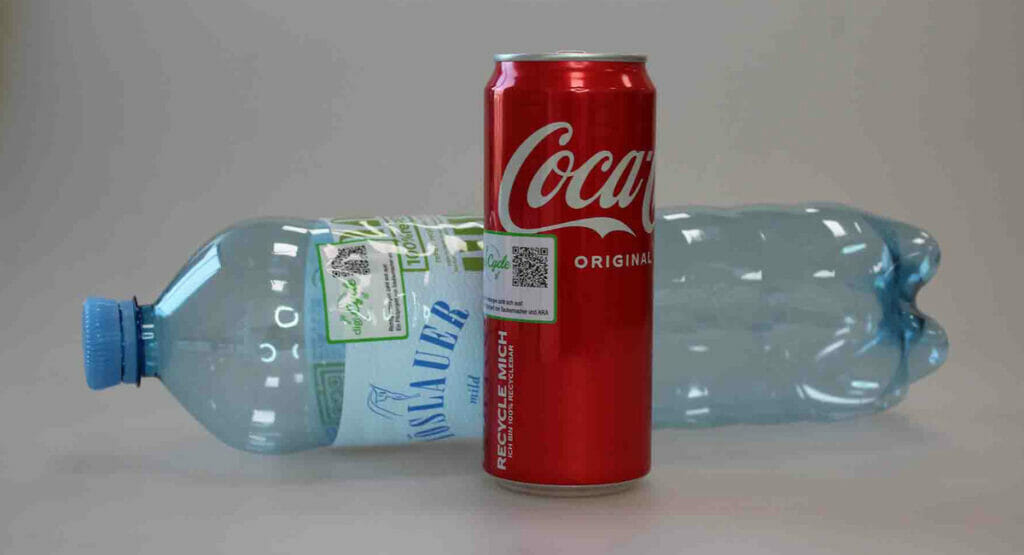
Unfortunately, in the area of rapidly developing traceability systems, all too often people do not think far enough ahead. Suppliers think in „silos“. As a result, it is not possible for a third party to take on a monitoring role as an independent party. The separation of powers plays an overriding role for us, for example in deposit systems. It should always be ensured that the brand owner does not have to store any private data. This can be realised by bringing a third party on board, as we were able to demonstrate in the field test with Saubermacher and ARA. This involved consumers disposing of empty bottles and cans not in the shop but directly at the recycling centre or recycling bins provided and the return deposit was credited directly to an app. The codes could only be read once. Our task was to print the labels and check whether the code was genuine. A third party operated an app that provided the bonus. It was important to us that not everyone could see all the data for the deposit. As a company, we didn't know how many codes each beverage producer who took part in the project had received. The data for the deposit return, i.e. the data on account details for crediting the deposit, was stored by the third participant, the app operator. This interoperability ensured that data could not be misused under any circumstances.
Image of a can and a bottle with labels
Digital contribution to the „digi-Cycle“ recycling project: return deposit directly via app - three „partners“ share the „access rights“. (Image: Securikett)

What is the aim of these solutions?

We want to ensure that private and public systems can work together reliably. Otherwise, a landscape of small code systems will develop and nobody will know whether these systems are genuine. Government applications alone usually only cover the bare essentials. We therefore believe that interoperability of systems, both public and private, is a good solution.

What do you think is special about these developments, what sets them apart from others?

We always think one step ahead with all our solutions and our top priority is consumer security. We offer a UID issuance platform within the company itself, have been working continuously for over ten years on the Codikett traceability platform, print tamper-proof labels and understand the application of IoT to the product. We consider a strict separation of systems to be sensible, depending on requirements. And if a customer wants us to issue a code, but the code system operators are third-party providers, then the principle of separation of powers is applied. Since the company was founded, consumer safety has been our top priority and we don't want to give counterfeiters a playground to undermine sensible innovations.
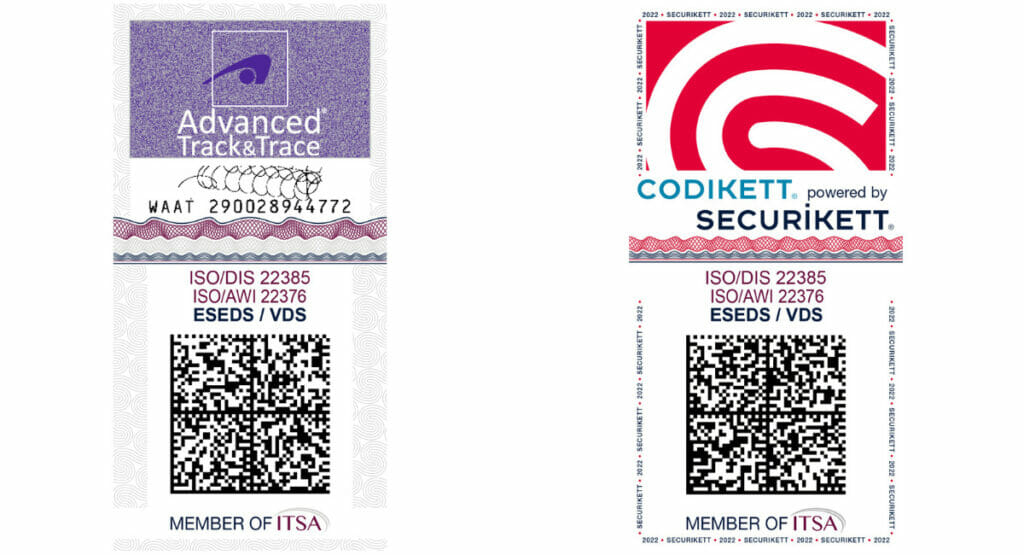
Image of two labels
Electronic verification by third-party providers: It is important to combine digital identification with physical authentication. Both tax stamps refer to the Otentik app for code verification. (Image: Advanced Track & Trace)

How important do you consider this development to be as a trend for the packaging industry as a whole?

The number of counterfeit products has risen massively in recent years, not least due to online trading and parcel shipping, which largely evades customs controls. The global damage caused by counterfeit products, not only to the economy but also to health, cannot be overlooked. Any kind of increased safety for consumers should also be a major concern for the packaging industry. After all, we are all involved in the cycle and are consumers ourselves. We also believe that a brand owner who relies on IoT must really ensure that what the customer is buying is genuine. If their security concept is not watertight, they will have a liability problem. Modern brands should make a very convincing commitment to the security of their brands and communicate this visibly, because a disappointed consumer would not be a good advertisement.

More news from the magazine

One hundred years blue tin

Since 1925, the Nivea cream can has borne its deep blue colour, white lettering and round shape - a design that has remained stable over generations, markets and crises and is now celebrating its 100th birthday.
Read more "
Display