The trend towards sustainability continues unabated, but processing more environmentally friendly packaging materials is often still a challenge. Theegarten-Pactec from Dresden is therefore constantly developing its high-speed packaging machines to enable manufacturers and brand owners to process sustainable packaging materials for confectionery and non-food items on an industrial scale.
Traditionally, different materials such as plastics, metals and papers are laminated together for packaging materials in order to achieve an optimum combination of strength, flexibility and barrier function to protect the product. In terms of sustainability, however, such laminates are problematic as they are difficult or impossible to separate and therefore cannot be recycled. As an alternative, monomaterials or paper-based packaging materials, which are said to have better recyclability, are currently very popular. However, they are more challenging during the packaging process. They can tear more easily, are more difficult to seal or have poorer folding properties.
Theegarten-Pactec wants to support manufacturers and brand owners on their path to greater sustainability. This is why the packaging specialist for small-piece confectionery is constantly developing its packaging machines and consistently aligning them accordingly, sustainable materials can also be processed industrially.

Patented preheating section for paper-based tubular bags
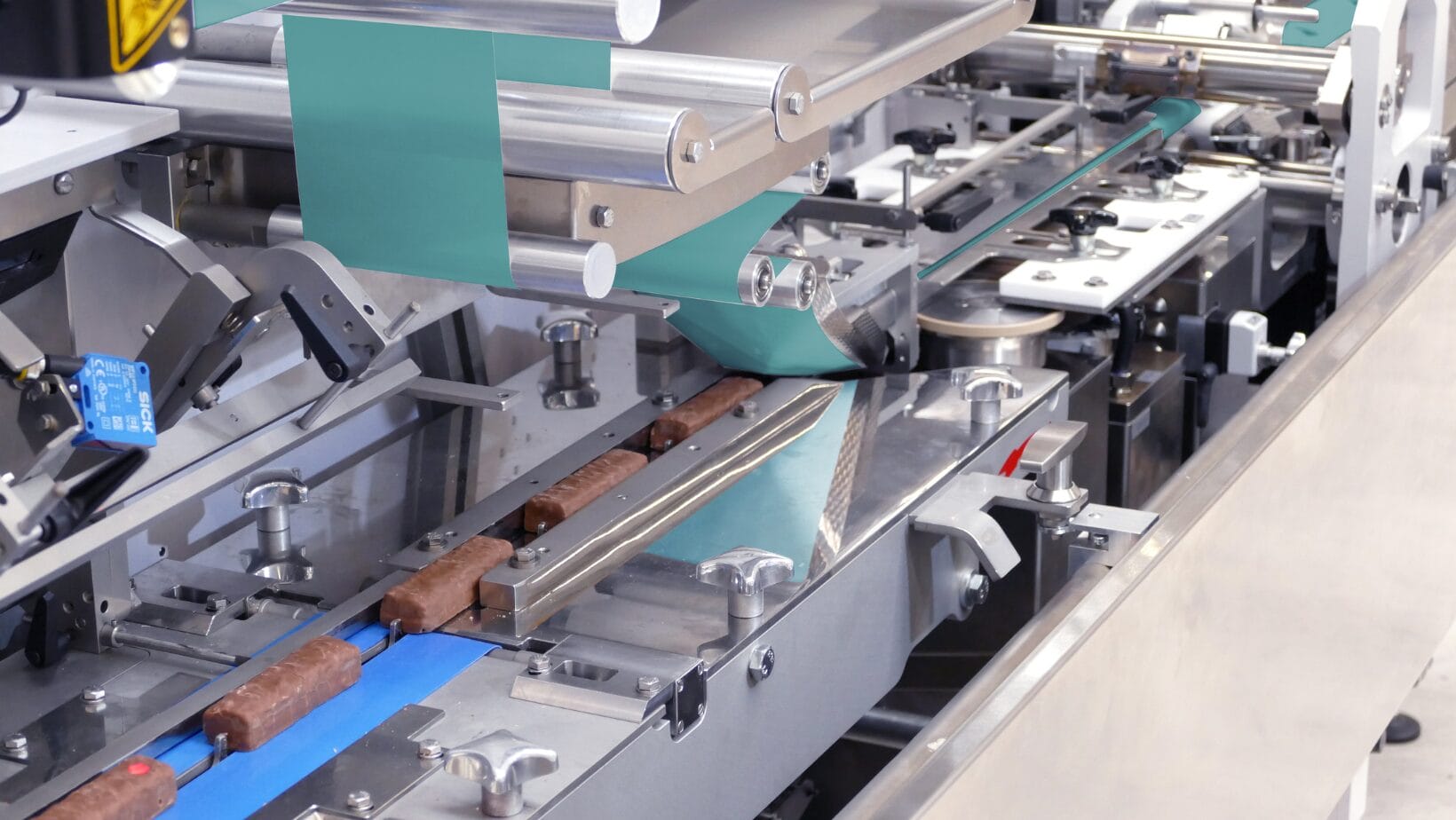
For example, Theegarten-Pactec has redesigned its FPC5 high-performance packaging machine for bar and tablet products to such an extent that it can now process paper-based tubular bags using both the conventional cold-sealing process and the far more complex heat-sealing process can. Specifically, the machine can be used to produce flow-wrap packaging made from barrier paper with integrated heat-sealability and a pure paper content of at least 95 per cent.
Preheating the sealing area during the unwinding process gives the paper a higher initial temperature, so that the heat has to be introduced into the packaging material via the sealing tools for a much shorter time during the actual sealing process. The Avoids damage to the packaging and the product, as these are guided through the machine particularly gently. In addition, the high speed of 100 m/min for paper-based packaging materials is achieved thanks to the reduced sealing time.
The special nature of the sustainable packaging material was also taken into account in another area: For the production of the paper-based tubular bags on the FPC5, Theegarten-Pactec the moulding shoulder modified for tubular bag production. Due to the material used and the geometry adapted to the packaging material, there is no risk of the paper creasing or even tearing when the tubular bag is formed.
Recyclable paper at high speed in the Double twist wrap processed
Theegarten-Pactec took a different approach to sustainability with its EK4 high-performance machine. With a Packaging speed of up to 2,300 products per minute hard sugar sweets can be packaged on this machine with recyclable, wax-free paper in a double twist wrap. Despite the high-speed range, the paper can be processed stably and .
This is made possible by Flexible processing of wax-free paper or other innovative packaging materials among other things by infinitely variable adjustment of the rotary gripper oscillation. The twisting angle is variably adjustable. Suitable rotary grippers are also available for different packaging materials. The fact that the EK4 works in an extremely material-saving manner also contributes to its sustainability credentials. For example, a servomotor-driven packaging material puller ensures an exact pull-off length and thus minimises packaging material consumption. With its EK4, the packaging specialist clearly demonstrates that recyclable, wax-free paper can be used without compromising on performance and product protection.

Suction seals for environmentally friendly chocolate packaging
Theegarten-Pactec focussed specifically on more environmentally friendly monofilms with the invention of the so-called suction seal process. The background to the idea was the fact that recyclable monomaterials have poor dead-fold properties, i.e. the packaging has to be sealed or glued shut after folding. However, there is a risk that the sensitive chocolate will be damaged. This is why Theegarten-Pactec developed a sealing station located directly after the actual wrapping or packaging process. As soon as a product has reached the sealing station, the sealing tool is moved to the product to be sealed at a distance of 0.5 mm to 1 mm and the packaging is sucked onto the sealing stamp with the help of negative pressure. In this way, there is no direct contact between the packaging and the chocolate product during the sealing process, which prevents pressure marks or other damage. Active cooling of the environment ensures additional product safety.
„The examples mentioned above show that there are many different ways to act sustainably. In the interests of the environment and our customers, we are constantly endeavouring to further develop our machines. After all, only if we enable the industrial processing of sustainable packaging materials can they become established across the board and worldwide.“
Markus Rustler, Managing Director at Theegarten-Pactec
Source: Theegarten-Pactec
Theegarten-Pactec at ProSweets Cologne: Hall 10.1, Stand G020 H029