The global stock of industrial robots has reached a new record of around 3.9 million units. The strong demand is being driven by a number of exciting technological innovations. The International Federation of Robotics reports on the key trends that will shape robotics and automation in 2024.
Artificial intelligence (AI) and machine learning
The use of artificial intelligence continues to increase in robotics and automation. The development of generative AI is opening up new solutions. This subgroup of AI specialises in learning through training and creating something new from it - these solutions have already become well-known with online tools such as ChatGPT. Robot manufacturers are developing Generative AI-controlled interfaces to programme robots more intuitivelyThe users programme using natural language instead of code. The workers no longer need any special programming knowledge to select and adapt the desired actions of the robot.
Another example is the Predictive AI, which analyses the performance data of robots to determine the future condition of systems. Predictive maintenance enables manufacturers to save costs for machine downtime. Machine learning algorithms can also be used to analyse data from several robots running at the same time and optimise processes on this basis. In general, the more data a machine learning algorithm receives, the better its performance.

Cobots for new applications
Human-robot collaboration continues to be an important trend in robotics. Rapid advances in the development of sensors, image processing technologies and intelligent grippers make it possible for robots to react to changes in their environment in real time so that they can work safely alongside humans. Collaborative robot applications support human workers in their daily workTasks such as heavy lifting, repetitive movements or working in hazardous environments are no longer necessary. Robot manufacturers are offering more and more areas of use for collaborative applications.
One current market trend is the increase in robotic welding applications, which has been triggered by the shortage of skilled labour in this segment. This demand shows, that automation does not lead to a labour shortage but, conversely, contributes to solving the personnel shortage. In this sense, collaborative robots will complement - not replace - investments in traditional industrial robots that operate at much higher speeds. Conventional industrial robotics will remain important for improving productivity in response to tight product margins. In addition, new competitors are entering the market, focussing specifically on collaborative robots. Mobile manipulators, the combination of collaborative robotic arms and mobile robots (AMRs), offer new use cases that could significantly increase the demand for collaborative robots.
Mobile manipulators
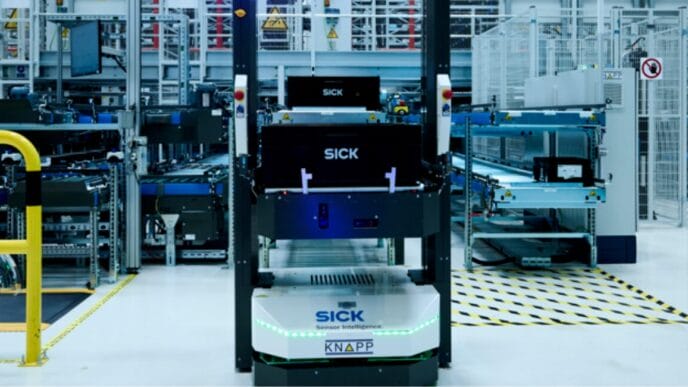
Mobile manipulators - known as „MoMas“ - automate the handling of materials in sectors such as the automotive industry, logistics and aerospace. They combine the mobility of robotic platforms with the dexterity of manipulator arms. This enables them to move in complex environments and handle objects. This is a particularly important capability in manufacturing applications. Equipped with sensors and cameras, these robots carry out inspections and maintenance work on machines and systems. One of the key advantages of mobile manipulators is that these machines can work directly with human labour. The shortage of skilled labour and personnel for factory jobs is likely to further increase demand in the future.
Digital twins
Digital twins are increasingly being used to optimise the performance of physical systems with their virtual counterparts. As robots in factories are increasingly digitally integrated, digital twins can utilise the real operating data collected, to perform simulations and predict probable outcomes. As a pure computer model, the twin can be tested and modified under stress conditions without causing wear or a safety risk. Compared to tests with physical systems, such virtual simulations save considerable costs. The advantage: digital twins bridge the gap between the digital and physical worlds.
Humanoid robots
In robotics, there have been significant technological advances in humanoids that can perform a wide range of tasks in various fields of work. The human-like design with two arms and two legs makes it possible for the robot, to be used flexibly in working environments that were actually created for people. For example, it can be easily integrated into existing warehouse processes and infrastructures. China's Ministry of Industry and Information Technology (MIIT) recently published detailed targets for the country's ambitions to mass-produce humanoids by 2025. The MIIT assumes that, that humanoids will be another breakthrough technology, similar to computers or smartphones, that could change the way we produce goods and the way we live.
The potential impact of humanoids on various sectors makes them an exciting area of development. However, the introduction of humanoids to the mass market remains a complex challenge. Costs are a key factor here: Their success will depend on whether they are profitable in competition with established robot solutions such as mobile manipulators, for example.
„The Top 5 Robotics and Automation Trends 2024 show that robotics is a multidisciplinary field where technologies support each other to create intelligent solutions for a variety of tasks. These advances will continue to shape the convergence of industrial and service robotics and the future of work.“
Marina Bill, President of the International Federation of Robotics
Source: International Federation of Robotics