Thimm Group: Focus on added value for the customer
The Thimm Group is one of the leading manufacturers of corrugated cardboard transport and sales packaging, sales displays, multi-material packaging systems and packaging-related services on the European market. This success story began in 1949 in Herzberg am Harz.
11. July 2018
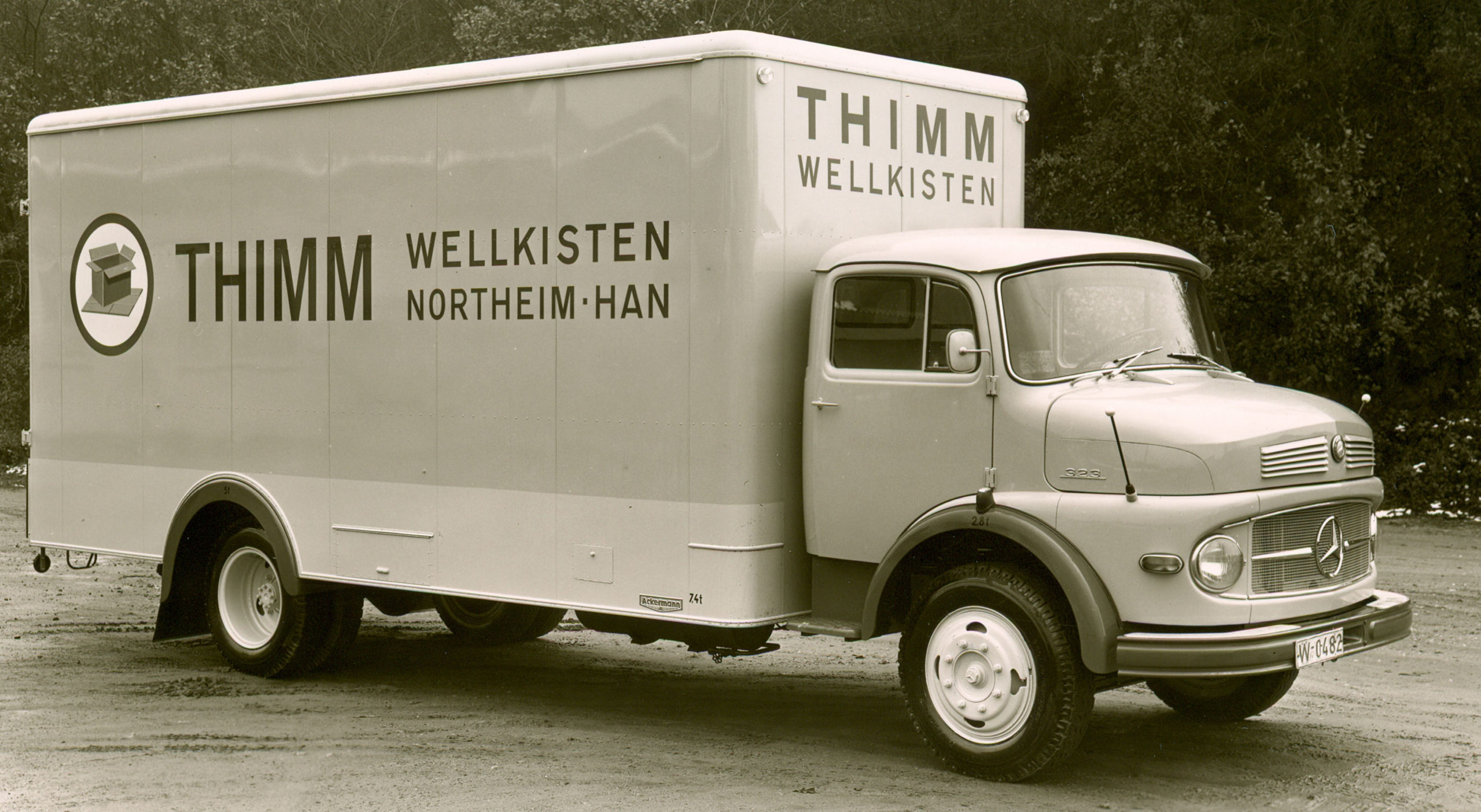
Thimm lorry 1964
The Thimm Group is one of the leading manufacturers of corrugated cardboard transport and sales packaging, sales displays, multi-material packaging systems and packaging-related services on the European market. This success story began in 1949 in Herzberg am Harz.
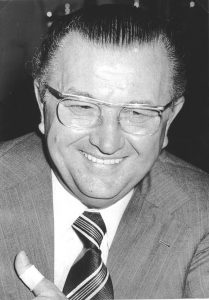
Company founder Walter Felix Thimm settles in Herzberg after his time as a prisoner of war. After his efforts to find a job in a West German corrugated cardboard company were unsuccessful, he ventured into self-employment and founded Walter Felix Thimm Papier- und Pappengroßhandlung. He knew the industry well, having completed a commercial apprenticeship at a corrugated cardboard factory in Lucka/Thuringia in the 1920s, for which he subsequently developed packaging and worked in sales.
Company founder Walter Felix Thimm
Initially, he traded in paper products for the local retail trade. A little later, he added special corrugated cardboard packaging for the emerging radio and television industry. To protect the sensitive surfaces of the devices, he cushions the Corrugated board packaging with cellulose wadding out. A niche product and an opportunity for Thimm to offer manufacturers real added value.
The first own corrugator
By 1951, the premises in Herzberg were already too small, so Thimm looked around for alternatives. In Northeim in Lower Saxony, where the group's headquarters are still located today, he discovers a plot of land in the immediate vicinity of the north-south railway line. The highlight in the associated building complex of a former canning factory is a large steam boiler, which at the time was an important prerequisite for the next step in the company's development: the Production of own corrugated board.
Display
At the end of 1958, Walter Felix Thimm succeeded in putting an old corrugator (WPA) into operation and thus securing the company's long-term existence. What sounds simple was in reality a Thriller. Because in order to ensure its own supply of corrugated board, the purchase and installation of the machine must be carried out in the utmost secrecy.
1959: View of the THIMM factory in Northeim.
There is no corrugator available in Germany and the young company cannot afford a new one from the USA. By chance, Thimm learns of a machine in Switzerland, but it is said to be ten years old and broken down into thousands of individual parts. Nobody could say whether it would ever work. What's more, it is beyond the available budget, so the only way to purchase it is through a „hire purchase model“. The chances of success are 50:50.
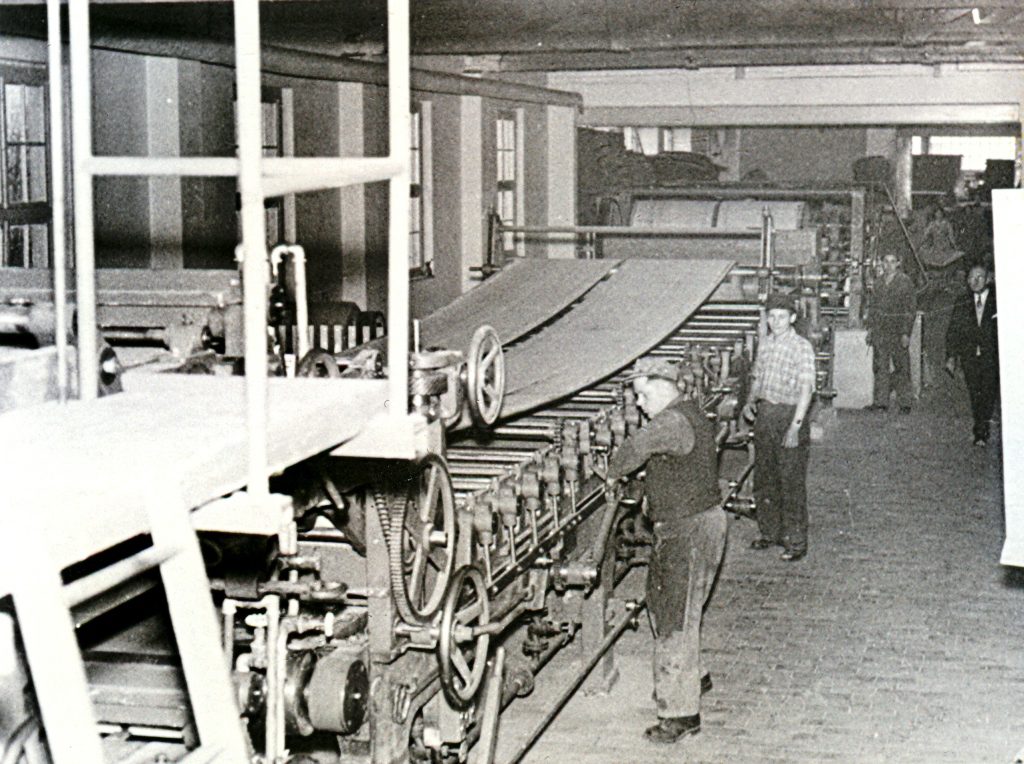
Thimm put all his eggs in one basket, brought the system to Northeim in twelve railway wagons and installed it piece by piece over the course of three months with the help of an engineer, whom he poached from the competition, and a special fitter from Dresden, whom he smuggled back and forth across the GDR border. Shortly before Christmas 1958, the first sheets roll off the production line. At the same time, the main suppliers get wind of the operation and immediately stop supplying the company with corrugated cardboard: The company is now on its own.
1959: The first own corrugator.
Focus on service, technology and promoting young talent
Thimm begins to build on its strengths: Service-orientation towards the customer's wishes and concentration on technology. Both require Qualified employees, which, then as now, are crucial to the company's success. Thimm began training apprentices back in the early 1960s. The company plays a key role in establishing the profession of packaging mechanic in Germany.
In 1964, Klaus Thimm, the eldest son of the company founder, joins the company. The graduate engineer specialising in paper production initially heads up packaging development with a test laboratory. Later, he also looked after important customers, developed cost-optimised packaging solutions for the chemical and automotive industries and was responsible for paper purchasing.
Customised packaging - from cars to foodstuffs
In 1966, the company becomes the first licensed producer and marketer of IATA air freight containers in Europe. Together with a car manufacturer and the advisory centre for seaworthy packaging, Thimm also develops an export crate with a plastic coating for the incipient shipment of spare parts overseas. But Thimm also has good ideas for everyday products: For fruit producers in the Altes Land region, the company creates Coated corrugated board, which not only protects the fruit, but also keeps it fresh for longer.
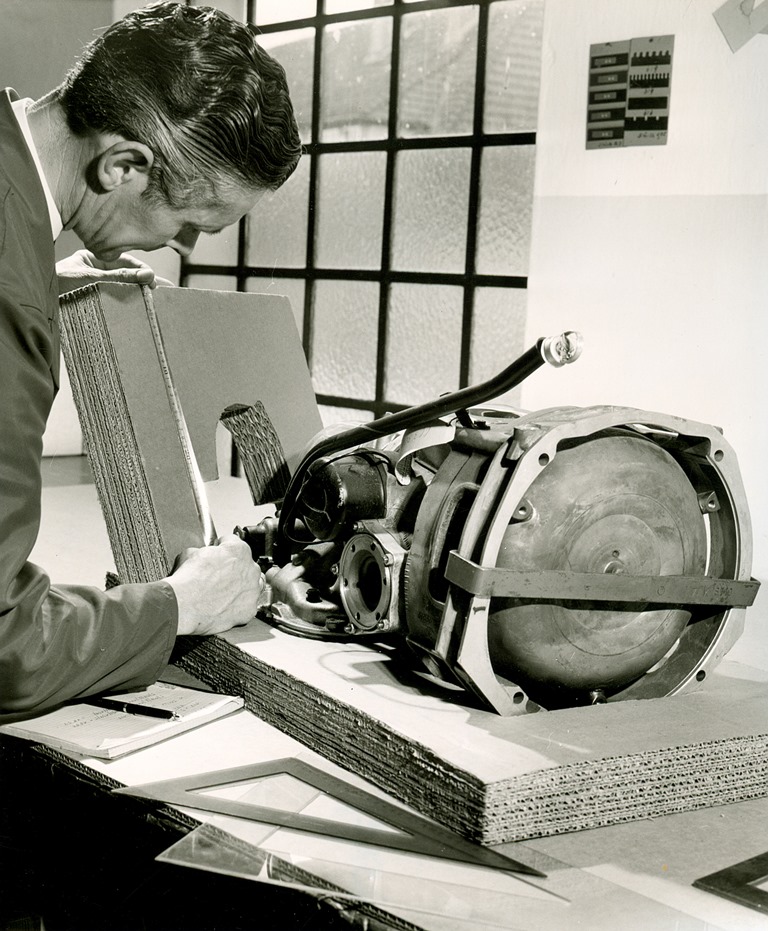
1969: Development of engine packaging in Northeim.
Technological expertise in finishing and processing
The entrepreneur recognised early on that packaging can also be an advertising medium. Together with the company's technical director at the time, Klaus Thimm developed an advertising medium in the 1970s. revolutionary printing processThimmColor®. It takes the advertising possibilities of packaging to a new level of quality. With the so-called belt technology, paper can be printed very flexibly and in any size with up to eight colours endlessly. No competitor has been able to imitate this patented process for decades.
Klaus Thimm
„For over 65 years, the name Thimm has stood for expertise in all aspects of packaging and the associated processes and services. Qualified and committed employees are the key to inspiring our customers time and again with creative ideas and to continuously developing and expanding our family business,“ says the owner Klaus Thimm.
The classic transport packaging is developing into a high-quality, sales-promoting packaging, The benefits of which were quickly appreciated by the up-and-coming discounters. The two engineers are thus doing pioneering work for the still growing area of multi-coloured pre-printed corrugated board packaging.
Since then, Thimm has continuously expanded its printing expertise and today offers the market a unique mix of technologies for packaging printing: from various flexographic printing processes to offset and digital printing. It is also this enthusiasm for technical progress that has repeatedly led to Thimm providing impetus in the German corrugated cardboard market. In the mid-1960s, for example, the company was the first in the industry to use rotary die-cutters.
Consistently looking ahead
Thimm also played a pioneering role in the introduction of various management systems. At the beginning of the 1990s, Thimm was the first company in the German corrugated cardboard industry to be certified according to DIN ISO. The company is also at the forefront of hygiene management and ethics audits as part of the sustainability movement. The advantages: On the one hand, Thimm fulfils the requirements that its customers place on a reliable partner. On the other hand, these systems provide important impetus for the further development of the company's own organisation.
From craft business to global player
The company's focus on market needs is also reflected in its geographical proximity to its customers. At the beginning of the 1970s, the Ruhr region is driving the transition from heavy industry to modern mixed industry and establishing sectors that require large quantities of corrugated board packaging. The same applies to the Rhine-Main region. The corrugated cardboard plants in Castrop-Rauxel were established in 1972 and in Alzey in 1980. At the same time, Thimm builds up an international sales network. The craft business of the past has now developed into a company with modern material flow concepts and an international orientation.
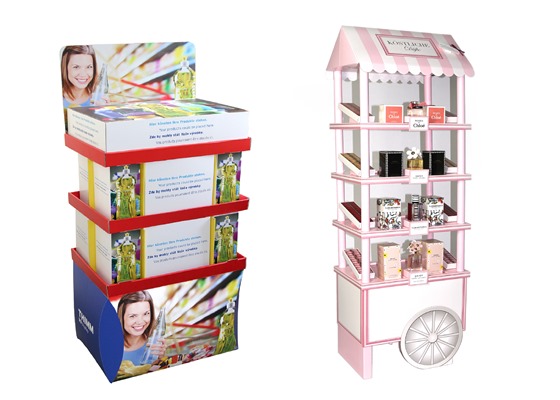
PoS displays: from modular standard concepts (left) to creative design solutions (right).
After the fall of the Berlin Wall, Thimm builds one of the first modern corrugated cardboard plants in the new federal states in Eberswalde, north of Berlin, in 1991. Just three years later, the company relocates near Prague in order to supply the local growth markets in Central and Eastern Europe with packaging as well as to support major customers in these new markets.
New structures
With the onset of globalisation in the 1990s, the number of Logistics and with it the demand for intelligent packaging solutions and optimisation concepts.
Thimm accepts this challenge, opens up new business areas and expands its product and service portfolio. The company presents this unique blend of high-tech and packaging at interpack 1999: under the new Umbrella brand Thimm - The Highpack Company the product range is organised into business units, making it more tangible for customers. Since then, the business units have continued to develop independently in their market segments to form today's Thimm - The Highpack Group.
Also in 1999, Klaus Thimm, who had managed the company alone since the death of his father in 1983, handed over operational management to Mathias Schliep, who has been Chairman of the Management Board since May 2000. Together with Jens Fokuhl he forms the two-member management team of the Thimm Group.
Mathias Schliep
„Doing things just as well as others is not the recipe for top performance in the market. It's about that, Anticipate added value for the customer and to develop ideas and business models from them,“ explains Mathias Schliep.
Growth and internationalisation strategy
Over the last ten years, the company has recorded average annual sales growth of around twelve per cent. Part of this very positive development has been continuous investment in the development and expansion of structures, locations and state-of-the-art production technology. Further production plants are gradually being built - partly on greenfield sites, partly through acquisitions, participations or strategic alliances. At the heart of this growth and internationalisation strategy is a deep understanding of the needs of customers in a wide range of industries.
As a reliable partner in the supply chain, the company supports key customers worldwide as part of integrated overall concepts, thereby making an important contribution to their value chain. A current example of such demand-orientated cooperation with customers is the integrated material flow concept, which Thimm is implementing with a logistics company in the port of Duisburg. In the world's largest CKD (Completely Knocked Down) centre for a car manufacturer, Thimm assembles customised transport containers and hands them over to the customer. „through the wall“ to the logistics company that packs and despatches the vehicle parts for export.
Modern product innovations
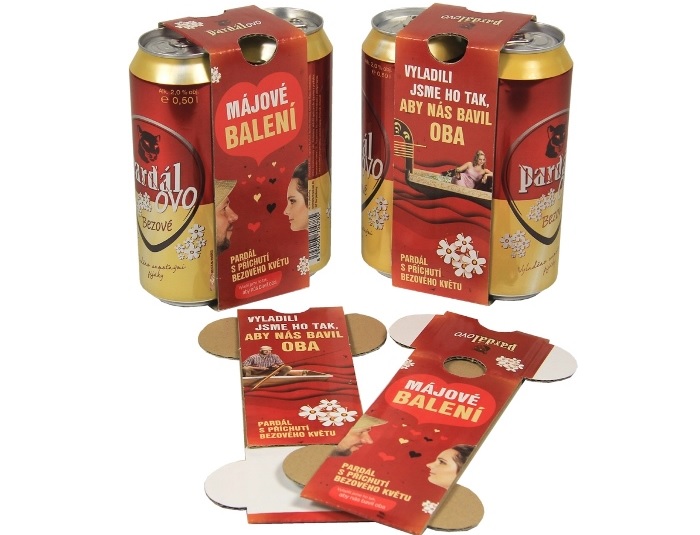
Product innovations from Thimm also contribute to value creation and are honoured with numerous awards every year. The most recent examples are shelf-ready packaging solutions with integrated pushfeed from the Thimm xPOSe® product family, Thimm foodWave ® | heatproof and Thimm Multipack | can.
multipack | can: for eye-catching sales and cross-selling campaigns at the PoS.
Since the beginning of the year, the multifunctional loading equipment Cone Pal® has been added to the company's product portfolio. As part of a partnership, Thimm produces and markets this economical alternative and supplement to conventional wooden or plastic pallets exclusively throughout Europe and in selected overseas markets.
Another speciality of the „Thimm“ brand are so-called Analyses of potential. Thimm experts analyse, compare and evaluate individual or several company sites with regard to existing packaging ranges and processes and identify potential savings and improvements.
All these competences, coupled with an irrepressible will to develop further, have characterised the company from the very beginning and are reflected today in an innovative Full service all aspects of packaging from a single source.
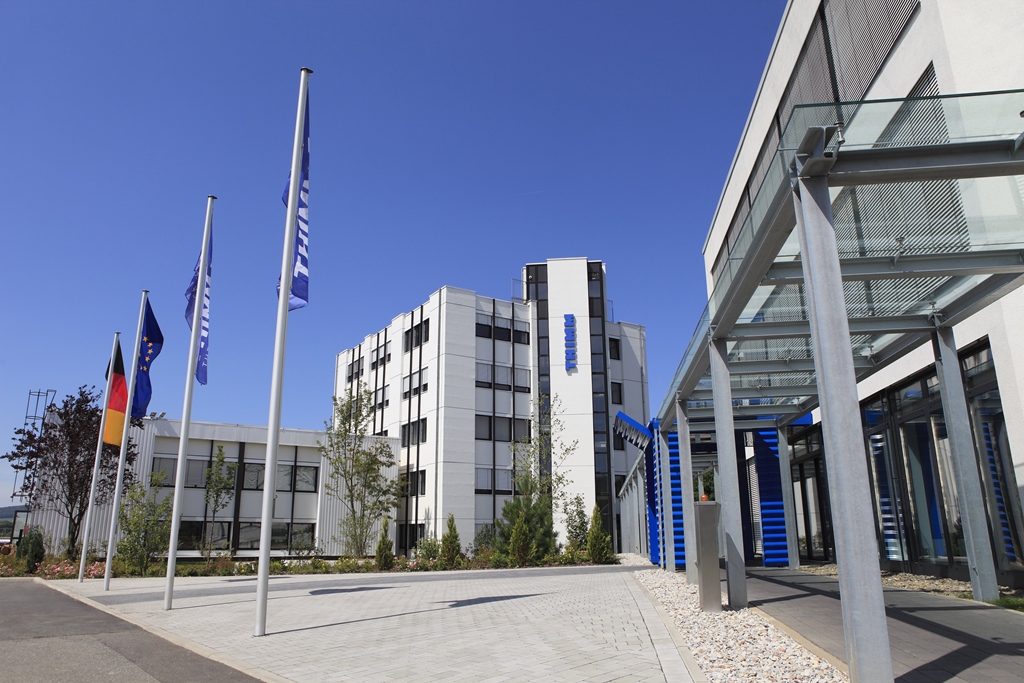
The THIMM Group headquarters in Northeim today.
Potential for the future
Klaus Thimm accompanies the further development of the company together with his two sons on the company advisory board. Keeping the group of companies in family ownership is out of the question for them. The corporate culture is also characterised by the family. This is based on three central values: Performance orientation, Appreciation and Willingness to develop.
Performance-orientation stands for serving the customer, appreciation for dealing with each other and a willingness to develop for the creativity and innovative ability of all employees to face challenges and continue learning. The exciting market for packaging offers many opportunities for this, so that there is also plenty of potential for new ideas, concepts and solutions for customers worldwide in the future. A challenge that Thimm is happy to take on.