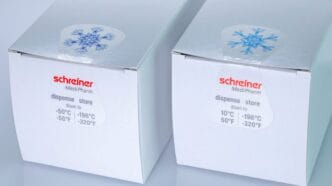
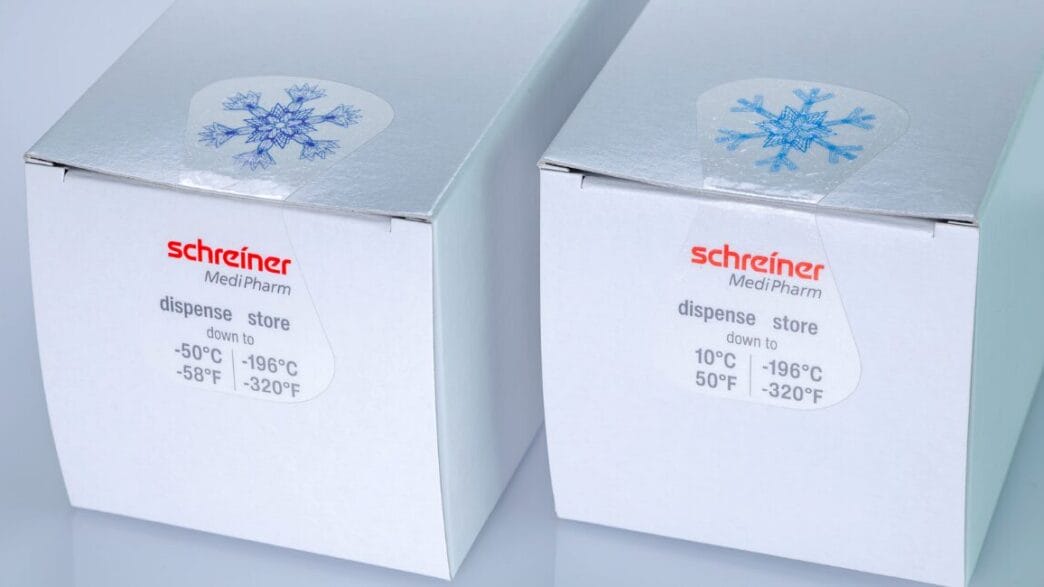
The requirements for pharmaceutical packaging are constantly increasing, especially when it comes to storage and transport at extreme sub-zero temperatures. Schreiner MediPharm has now developed a new deep-freeze seal that is specially designed for sealing folding cartons at temperatures as low as -196 °C.
This innovation is particularly relevant for the safe storage and transport of medicines that are dependent on low temperatures during production and use, such as mRNA active ingredients and biologics.
The EU Falsified Medicines Directive and ISO 21976 stipulate tamper-proof packaging for prescription medicines. At extreme sub-zero temperatures, the adhesion of conventional seals often reaches its limits, which can jeopardise the integrity of the products and the safety of patients. To meet these challenges, Schreiner MediPharm has developed a seal that adheres reliably even under extreme conditions and makes tampering attempts visible.

The frozen food seal in detail
The transparent deep-freeze seal from Schreiner MediPharm offers a multi-tear effect as a double safety mechanism. If an attempt is made to remove the seal, an irreversible tear in the film is caused by the integrated safety punchings. Depending on the cardboard surface, a fibre tear can also occur on the folding carton, which makes tampering immediately recognisable. An elaborate guilloche is also integrated as an authentication feature, which can be supplemented with additional security features depending on the threat scenario.
The seal is available in two versions: one for dispensing at 10 °C and another for applications down to -50 °C. Both variants fulfil the requirements of the relevant safety guidelines and adhere reliably throughout the entire supply chain. Schreiner MediPharm offers comprehensive consulting services to customise each solution to the specific needs and threat scenarios of pharmaceutical manufacturers.
Source: Schreiner MediPharm