With over 87,000 systems installed in more than 60 countries, Tomra is the global player in reverse vending - with cloud-based tools, digital features and energy-saving functions.
6 November 2025
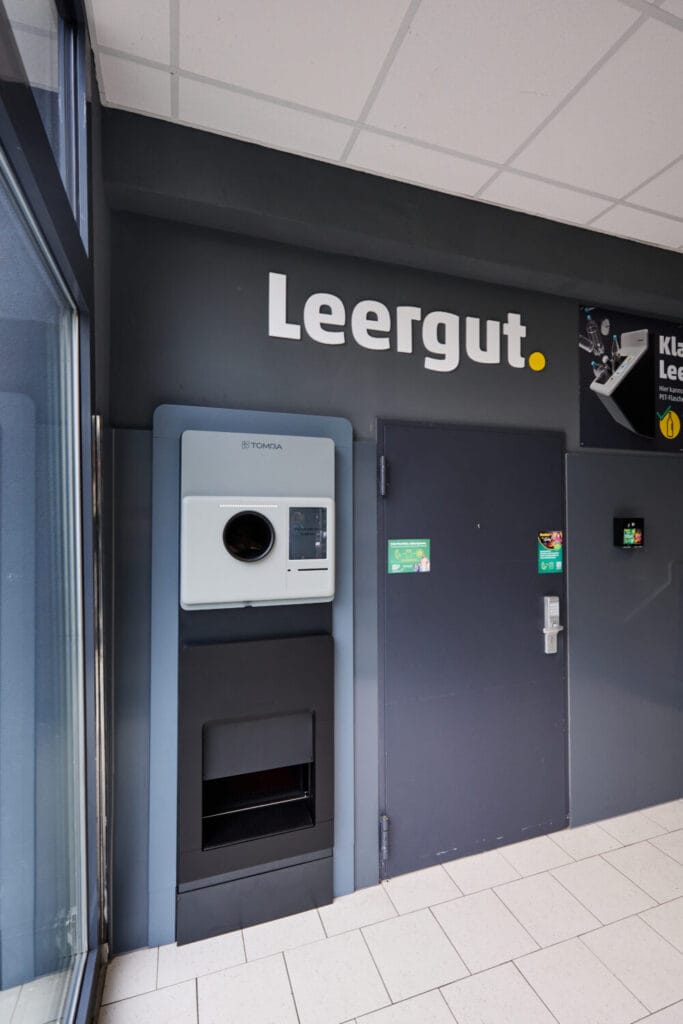
Thanks to the multi-feed function, customers can put all their empties (bottles, cans, glass bottles) into the Tomra R2 at once. (Image: Tomra)
packaging journal AUDIO - Listen to this article:
0:00
0:00
When the first Tomra reverse vending machine was created in Norway in 1972, little did anyone realise that decades later this innovation would set the global standard for deposit systems. Today, with over 87,000 systems installed in more than 60 countries, Tomra is the global player in reverse vending - with cloud-based tools, digital features and energy-saving functions.
„Today, our reverse vending machines 48 billion beverage containers annually worldwide collected, sorted and sent for recycling. We currently have more than 31,000 machines installed in Germany alone,“ explains Thomas Løstegård, Managing Director of Tomra Collection. The German subsidiary was founded in 1985 and is now based in Langenfeld.
The 40th anniversary this year is also an opportunity for Tomra to present the next generation of its technologies. It is becoming clear: Returning empties is no longer a purely logistical process, but is becoming a decisive factor for sustainability, customer experience and employee relief in retail. The future viability of retail companies increasingly depends on their ecological footprint.
(Image: Tomra)
„All major German retailers have committed to reducing their emissions. However, as the majority of emissions are generated in the value chain, retailers cannot achieve their targets without their suppliers. At Lidl and Kaufland, for example, 99 per cent of emissions are generated by suppliers.“
Display
Christina Ek, Head of Sustainability at Tomra
Tomra therefore relies on life cycle assessments to evaluate the environmental impact of its appliances over their entire life cycle. Christina Ek: „Today, we know more about our products and their impact over their entire life cycle than ever before.“ Based on these analyses, ecological criteria are incorporated directly into product development: more compact transport solutions, the use of recycled materials or energy-saving modes such as the sleep mode on the Tomra R2.
Returning empties must be sexy
Tomra has had a major impact on reverse vending technology, most recently with the current RollPac and R2 solutions. Josef Mühlenbein, Edeka owner from Kassel, knows first-hand that this is not just about machines. In his store, for example, the new Tomra R2 has already been providing for 150 per cent more reverse vending machines than in the same month last year. Thanks to the multi-feed function, customers can deposit all their empties at once, as the R2 takes back bottles, cans and even glass bottles in one go without pre-sorting. The machine counts and sorts the empties automatically and prints the deposit receipt. An illuminated touchscreen guides customers intuitively through the process, significantly reducing waiting times.
For Josef Mühlenbein, one thing is clear: „Returning empties has to be sexy. That means no queuing, no noise, no dirt.“ The new generation of machines fulfils exactly these expectations. Customers appreciate the speed and simplicity, while employees benefit from less effort and greater cleanliness. For retailers, this not only means satisfied customers, but also higher sales: According to a study, 93 per cent of consumers spend their deposit money directly at the store.
Modern reverse vending machine: The new Tomra T100 with digital deposit payment and intelligent user guidance is prepared for paperless operation. (Image: Jannik Hammes Photography)
The Rewe supermarket Dreschmann & Ludwig in Langenfeld has also opted for a Tomra R2. The brand new Tomra T100, the next generation of single-feed vending machines, is also being used in the store. Dreschmann & Ludwig was one of the first eight locations in Germany to introduce the T100, and more than 30 machines have now been installed. With digital deposit payment and intelligent user guidance It combines functionality with sustainability, because the model is prepared for paperless operation and a Dimming function on the display supports energy-saving use. At the Rewe supermarket in Langenfeld, two T100s work alongside the R2, each with a RollPac vertical compacting solution in the background.
(Image: Tomra)
„With the T100, we are consistently taking the next step towards modernising reverse vending solutions for retailers and combining intelligent design with sophisticated technology.“
Thomas Løstegård, Managing Director at Tomra Collection
Vertical compacting as a game changer
Last year, Tomra launched the RollPac as the first system for utilising retailers' existing roll container infrastructure. It requires less floor space and thus creates space in the warehouse, for example for the return of reusable packaging. The system also creates around 30 per cent more collection volume and uses existing roll container infrastructures. Changing the bins only takes a few minutes and can be done by any employee - a tangible benefit for team satisfaction.
The future of reverse vending
The return of empties is developing a strategic success factor in retail. Systems such as the R2 and the T100 are already demonstrating how technology can improve customer experiences and put sustainability into practice. Tomra is thus also positioning itself as a shaper of tomorrow's resource utilisation.
packaging journal 5/2025
This article was published in packaging journal 5/2025 (October).