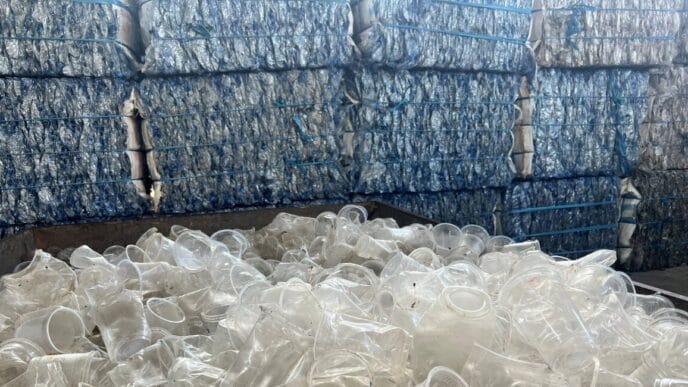
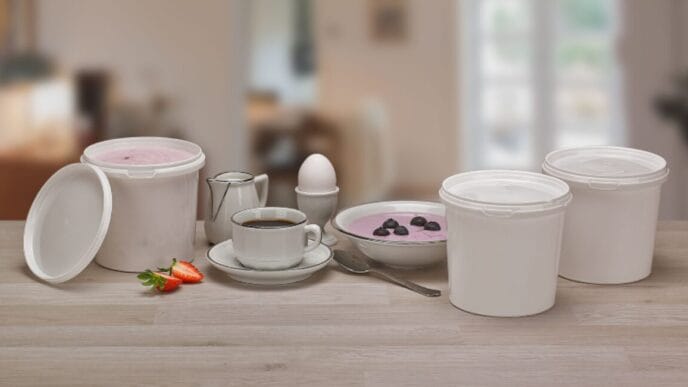
The Bielefeld-based intralogistics specialist Torwegge is committed to greater sustainability in conveyor technology and manufactures its TPBK wheels entirely from recycled plastic granulate - obtained from yoghurt pots.
With an annual production of more than 100,000 units, the company thus offers an environmentally friendly solution for the production ofs for various industries such as mechanical engineering, furniture production and food manufacturing. Thanks to their special properties, TPBK wheels are load-bearing, non-marking, odourless and free from carcinogenic polycyclic aromatic hydrocarbons (PAHs).
„By using recycled granulate, we reduce the consumption of primary resources in production and the amount of plastic waste. With this approach, we combine ecological responsibility with the high standards of functionality and quality that modern industrial and commercial companies expect.“
Niclas Lottmann, Production Manager at Innova Plast Kunststofftechnik GmbH, a subsidiary of Torwegge
The Bielefeld-based company acquired the plastics specialist Innova Plast last year and thus significantly expanded its range of services. Among other things, the plastics technology division was added to the portfolio, which includes the development and construction of plastic items.

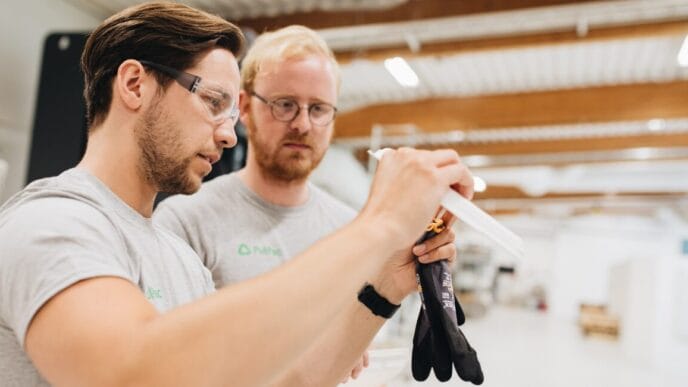
TPBK wheels are manufactured in precise work steps: After sifting the material, the granulate is heated and the ball bearing is overmoulded. The production process requires only minor adjustments compared to the use of new granulate. The injection temperature is slightly increased by around five degrees due to the specific properties of the recycled pellets. „We made a conscious decision to use recycled material in order to optimise costs and reduce the environmental impact,“ explains Lottmann, adding: „The granulate fulfils our strict requirements for flowability and impact resistance, so that the quality of the wheels is guaranteed at all times.“
The TPBK wheels consist of a ball bearing, a running surface made of thermoplastic rubber and a wheel body made from recycled polypropylene (PP), obtained from yoghurt pots. They are equipped with thread protection discs to protect against dust and dirt. Their non-marking properties, high load-bearing capacity and odourless use make them ideal for a wide range of applications, especially indoors. Thanks to their PAH-free production, the wheels also fulfil the highest environmental and health protection standards and are therefore Particularly suitable for the food and medical industries.
„Our TPBK wheels show that sustainability and functionality can be successfully combined,“ emphasises Lottmann. At the same time, the recycled granulate also offers economic advantages, as it is cheaper than virgin polypropylene. Torwegge remains open to other recycled materials in the future. „We are convinced that the use of sustainable materials in conveyor technology will continue to gain in importance,“ says Lottmann.
Source: Torwegge