Transformation of the recyclers (II): BellandVision
As part of the Veolia Umweltservice Group, BellandVision focuses on strategic partnerships for forward-looking packaging recycling and emphasises the importance of early decisions by manufacturers.
11 September 2024
From collection to recyclate - the dual systems shape the circular economy.
(Image: Veolia Germany)
In the past, the dual systems' primary task was to collect, sort and recycle used packaging for manufacturers throughout Germany. Today, recyclability and the use of recyclates are essential and the focus is on them: as part of the Veolia Umweltservice Group, BellandVision relies on strategic partnerships for forward-looking packaging recycling and emphasises the importance of early decisions by manufacturers.
For more than 30 years, used packaging has been collected, sorted and recycled separately from residual waste in Germany. After recycling in Germany was initially raised to a new level by the Packaging Act in 2019, EU-wide regulations for handling packaging and packaging waste are in the starting blocks with the PPWR, which will once again reorganise the interaction between the economic players involved.
In the beginning, the services provided by the dual systems were largely standardised and the price was the main deciding factor when choosing a system partner. From the point of view of some manufacturers, it hardly mattered which dual system they used for their packaging. The main thing was that the price was right. In the future, this one-dimensional approach could prove to be short-sighted for manufacturers of packaging subject to system participation. The following applies, to act with foresight, BellandVision knows that it is better to be safe than sorry.
Packaging Act as a trigger for change
When the Packaging Act came into force in 2019, the industry began to rethink its approach. Although the current version of Section 21 VerpackG has not yet been able to achieve 100 per cent of the steering effect hoped for by the legislator in terms of recyclability and the use of recyclates, the very existence of such a regulation has brought movement to the market. As packaging conversions require a certain lead time, large retailers and manufacturers have already started to implement them, check the packaging range for recyclability and initiate targeted measures. The use of recycled plastic as a raw material is also becoming increasingly common.
Display
EU regulation and amendment increase requirements
However, this was only the beginning, as the requirements for manufacturers continue to increase. §Section 21 of the German Packaging Act (VerpackG) is to be amended in future with more binding requirements for recyclability. In addition, the EU Packaging Regulation (PPWR) is another milestone for the circular economy that is still awaiting final approval from the newly elected EU Parliament. As a result, only packaging that can be recycled will soon be allowed to be placed on the market in the European Union. In addition, depending on the application, plastic packaging must be recycled, contain at least 35 per cent recyclates as early as 2030. This next evolutionary step requires a fundamental change in the cooperation between manufacturers and dual systems. This is because it will not only be expensive for manufacturers who do not fulfil the legal requirements, but they may no longer be allowed to place packaging on the market in the EU.
More recyclable packaging increases the quality and quantity of recyclate. (Image: Veolia, Christophe Majani D'Inguimbert)
Transparency and knowledge transfer
The further development of the circular economy towards closed material loops entails great complexity for all economic players, and information asymmetries between manufacturers, packaging producers and the recycling industry must be further reduced. Platforms such as the Forum Rezyklat are therefore indispensable for the exchange of knowledge. Specialist package 2 „Technology and recyclability“, headed by BellandVision, deals with current issues, in particular the minimum standard, and makes a comparative study on sorting innovations and a study on relevant criteria for the recycling of paper-based packaging with barriers available to the public free of charge in the interests of market transparency.
Long-term partnership instead of a pure contractual relationship
However, knowledge alone is not enough to master the new challenges. It also requires action on the part of manufacturers and dual systems. Due to the new Europe-wide requirements the demand for high-quality recyclates will increase immensely by 2030, while qualified suppliers with recycling expertise will remain in short supply. The same applies to the demand for sound advice on recycling-friendly packaging design.
(Image: BellandVision)
„The challenges require long-term partnerships between dual systems, retailers, manufacturers and packaging producers. Issues such as the use of recyclates and design for recycling require continuous cooperation, which must be initiated at an early stage. Those who continue to make purely price-driven decisions on system participation will face problems in the future.“
Diana Uschkoreit, Managing Director of BellandVision GmbH
The choice of a competent and reliable recycling partner becomes a critical success factor. It must provide manufacturers with the right advice and support them in fulfilling recycling quotas and procuring recyclates. Access to raw materials and the Group's own sorting and recycling facilities can be utilised for this purpose.
Everything from a single source
The magic words for the future are „recyclability“ and „use of recyclates“ - and this is exactly where BellandVision comes in. In order to prepare customers for future requirements in the best possible way, the company has took the initiative at an early stage and created the necessary structures, services and capacities. A team of packaging and recycling experts has been put together to establish innovative solutions and processes.
Time is of the essence, because before packaging can be converted, thousands of items in a manufacturer's range must first be evaluated to identify non-recyclable packaging. With flexible software solutions and lean processes BellandVision quickly determines the status quo and responds to individual customer requirements. The consulting activities for packaging optimisation are supported by our partner Circpack by Veolia, e.g. through sorting tests in our own sorting facilities or the certification of recyclable packaging - all from a single source.
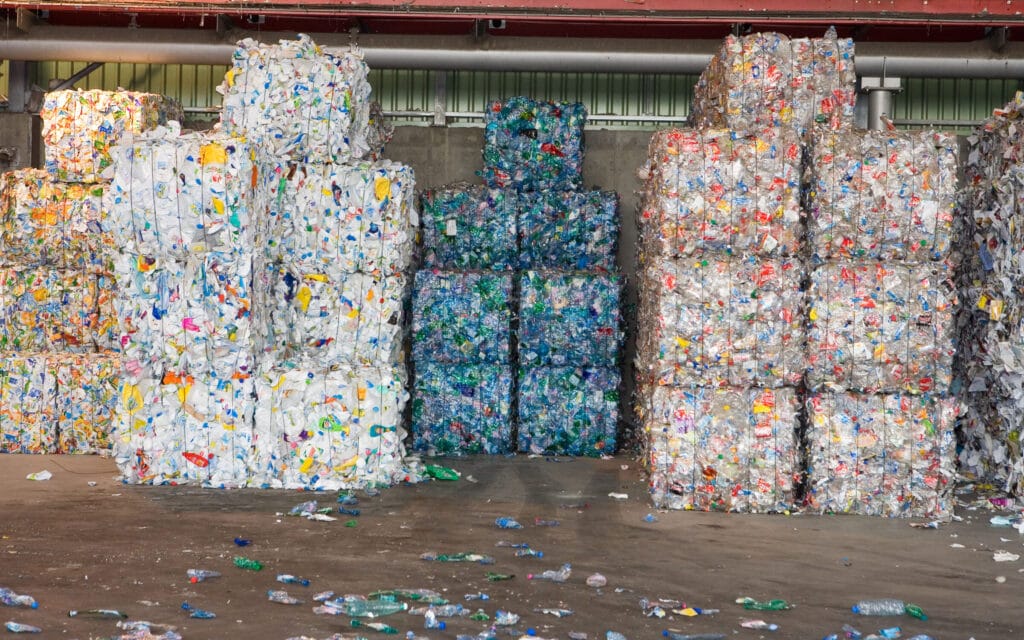
A high market share facilitates access to bale goods and recyclate. (Image: Veolia, Jean Marie Ramès)
Utilise potential
BellandVision customers also receive the best advice on the use of recyclate. As part of Veolia, the pioneer of ecological change and the world's largest plastics recycler, the company provides customers with pioneering and long-term support in the use of recyclate. Manufacturers of packaging subject to system participation therefore have a reliable partner at their side and are ideally equipped for the requirements of the future - and not just in terms of system participation. „With our expertise, which based on the experience of analysing well over 30,000 individual packages, we are one of the top addresses for Design4Recycling solutions. Our Circular Consultants also use their expertise to analyse extensive packaging ranges. They have been advising manufacturers on recycling-friendly packaging and optimising the use of recyclate in product development for several years. Only this close collaboration and continuous exchange of knowledge makes it possible to achieve the ambitious recycling targets,“ adds Diana Uschkoreit.
Together with international recycling experts, evaluation methods were developed to support manufacturers in packaging optimisation and facilitate the development of new packaging concepts throughout Europe. „Through our international Group network, we have access to one of the largest plastic recyclate quotas in Europe for a wide range of applications. With BellandVision, manufacturers of packaging subject to system participation have a reliable partner for recycling and are ideally positioned for future requirements,“ emphasises the Managing Director.