With TriVision's technology, the food industry can avoid costly recalls, significantly increase quality and improve availability.
19 July 2019
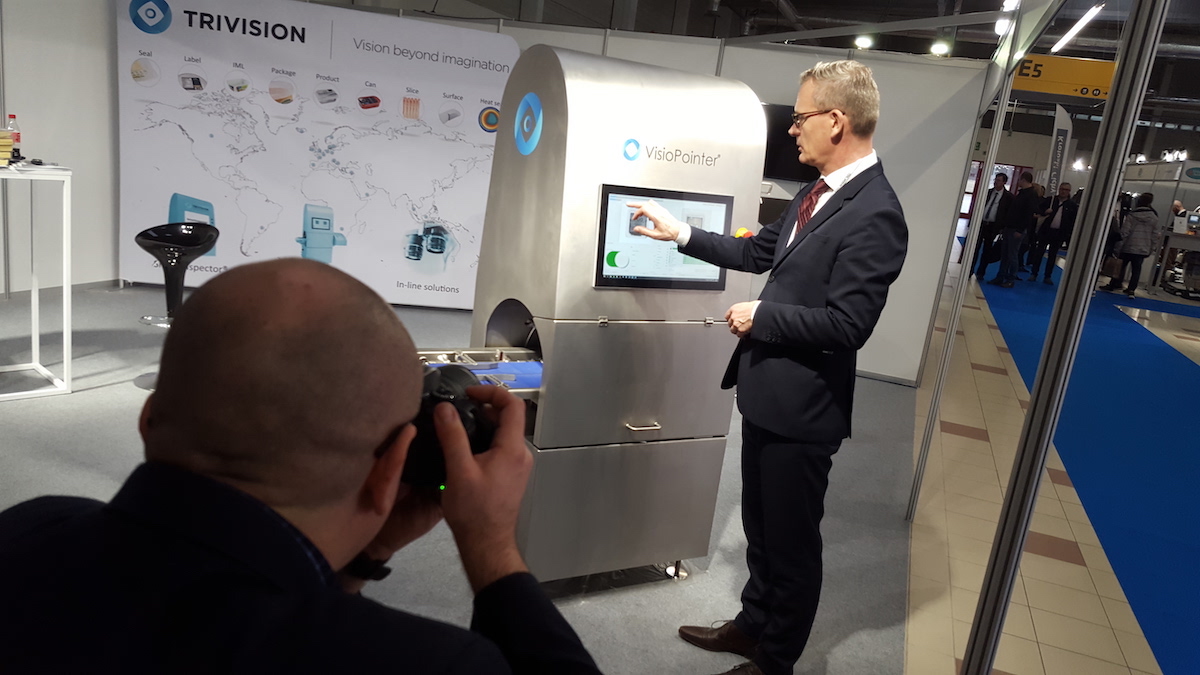
Poland tradeshow (Image: TriVision)
With the vision technology from TriVision in Denmark, the food industry to avoid expensive recalls, significantly increase quality and improve the OEE (availability). Danish Crown and Arla Foods are already using this technology to ensure that high-quality food does not have to be rejected due to packaging errors.
This has led to an increase in performance here. Trivision has also recently started cooperating with the German food industry and will be represented at IFFA, the International Butchers' Trade Fair in Frankfurt am Main, in May.
„There is great interest in the international meat industry in effective, uncomplicated vision technology that protects against expensive, brand-damaging recalls. The technology combines cameras with highly developed software, recognises faults at an early stage and indicates directly in which area of production intervention is required.
This can save large food companies a lot of money. Germany ranks third worldwide in the use of industrial robots and will therefore be able to benefit from the proven vision technology in the best possible way“ Jesper Bach, CEO at Trivision
Display
CEO Jesper Bach TriVision (Image: TriVision)
Avoid return containers from China
Danish Crown accounts for 21 per cent of Danish exports to China and ships 24 containers filled with meat products to the People's Republic every day. All goods are labelled with Chinese characters, which makes manual inspection difficult. Even a tiny printing error can result in a character with a completely different meaning. There is also the threat of fines if the labels cannot be scanned.
„The long transport route is one of the biggest challenges when exporting to China, as errors in our product packaging only become apparent after a long, expensive journey. The discovery of a single packaging error, which would lead to the rejection of a full container and a fine, is already enough to amortise our investment in the vision system.
With the TriVisions SmartInspector, we can immediately recognise which products and work teams have problems and can subsequently address the employees concerned directly and ask them to work more precisely“ Steffen Jørgensen, IT consultant at Danish Crown
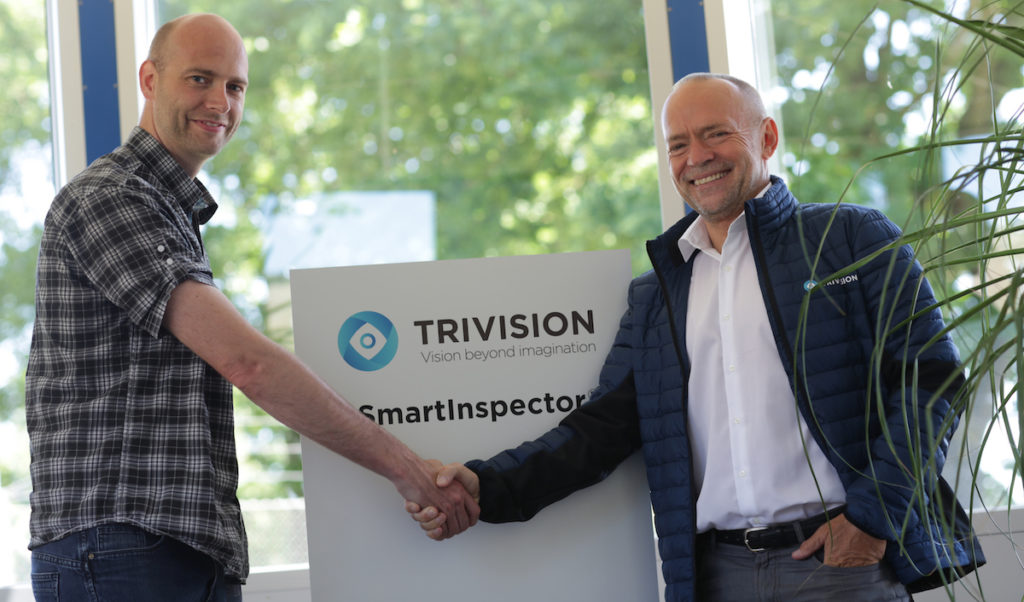
IT consultant Steffen Jørgensen from Danish Crown and Founder of TriVision Ole K. Neckelmann (Image: TriVision)
Not only is the packaging checked before dispatch, Danish Crown also receives detailed quality documentation, which can be used in the event of a complaint to prove that the fault was not caused by the company, but by the transport company.
Fewer and shorter downtimes
Arla also uses TriVision vision technology to ensure that a packaging error does not overshadow the high quality of the contents. Soiling on the seal, quality defects and incorrect labelling are detected. This allows problems to be rectified before damage occurs. At Arla, quality-related production stoppages have decreased as a result. At the same time, the number of customer complaints and the amount of waste have fallen.
„Before we implemented the TriVision system, production stops were not uncommon for us. Thanks to the new system, many errors have been rectified in all areas of our production and the number of customer complaints has fallen sharply“ Bjarne Nielsen, Production Line Manager at Arla Foods
Bjarne Nielsen, Production Line Manager at Arla (Image: TriVision)
The TriVision technology could be implemented at Arla without having to change the entire production line. With its 80 cm x 80 cm side length, the TriVision system is so compact that it fits into any production line. The secret is a combination of cameras and software that is easy to use and has been developed over a period of almost 20 years.
1500 macro can photos per minute
A third TriVision technology - CanInspector - is used by tinned fish producer Sæby. This is one of the world's largest producers of tinned mackerel fillets, supplying 130 million tins a year all over the world. A large proportion are private labelled, and 85 % are exported - with up to 35 different sauces and licks.
This means that Sæby changes its production frequently and can therefore benefit greatly from the vision technology. The fish tins are photographed eight times per second from different angles - the machine processes almost 1500 photos per minute and checks the crimping, artwork and print, among other things.
„In my opinion, the machine is a true marvel! It checks the products so quickly that it's impossible for a human to keep up. We are currently working on a few additional programmes that will save us a lot of money in the future“ Torben Jensen, Operations Manager at Sæby