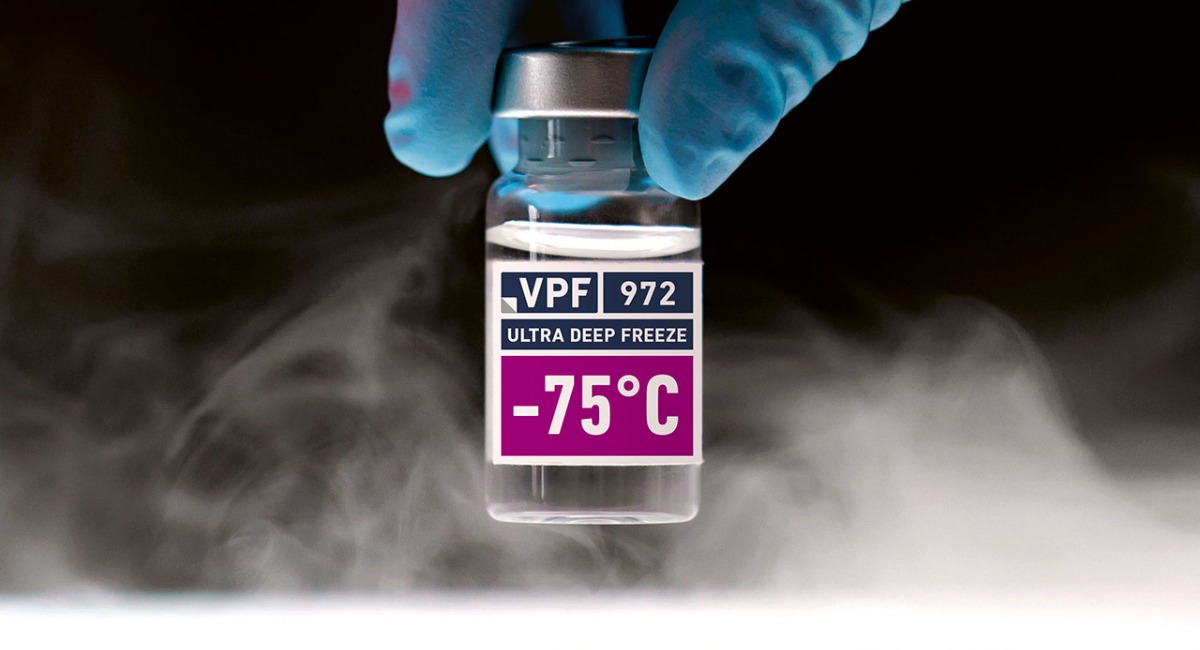
Extreme cooling is a necessary requirement for pharmaceutical products such as Covid-19 vaccines in order to guarantee their effectiveness. A new Ultra Deep Freeze adhesive, which can be used at temperatures as low as -75 °C, ensures that labels adhere securely to glass vials.
The adhesive specialists at VPF have launched the new Ultra Deep Freeze adhesive labelled 972 for this segment. Tests confirm that it Can be used in conjunction with suitable PP face materials for temperatures down to - 75 °C is ideally suited for labelling vaccine doses or syringes, for example, which have to be stored and transported at extremely low temperatures.
Ultra Deep Freeze pressure-sensitive adhesive extensively tested
VPF has had the temperature resistance of the highly transparent dispersion acrylate adhesive 972 extensively tested by an independent institute. As Glass vaccine doses were used as test objects with a diameter of 30 mm, labelled with the material PP white glossy 60 μ (VPF 60659), coated with 18 g/m2 of Ultra Deep Freeze Adhesive 972.

In the test series, the glass vaccine doses labelled at room temperature were exposed to a temperature of - 75 °C for 72 hours and then warmed to + 5 °C for 12 hours. The test result has confirmed the temperature resistance of the new adhesive. This still had full adhesive strength and cohesion values; no embrittlement of the adhesive or edge peeling of the labels was detected.
Wide temperature window
VPF gives as Temperature window of the adhesive - 75 °C to + 70 °C The labelling temperature should be higher than - 5 °C. The low-migration adhesive is equally suitable for paper and film face materials. It has ISEGA approval for direct contact with dry, moist and fatty foods with a correction factor of at least 3 (in accordance with EU Regulation 10/2011). In addition, the adhesive 972 Can be used for labelling blood bags.
SourceVPF : VPF