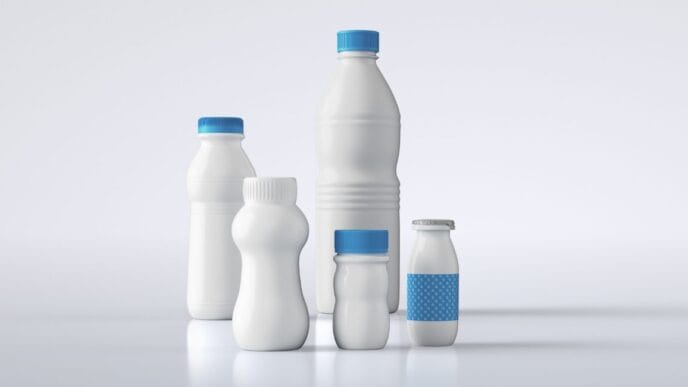
Leak testing is indispensable in the production process of airtight packaged pharmaceuticals and foodstuffs. Microscopically small leaks must be detected, the product and packaging must not be damaged and, of course, it should be carried out very quickly and efficiently. An inspection system based on an alternative vacuum technology was developed for this task in collaboration with several partners.
So-called Microleaks are so small that they are not noticeable during a manual inspection, but are large enough to accelerate the spoilage of a product. This creates health risks for the consumer and unnecessary costs for the manufacturer. This is why companies in the food and pharmaceutical industries attach great importance to packaging. Leaking packaging must ejected from the production process as early as possible be checked. To be able to recognise whether air bubbles are escaping, packaging is randomly submerged under water. However, these manual checks are not nearly reliable and precise enough to detect microscopically small holes.
Speed is also required with vacuum technology
The Dutch company Oxipack Leak Detection has developed an alternative method for leak testing that is based on innovative vacuum technology based. „The principle is simple,“ explains Pim Jobse, technical director of the Houten-based company. „You place the product between two rubber membranes, seal everything and create a vacuum. If the packaging is tight, nothing happens. But if there is a small hole in the packaging, the pressure in the vacuum chamber rises.“ With this method using vacuum technology, it is possible to detect leaks as small as ten micrometres.


But the vacuum method also takes time. Too much time. „The whole process takes about half a minute,“ says Jobse. The Time factor presented Oxipack with a particular challenge: in order to meet the requirements of the market in the area of inline leak testing, a system had to be able to test 120 units per minute. The company was therefore looking for a machine manufacturer that could develop a solution with the necessary efficiency.
Cooperation at eye level
For Oxipack, the Machinefabriek Geurtsen as the ideal mechanical engineering partner. For the control technology, the company relied on B&R. „This is mainly due to their development environment Automation Studio“, explains Wardo Dietrich, the chief designer at Geurtsen. „Whatever I connect to my system, the communication works perfectly. As a programmer, I can do all my work in a familiar environment.“
In addition to the ease with which all his questions were answered, Jobse was particularly impressed by the user-friendly diagnostic functions of the control unit impressed. „Without having to do anything, the status of the control unit is displayed immediately. Everything is pre-programmed. With other manufacturers, for example, I am told that there is a driver error. But I have to find out how to solve the problem myself. With the System Diagnostics Manager, B&R provides a tool that not only displays detailed information, but also a solution.“
Leak test on the Ferris wheel: once round and round
Oxipack had clear expectations of Geurtsen's developers. „Based on previous negative experiences, I wasn't actually supposed to develop a machine carousel,“ says Dietrich. In the end, however, almost all ideas proved to be too cost-intensive, and only one serious option remained: the Carousel variant. In contrast to the horizontal carousel that Oxipack had previously used, Dietrich set up his carousel like a Ferris wheel on. This has significantly reduced the space required.
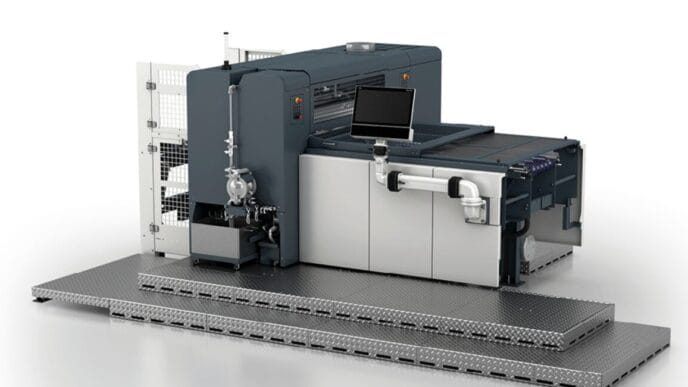
The inspection system with the name The Rotary is equipped with up to twelve measuring chambers. When a product is conveyed into a chamber, it closes. The air is then released and the reaction checked. Once the packaging has reached the starting point, it is determined whether it is sealed or needs to be ejected. The product then slides onto the appropriate conveyor belt.

For the infeed, Geurtsen opted for a shuttle conveyor that reverses at the last moment while the conveyor belt continues to run. „This positions the product accordingly,“ says Dietrich. „We often use this method. In this case, however, the timing was very tight because the feed belt merges into a rotating wheel.“ Geurtsen and B&R worked together to find an optimal solution through numerous tests.
Integrated drive system
The feed belt and wheel were optimally synchronised with the help of a fully integrated drive system from B&R. This includes servo drives, inverters and safety technology. The system is controlled via a Panel PC 2100 from the company. It combines visualisation and a powerful PC-based controller in a single device. „With the help of B&R's mapp software components, the shuttle conveyor can be synchronised without complicated calculations. Adapt to different packaging. Only a few parameters need to be set,“ Jobse emphasises.

With the mapp component for recipe management, machine operators can quickly switch between products of different sizes and weights. By using sensors to automatically determine the product parameters, it is even possible to test product combinations simultaneously.
Space-saving and flexible
The first new inspection system with vacuum technology from Oxipack and Geurtsen was delivered to an Italian customer for testing purposes. „The system can inspect 20 products per minute,“ says Jobse. However, a speed of around 120 products per minute is required for a practical inline leak test during operation. „That's where the Modular structure paid off,“ says Jobse. „Five more wheels can easily be added without significantly expanding the footprint of the packaging line.“