Hot melt adhesives have different properties and should not be mixed. However, this can happen again and again when changing adhesives and lead to problems. To ensure that everything runs smoothly, the adhesive application system must be thoroughly cleaned when changing the adhesive.
Many producers in the packaging, converting and printing industry, the so-called consumer industry, rely on Robatech Adhesive application systems. If such an adhesive application system comes to a standstill, an entire production line usually comes to a standstill - a no-go for many companies. A frequent cause of such a standstill is due to burnt adhesive, often in connection with a change of adhesive. Why? Too little attention is probably paid to cleaning when changing adhesives. As every adhesive has specific properties, the top priority is never to mix hotmelt adhesives! Mixing adhesives inevitably leads to problems that are not necessarily immediately visible, but can be recognised before they occur. Medium to long-term consequences Experts warn.
Looking at the specific properties of adhesives, it quickly becomes clear why mixing different hotmelt adhesives leads to problems. An example: an adhesive with a processing temperature of 150-170° C is replaced by an adhesive with a processing temperature of 130-150° C. If the new adhesive is now added to the old one in the tank, two things happen: Firstly, the new adhesive burns because the temperature in the tank is too high. Secondly the viscosity of the adhesive is reduced, when it is heated above its processing temperature - it becomes very thin. The low-viscosity adhesive is conveyed through the system faster because it flows better, while the old, thicker adhesive remains in the tank and burns. Burnt adhesive is not immediately noticeable, but once coking has set in, it can settle somewhere in the adhesive application system - with disastrous consequences. Heating hoses can become overgrown and application heads can become blocked. To avoid this, the entire adhesive application system thoroughly cleaned during an adhesive change become.

Clean adhesive application systems are necessary
Another problem that can arise due to mixed adhesive is Incorrect adhesive application. If, for example, the viscosity is too high due to incorrect temperature settings, the adhesive is too viscous - in other words, too little adhesive is applied. If, on the other hand, the viscosity is too low, too much adhesive is applied because it is too thin. However, incorrect bonding is also caused by an open time that is too long or too short - i.e. the time it takes for the adhesive to set. These problems show how important it is to change the adhesive properly. Because a Clean adhesive application is only possible with a clean adhesive application system.
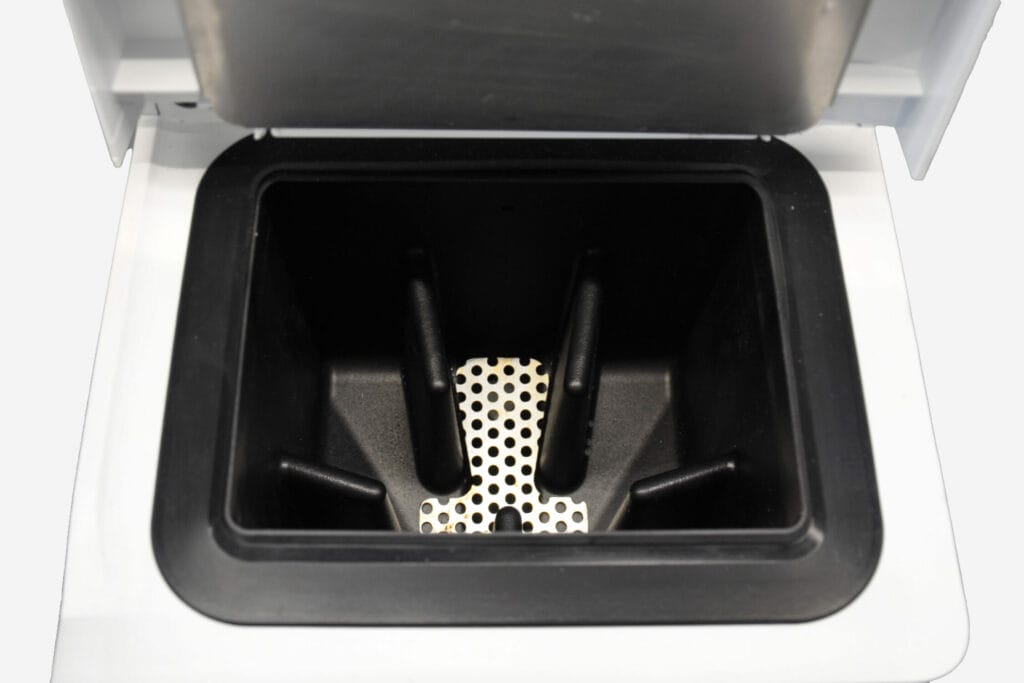
The entire adhesive application system should therefore be cleaned every time the adhesive is changed. The procedure is relatively simple: The Old adhesive must be removed and new adhesive poured in. Cleaning agents are generally not necessary. Adhesive residue in the adhesive tank can be removed with a wooden scraper and a lint-free cleaning cloth. Heating hoses can be rinsed with new adhesive. Rinsing the old adhesive is displaced by the new adhesive. The application heads can also be rinsed with the new adhesive. In the meantime, the adhesive filters from the melter and the application head can be soaked in heated technical white oil, as can the application nozzles.
Investing 3-4 hours in cleaning is a manageable effort that can be planned. Downtimes due to burnt adhesive and clogged application heads or hoses, on the other hand, cannot be planned, troubleshooting is difficult and the necessary cleaning takes much longer. In the worst case, hoses or application heads have to be replaced. A Thorough cleaning when changing adhesives on the other hand, creates the best conditions for the new adhesive right from the start.
Source: Robatech
More news on adhesives


Jowat strengthens the circular economy with sustainable packaging adhesives

Robatech starts co-operation with ABB

Henkel opens RecycLab in Shanghai

Tesa expands plant in Offenburg