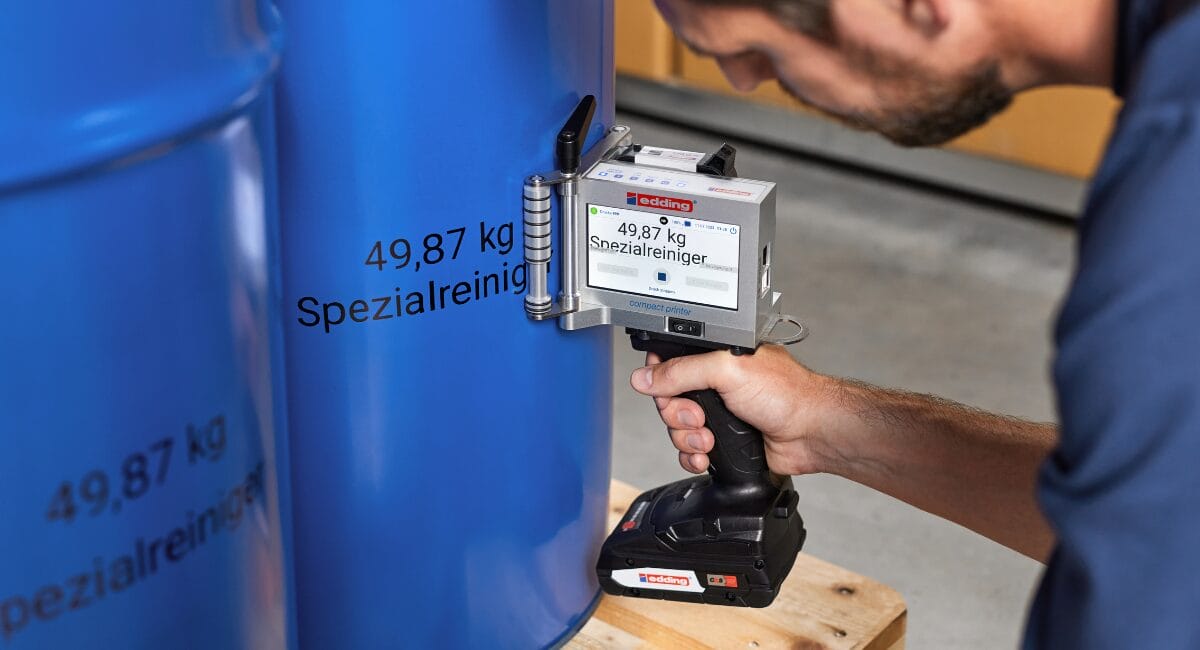
The cooperation between Edding and Elried combines innovative printing systems such as the new In-line Pro IP67 with the special Edding ink portfolio. What's behind it and why this offers unique added value in production.
Back in 2018, Edding AG and Elried Markierungssysteme decided to combine their strengths and launch an innovative series of industrial TIJ printing systems on the market. The idea was to combine Elried's expertise in mechanical engineering with Edding's expertise in ink development to achieve superior printing results by combining the best printer with the best ink.
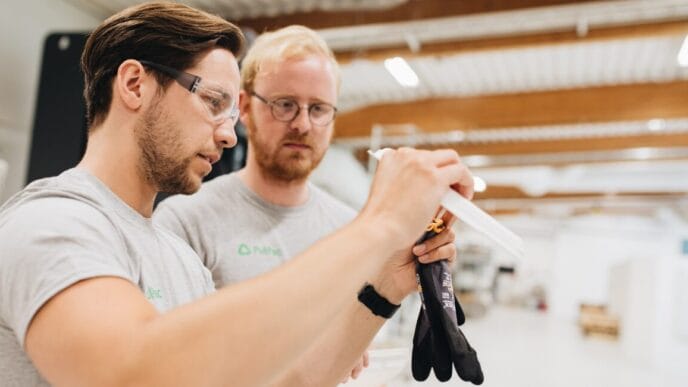
But what makes an ink truly unique? If individual windows at Edding's headquarters in Ahrensburg are still lit up at night, then it is usually the ink development offices. The team at Edding aims to optimise all the important dimensions of an ink, even if these initially seem contradictory from a chemist's point of view:

- Long decap time (the downtime that a cartridge tolerates without having to be wiped afterwards)
- High yield
- High coverage ratio
- Durable UV and weather resistance
- High edge sharpness of the printed image
- High throw distance or high pressure distance
- Permanent adhesion to all substrates
Unrivalled successes have been achieved in all of these areas in recent years:
In terms of decap time, Edding has launched NPXP, the first universal ink on the market that adheres to all surfaces (including plastic, film and glass) and still has a decap time of 72 hours. This means that even if the ink is not used for several days, it will still produce a perfect print image without any cleaning. This is the first time Edding has been able to solve the familiar problem of print heads drying out.
The yield per cartridge is a decisive factor, especially in thermal inkjet printing, i.e. printing with cartridge-based systems. These systems often have a bad reputation for causing high printing costs. However, numerous customer tests have shown that Edding inks achieve twice the range of traditional cartridges with the same printing parameters. Combined with the ink-saving technologies developed by Elried, this results in a range that is up to six times longer and thus the possibility of achieving over three million prints of a best-before date from a single cartridge. Together with the fact that Edding systems are maintenance-free, this results in unrivalled low printing costs.
Edding has developed a complete portfolio of pigment-based inks in black, white, yellow and light blue in addition to particularly high-contrast dye inks to ensure a high degree of coverage. This enables high-contrast labelling even on dark backgrounds without having to give up the ease of use of a cartridge-based inkjet system.
Significantly higher process reliability
With regard to the durability of the print as well as UV and weather resistance, it goes without saying that all Edding inks have to undergo a comprehensive test programme in the laboratories before release and are therefore delivered with tested durability.
The high edge definition of the print also allows the inks to replace previous TTO applications. Only with this increased precision is it possible to print barcodes and data matrix codes with top marks according to the ISO standard and ensure high legibility.
The throw distance, i.e. the maximum print distance, is always relevant for high-resolution printing. Due to the very fine droplet sizes, a high print distance is naturally more difficult to achieve than with the rather coarse print images of continuous inkjet systems. Nevertheless, Edding has been able to achieve print distances of up to 18 millimetres with inks such as the SP25, many times greater than the usual high-resolution printing systems. This leads to significantly higher process reliability, especially when printing secondary packaging.
Of course, in addition to all these requirements, the inks must above all achieve secure and durable adhesion on all substrates. While absorbent substrates such as cardboard are not yet a challenge here, the variability of the materials to be printed on is a special feature of industrial printing. For this reason, Edding has developed special processes to optimise the composition of the inks for the broadest possible coverage of a wide variety of materials. Challenging applications such as printing on plastics and films, particularly cold or warm surfaces and resistance to alcohols and cleaning agents can thus be ensured. This gives customers a high degree of flexibility in their choice of packaging material without having to take the printing system into consideration.
Particularly challenged in the area of regulation
There are also numerous special inks, such as UV-readable security inks, alkali-resistant inks for printing on concrete, thermochromic inks with colour change or magnetic inks. Edding also develops suitable inks for new challenges according to customer requirements.
Last but not least, Edding's experts are particularly challenged in the area of regulation. Nowadays, Edding and Elried's customers are faced with a comprehensive range of regulatory requirements that are constantly coming up with new specifications and are difficult to keep track of. Edding develops inks that always meet the latest requirements and supports customers by providing them with the necessary certificates and attestations.
Edding and Elried started out with the aim of combining the best printer with the best ink to make labelling easy for customers again - in line with the company motto „Mark it simple“. The teams in the Edding laboratories and the regulatory department make a decisive contribution to this - even when the evenings get longer again.