Since January 2023, the obligation for catering establishments to offer reusable packaging has been in force. However, the obligation to offer reusable packaging has not yet led to a noticeable increase in the proportion of reusable packaging. The BMEL-funded REPAID project is now showing what politicians and the catering industry can do.
Whether it's a coffee to go or a burger from a delivery service, customers of cafés, restaurants or delivery platforms usually receive their orders in disposable packaging, which is then thrown away. How can Environmentally friendly reusable packaging as an alternative become more attractive?
A Project team from research and practice shows what can be done now: Companies should Implement simple measures in the sales area, For example, staff should address customers directly and reusable containers should be clearly visible. In order for reusable containers to become more widespread, however, the catering industry must be supported by politicians through the creation of a low-threshold take-back infrastructure on site.

In the REPAID project funded by the Federal Ministry of Food and Agriculture (BMEL), the Institute for Energy and Environmental Research (ifeu) and the Institute for Ecological Economy Research (IÖW), together with the reusable system providers Recup and Vytal, have investigated how reusable packaging can be promoted in the catering industry. They have now summarised their recommendations in a Impulse paper for politics, in Recommendations for action for the catering trade and a Background paper published.
Reusable saves material costs and CO2-emissions
The reusable offer obligation has been in force since January 2023. It stipulates that many catering establishments must offer a reusable option for plates, bowls and cups, for example. However, this obligation has not yet led to a noticeable increase in the proportion of reusable food in the catering industry: Around 14.6 billion disposable packaging units were issued in 2023, one billion more than in the previous year. The REPAID project shows that reusable packaging is not only good for the environment, but also financially beneficial for caterers: In the practical test, the participating companies saved between 10 and 16 per cent of packaging costs on average and an average of 12 per cent of CO2-footprint for packaging.
„Reusable packaging is a win-win situation for restaurateurs and the environment. The higher the proportion of reusable packaging in a business, the greater the potential for financial savings and the more reliable and faster the return process, the greater the contribution to environmental protection.“
Patrick Schöpflin, IÖW project manager
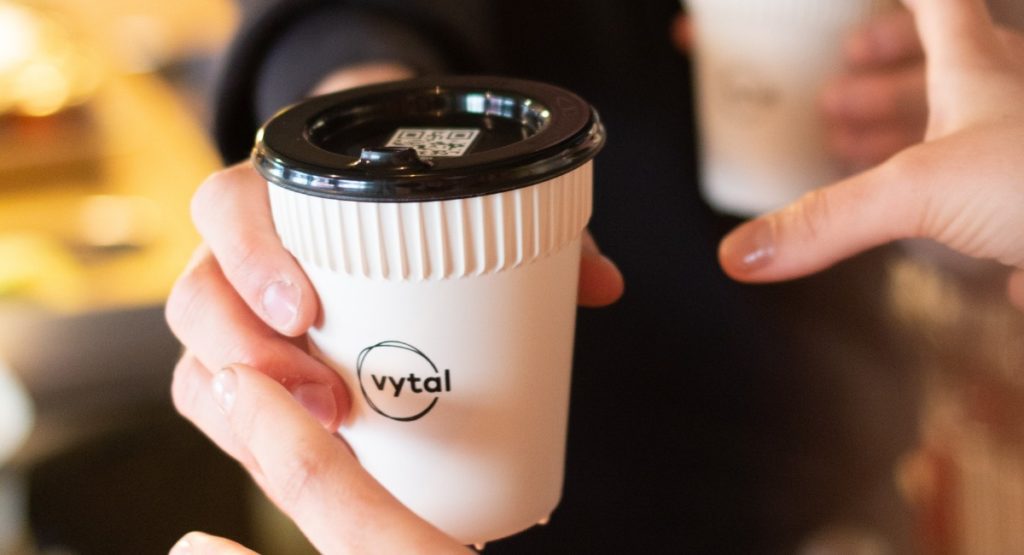
Prominently offer reusable packaging, simplify returns
Even simple measures can increase the reusable quota in cafés and restaurants. The project analysed various measures. Conclusion of the practical test: Reusable alternatives should be actively offered and clearly displayed when ordering - such as cups on the coffee machine. The price advantage of reusable containers can also motivate customers to opt for the alternative.
„A key advantage of a widespread reusable system is that customers can return the containers to many different businesses, because the easier it is to borrow and return reusable containers, the more attractive it becomes.“
Alexandra Berendes from the reusable supplier Recup
Ole Scharpen from reusable packaging supplier Vytal adds: „For many customers, returning the cups or containers is a source of uncertainty. They should be shown how uncomplicated it is to return the containers and which businesses in the neighbourhood participate. Clues can be posters or stickers, that are made available to restaurateurs.“
Levers to promote reuse: Delivery platforms
Many people find it convenient to order food and drinks to their homes using an app. Online ordering is therefore a key lever for establishing reusable options. To this end, providers should integrate the request for the reusable packaging option as standard in the ordering process and ideally preset - reusable packaging is being established as the new normal. At present, it is still too complicated to decide in favour of reusable packaging. In addition, logistics and hygiene regulations make returns difficult. Possible solutions: Public reverse vending machines and, for example, a separate compartment for used reusable containers for transport.
Dual strategy required
In times when the catering industry is faced with challenges such as high inflation, it should not be left alone with the promotion of reusable packaging. The project team recommends a dual strategy: „Our results show the limits of the room for manoeuvre for catering businesses, which is why Accompanying political measures for a packaging turnaround in the to-go area,“ says project coordinator Benedikt Kauertz from ifeu.
One lever for the federal government and local authorities to promote reusable packaging is, for example a standardised national levy for disposable packaging based on the Tübingen model: The city has already successfully introduced a municipal tax on disposable packaging in 2022. Also Constance introduced a packaging tax on 1 January 2025. To go one step further, These packaging taxes should be further developed into a standardised national levy. should be made. The researchers also recommend extending the obligation to offer reusable packaging: Exemptions for materials and company sizes should be withdrawn and delivery platforms should be obliged to simplify reusable orders. According to the researchers, local authorities and cities should promote reusable options and develop take-back infrastructures that suit local conditions.
„Improved take-back structures for reusable containers are an important step towards relieving the burden on customers, caterers and delivery platforms. We therefore recommend that cities and municipalities use the money collected from a single-use levy for a specific purpose in order to set up and operate an expanded take-back infrastructure.“
Carola Bick, Scientist at ifeu
The recommendations were developed in the project „REPAID - Promotion of reusable solutions to reduce single-use plastic service packaging by automating take-back, interventions at the point of sale and digitalisation options“. The team of researchers and practitioners tested in ten catering establishments how the demand for and return of reusable containers can be increased for to-go consumption. REPAID is part of the RePack network, which brings together twelve innovation projects on plastic reduction in food packaging. The project was funded by the BMEL on the basis of a decision by the German Bundestag. The project was sponsored by the Federal Office for Agriculture and Food (BLE) as part of the programme to promote innovation.
Source: Institute for Ecological Economy Research (IÖW)