The coalition agreement between the CDU/CSU and SPD affects packaging manufacturers and packaging companies alike: from recycling obligations and chemical recycling to tax relief. The most important points at a glance.
The new German government has set clear industrial policy and ecological guidelines in its coalition agreement - with a direct impact on the entire packaging industry. This affects companies that develop and produce packaging or packaging machines on the one hand, and the industries that bring packaged goods to market on the other - such as the food, pharmaceutical and consumer goods sectors. Both sides are faced with new regulatory requirements, but also structural simplifications.
„We are reforming Section 21 of the Packaging Act and implementing the EU Packaging Regulation in a practicable way. We are integrating chemical recycling into the existing waste hierarchy. We are strengthening strategies for waste prevention, the use of recyclates and the shared economy.“
(from the coalition agreement, section on the circular economy)
Circular economy as a central topic
One of the most important focal points of the agreement is the consistent further development of the circular economy. The coalition has announced a reform of Section 21 of the German Packaging Act and intends to EU packaging regulation (PPWR) practicable in Germany. This primarily affects companies in the packaging industry - i.e. machine manufacturers, packaging producers and raw material processors. In future, they will have to increasingly adapt to the fact that their technologies and materials must be designed in such a way that packaging can be better reused or recycled.

At the same time, the Chemical recycling integrated into the waste hierarchy. For manufacturers of plastics and multilayer materials, this means new scope - but also the obligation to develop their products in line with the now expanded recycling definitions. The government also wants to specifically support strategies for waste avoidance, the use of recyclates and the strengthening of reusable and shared economy models.
This has tangible consequences for the packaging industry, such as food and cosmetics manufacturers: In future, packaging solutions must fulfil higher ecological standards - both in terms of material use and recyclability. Companies are being encouraged to pay more attention to recyclability right from the product design stage. This brings with it not only technical but also economic challenges - because costs, availability and customer acceptance can vary depending on the choice of material.

These are the five most important points for packaging manufacturers
§ Section 21 VerpackG will be amended - with new requirements for design-for-recycling, the use of recyclates and reusable solutions.
Chemical recycling becomes part of the official waste hierarchy - new opportunities for material and technology development.
Instead of a blanket ban, the government is focussing on risk-based regulation and substitution with alternative substances.
In future, production facilities and test centres can be planned more easily thanks to fictitious approvals and general permits.
Programmes such as SME-innovative, INNO-KOM and ZIM are strengthened, access to KfW is simplified.
Chemicals policy: no bans, but clear expectations
Another key topic in the agreement is chemicals policy. The German government is committed to Germany as a centre for chemicals and rejects a blanket ban on entire groups of substances such as PFAS (perfluorinated and polyfluorinated alkyl substances). Instead, a risk-based approach should be pursued: Where safe alternatives are available, these should be prioritised.
This is particularly important for packaging manufacturers who use PFAS in barrier packaging, for example to repel grease or water vapour in food packaging. While the total ban has not materialised, the Pressure for substitution and innovation. For the packaging industry, this means that it must expect potential changes and should seek dialogue with its packaging suppliers at an early stage in order to ensure delivery capability, product safety and regulatory compliance.
Relief through simplified authorisations and less bureaucracy
One ray of hope for both sides of the industry is the announced simplification of authorisation processes. The German government is planning to implement planning and construction projects more quickly - for example through so-called fictitious authorisations, new framework permits and a stronger bundling of public interests. This could save time and money in future for packaging machine manufacturers or converter companies that want to expand production lines or introduce new technologies.
The packaging industry should also benefit from these simplifications, for example when switching to new packaging formats, cleaning systems for reusable containers or the integration of digital take-back solutions. The coalition agreement expressly emphasises that Small and medium-sized enterprises (SMEs) should be spared from bureaucratic overfulfilment of European rules - for example when implementing the EU taxonomy or the new sustainability reporting obligations.
Effects on packaging companies
In future, stricter requirements will apply to recyclability, reusability and the use of recycled materials
Shared economy and take-back/cleaning systems take centre stage - also conceivable for non-food
Manufacturers must ensure that the packaging used is compliant - even with possible PFAS substitutions.
The implementation of the CSRD and CSDDD is to be simplified for SMEs and not overfulfilled nationally.
Tax relief and subsidy programmes
SMEs are to be strengthened - through tax relief, reduced verification requirements for subsidies and improved access to innovation programmes. Programmes such as SME-innovative, INNO-KOM or the Central Innovation Programme for SMEs (ZIM) are to be expanded. This will benefit both machine and material developers as well as start-ups in packaging technology.
At the same time, the contract also includes large packaging companies, for example through Funding approaches for decarbonisation, simplified framework conditions for investments or planned special tax write-offs in connection with green technology. The clear objective: those who invest in sustainable solutions should find better financial conditions in future.
European requirements: Simplify instead of overburden
At EU level, the government wants to take a pragmatic approach. Small and medium-sized enterprises in particular are assured that national implementations will not go beyond European requirements. Particularly with regard to regulations such as the Deforestation Regulation (EUDR)which Supply chain due diligence (CSDDD) or the Sustainability reporting (CSRD) emphasises the coalition's intention, enable low-bureaucracy and practical solutions. This creates a degree of planning security, particularly for internationally active companies in the packaging and consumer goods sectors.
Opportunities for some, pressure for all
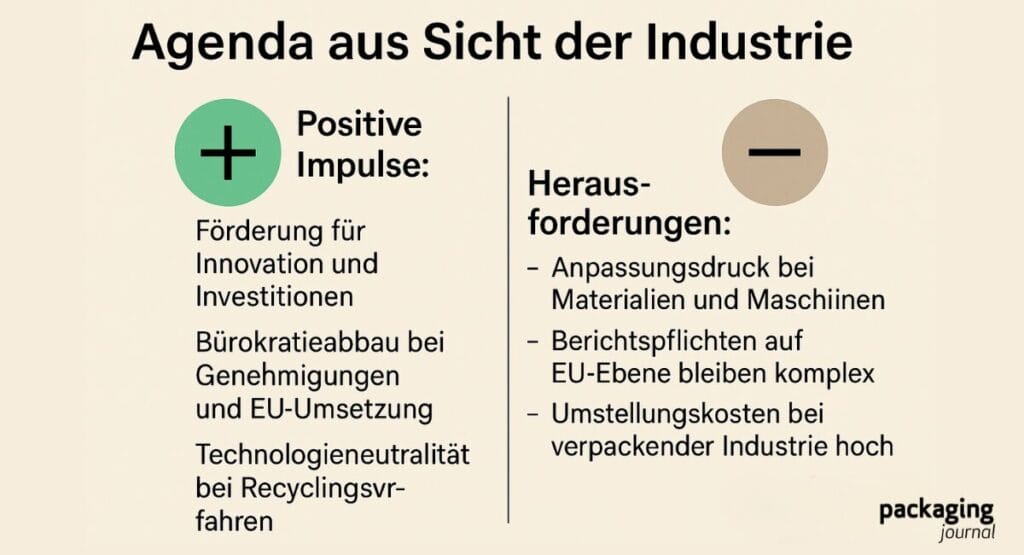
The coalition agreement of the new German government clearly places the packaging industry at the service of the sustainability and digitalisation agenda. It offers scope for innovation, promotes investment in modern recycling technologies and at the same time makes companies more accountable. For manufacturers of packaging and machines, this means developing new solutions more quickly and making them marketable. For the packaging industry, on the other hand, it means setting up products and processes in a regulatory clean and ecologically sustainable way.
Those who manage both - technological development and strategic foresight - will not only be affected by the new political reality, but can actively benefit from it